

Your oldest blog post might still bring in traffic, but is it bringing in customers? An SEO content refresh works best when you prioritise pages by search opportunity, buyer intent and lead quality, not by publication date alone. Start with pages that already reach potential customers, fix what stops those visitors enquiring, then measure whether the enquiries improve.
That means looking beyond rankings. A page can attract fewer clicks than another and still do more for your business. The first job is to find out which pages deserve your time.
Why an SEO content refresh needs a commercial goal
Refreshing a page means improving existing content so it remains accurate, useful and aligned with what people search for. That might involve updating an outdated comparison or adding evidence when facts, offers or buyer expectations change. It doesn’t mean changing the date and calling the work done: content freshness alone doesn’t justify a rewrite.
Content decay is a useful prompt for review: clicks, rankings or enquiries fall over time. But a decline isn’t proof that the copy is the problem. Search demand, competing pages and changes to the results page can all affect performance.
Start with your customer’s question. If a London consultancy gets plenty of visits to a broad explainer but no relevant enquiries, more traffic may not help. A narrower page addressing how a buyer chooses a provider could be more valuable. That’s why getting more SEO value from existing content starts with the page’s job, not its age.
Build an inventory before you choose pages
Bring search and lead data together
Export your indexable pages from a crawler or sitemap to create a content inventory. For each URL, record its page type, intended audience, main topic, last substantive update and any known technical issue. Flag overlapping URLs for later keyword cannibalization review. A B2B SEO content audit is easier to act on when every important page has an owner and a clear purpose.
Add Google Search Console clicks, impressions, click-through rate (CTR) and average position. Compare recent 28-day and 90-day periods with suitable earlier periods. Average position helps you spot movement, but it isn’t a fixed keyword ranking for every searcher.
Then add Google Analytics 4 (GA4) landing-page activity and CRM outcomes. B2B lead tracking in GA4 helps you separate an initial form submission from an enquiry sales would pursue. Exclude internal traffic and test leads where possible, and flag incomplete data.
Check whether the page can compete
A page with falling clicks may have an indexing, canonical or redirect problem. Check that before commissioning a rewrite. For larger sites, automated technical SEO checks can flag issues, but someone still needs to review their cause and commercial impact.
Also inspect the live UK search results for the page’s main queries. Have the results shifted towards service pages, comparisons or direct answers? Your content should match the buyer’s current need, not simply contain the right phrase.
Which pages deserve an SEO content refresh first?
Score opportunity against lead value
Use a simple score to shortlist pages for an SEO content refresh, then review the shortlist yourself. Give each factor 0, 1 or 2 points: zero for weak evidence, one for mixed evidence and two for a strong case. The numbers organise discussion; they aren’t a forecast.
| Factor | What earns a higher score | Where to check |
|---|---|---|
| Search opportunity | Relevant impressions, with weak CTR or recoverable lost clicks | Search Console queries and pages |
| Buyer intent | The page answers a question close to choosing or contacting a provider | Live results and sales questions |
| Lead value | Visitors produce qualified enquiries or support valuable deals | GA4 and CRM |
| Ease of improvement | You can fix a clear gap without rebuilding the page | Content and technical review |
An eight-point page isn’t automatically first. If it’s unindexed, fix that problem before editing its introduction. If the CRM data is unreliable, investigate the tracking before judging lead value.
Look at queries as groups, not isolated keywords, to spot related buyer questions and build topical authority. Clustering keywords by search intent can help you see which questions belong on one page. Check the search results to see which page types appear for each query. Treat keyword cannibalization as a diagnosis to investigate, not an automatic reason to merge pages. AI-assisted SEO workflows can sort exports and flag declines, but the decision about buyer value remains yours.
Pick an action, not just a score
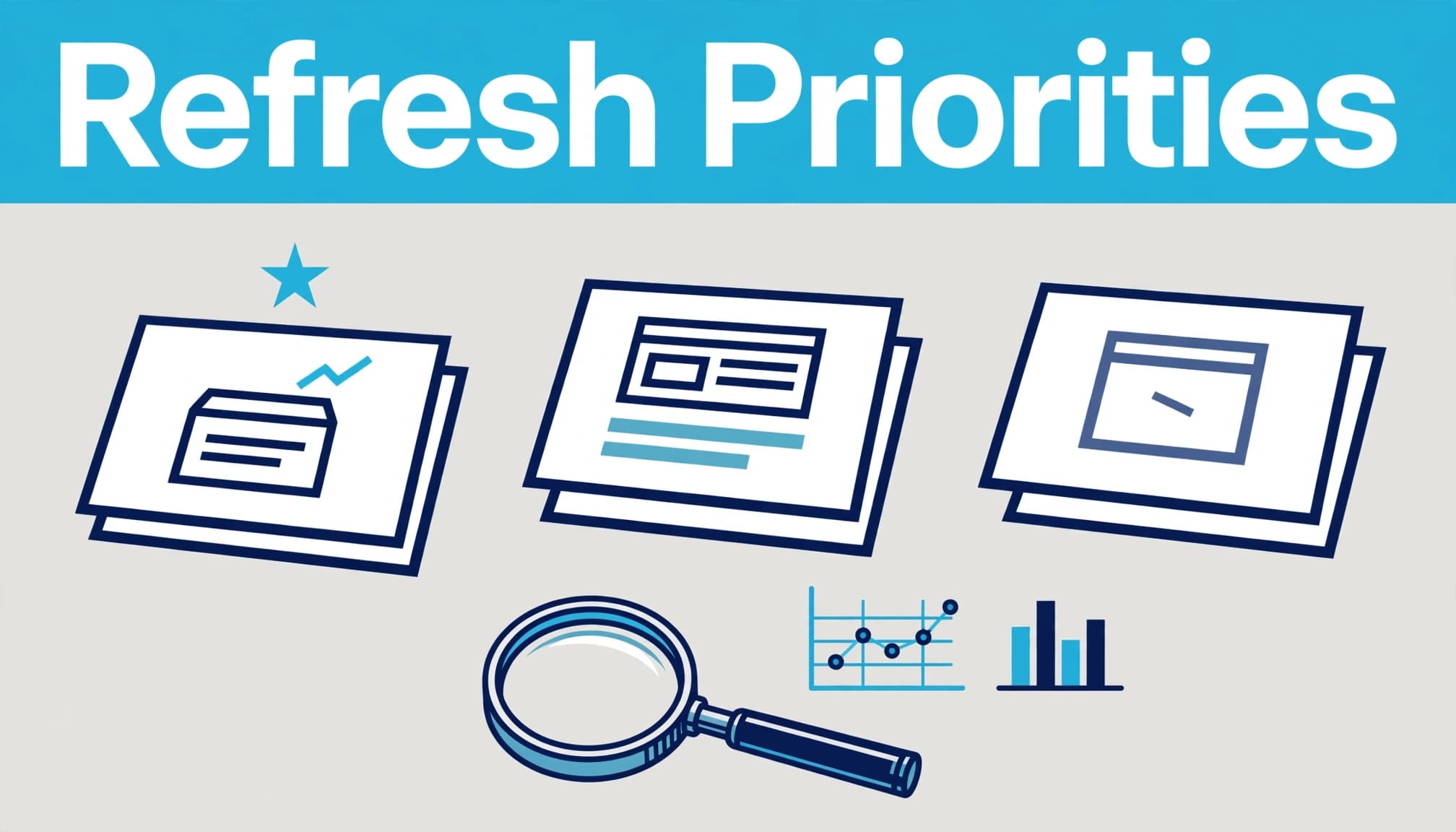
Put each shortlisted URL into one of four groups: refresh, consolidate, leave alone or remove after checking its value. A high-impression page with a weak title or meta description may need a modest refresh. Two pages answering the same buyer question may need consolidation. A page that still attracts qualified leads may need nothing.
Be careful with apparent quick wins. A page near the top of the results for student research isn’t a stronger prospect than a lower-ranking page attracting buyers. Use content gap analysis to find missing buyer questions rather than adding sections solely to capture more searches.
Refresh the answer and the route to enquiry
Make the content useful again
Read the page as a potential customer. Can you tell what the business offers, who it’s for and what happens next? Replace obsolete claims, broken links and outdated references. Add current service details, limitations and examples you can support.
An SEO content refresh is usually right when the URL still serves the right intent and most of its content holds up. Rewrite when the underlying question, audience or offer has changed enough that small edits won’t solve it. Writing for visitors and search engines and effective content optimization mean giving the reader a clear answer, not repeating a keyword.
For example, a Manchester software consultancy’s guide to implementation costs might earn attention but leave buyers unsure what affects a quote. Explaining scope, likely decision points and when to request an assessment makes the page more useful without inventing a price.
Add proof without adding clutter
Put a direct answer near the top, followed by the detail a buyer needs to check it. Use clear headings, relevant expertise and evidence for substantial claims to build E-E-A-T signals, without treating them as a guarantee of rankings. Link to a suitable service page when the reader is ready for help.
AI can draft a summary or identify missing questions. It shouldn’t invent a client result or decide that a claim is current. Apply quality checks to AI-assisted content before publishing, especially where the page discusses costs, outcomes or regulations.
Consolidate overlapping pages without wasting their value
Decide whether the pages do the same job
Two URLs can mention the same topic without competing. One may explain a problem whilst another helps a buyer compare services. Keep both if their search intent and next steps are distinct.
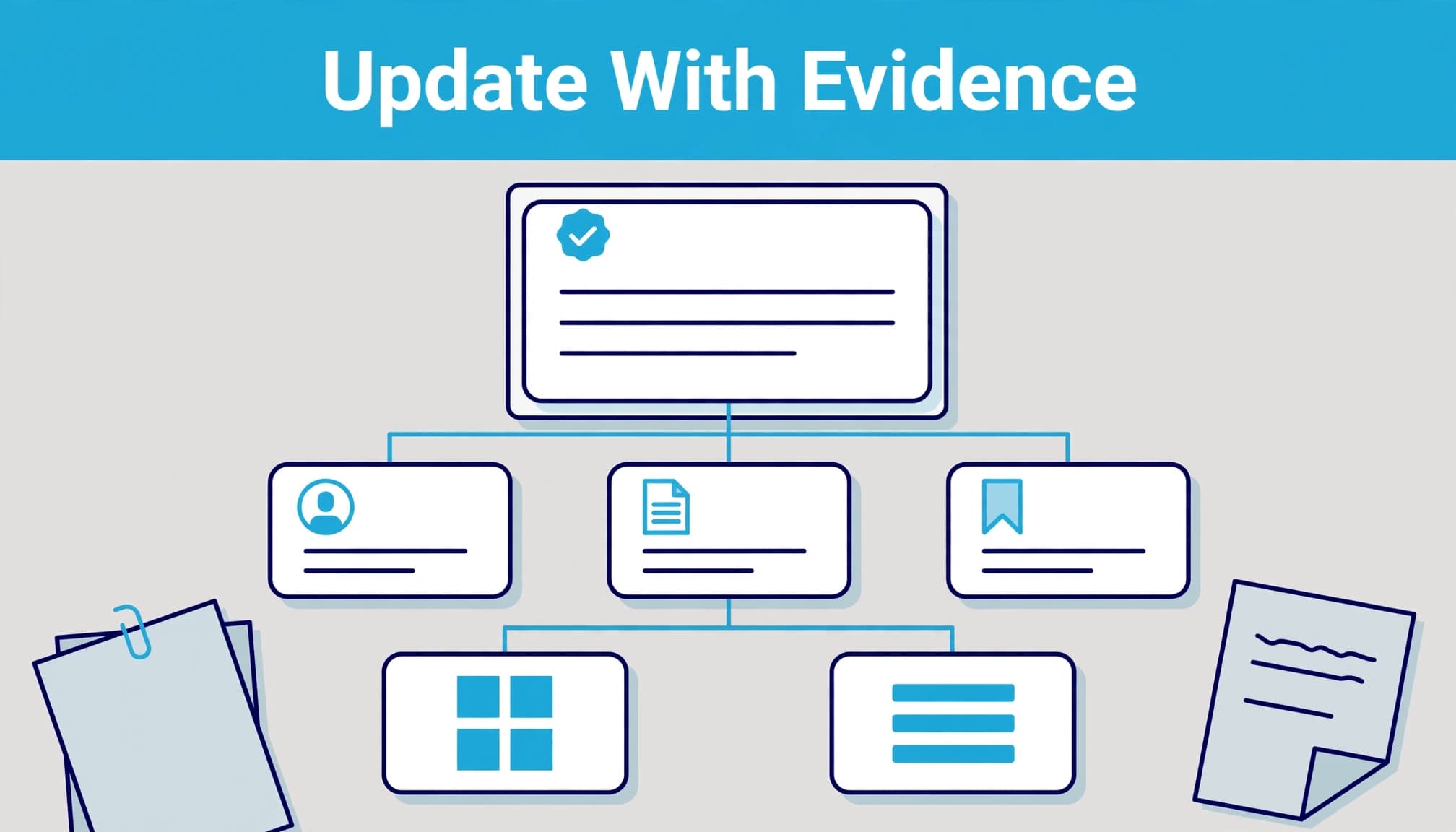
If both target the same query and offer near-identical answers, they may be competing through keyword cannibalization. Compare intent, existing leads, useful copy, internal references and backlink profile before choosing the stronger destination. Keyword cannibalisation checks help you decide whether to differentiate the pages or combine them. Don’t merge solely because a tool flags a shared keyword.
Make a URL change carefully
Where you retire a genuine duplicate, move its useful material to the chosen page and set up 301 redirects to that close replacement. Update internal links and your sitemap, then test the old and new URLs. Google’s redirect guidance for Search explains how permanent redirects work.
Keep the existing URL when you’re simply updating its content. A redirect isn’t a reason to expect identical traffic after a merger, and sending every retired page to your homepage won’t help the visitor. Review canonical tags and redirect basics as part of technical SEO if duplicate URLs or a site change complicate the decision.
Account for AI search without chasing freshness
Google AI Overviews and other answer engines can change how someone finds and assesses your page. Clear explanations, checkable evidence and accurate, accessible content support eligibility across search engines and their features, but an updated date doesn’t earn a citation.
Google’s guidance on AI features in Search says there are no extra technical requirements for AI Overviews or AI Mode beyond normal Search eligibility. Make the page accessible, useful and accurate first. Accurate structured data may help describe visible content; FAQ markup doesn’t guarantee a citation.
For a commercial page, state your scope plainly. A buyer asking an answer engine about a service still needs to understand your experience, exclusions and next step. AI search guidance for B2B service pages applies the same practical test: can someone verify what you offer? For broader questions, ChatGPT search optimisation guidance is useful context, but don’t create an AI-only version of every page.
Measure qualified leads after the update
Keep a record of what changed
Save the publication date, previous title, revised sections and any technical changes. Compare a sensible period before and after, allowing for low-volume pages that need longer to show a pattern. Track non-brand query impressions, clicks, click-through rate (CTR) and search rankings, then compare the page’s organic landing traffic with its baseline.
Then review content performance across search and CRM data, including enquiry quality. GA4 key events show important actions, but your CRM should tell you which enquiries became qualified opportunities. Google’s recommended lead-generation events provide a useful starting point for measurement. Automated SEO reporting can bring the figures together without treating clicks as sales.
If numbers move, check seasonality, consent settings, URL changes and sales follow-up before claiming the refresh caused the change.
Keep AI visibility in proportion
Google Search Console now provides dedicated generative AI performance reporting alongside overall Web performance data. Use it as another visibility view, not as a lead total. For ChatGPT or Perplexity, record a fixed set of buyer queries, the date, UK location and whether your page is cited. AI search reporting for B2B teams can help you keep that review consistent.
An AI citation doesn’t prove someone visited or enquired. Compare citations with identifiable referrals and CRM outcomes where available. Monthly LLM search testing is more useful than reacting to a single changing answer.
Turn the shortlist into a manageable plan
In the first 30 days, establish the inventory and repair broken measurement. Select a small set of commercially relevant pages for your first SEO content refresh. Assign each page an owner and define the change you’ll make.
Over the next 30 days, publish updates to the highest-priority pages and resolve genuine overlap. Make each change a defined content optimization, such as improving a title, call to action or enquiry path. A buyer might first find an article through SEO, then return after seeing PPC, Google Ads or Facebook Ads. Keep those journeys in mind without awarding one channel all the credit.
By day 90, review clicks, qualified leads and sales feedback against your baseline. Put pages that haven’t improved back into diagnosis rather than updating them again by habit. Marketing attribution helps you interpret the wider journey without pretending every influence is measurable.
Key takeaways
- Prioritise buyer value alongside search opportunity; the busiest page isn’t always the best lead source.
- Check intent and technical health before editing copy or merging URLs.
- Measure qualified enquiries after publication, and treat AI visibility as supporting evidence.
Common questions about content refreshes
How often should you refresh a page?
Review important pages when facts, your offer, search intent or performance change. A regular audit helps you spot those changes, but there is no useful rule that every page needs rewriting each year.
Can updating an old post improve rankings?
It can improve a page’s usefulness and search performance when you fix a real problem. An edit alone doesn’t guarantee higher rankings. Keep the URL where it still serves the right purpose, and judge the result against clicks and lead quality.
Make the next refresh count
The old post in your traffic report may need a better answer, a clearer enquiry path or no change at all. Start with the evidence, then spend your time where a refresh has a realistic chance of bringing better leads.
If you need help choosing those pages and measuring what happens next, talk to Flow20 about a Digital marketing plan built around qualified enquiries.