
A buyer can ask an artificial intelligence tool for suppliers, get a shortlist and never see your business. That’s the answer gap that matters: you may have a relevant offer, yet AI search results leave you out, describe you incorrectly or point the buyer towards a competitor. Improving AI search visibility starts with checking those answers against real buying questions, then fixing the information behind them.
You don’t need a perfect score. You need to know which gaps could affect a qualified enquiry and what you can do about them.
What an answer gap looks like to a B2B buyer
Suppose you provide specialist software implementation for UK manufacturers. A prospect asks ChatGPT which firms can handle a particular integration. Your site explains the work, but the answer names other providers. Competitor research can compare their offers with yours. That’s a useful gap to investigate, not proof that an AI system has ruled you out.
The more urgent case is an answer that names you but gets the offer wrong. An old price, a retired service or a confused company identity could put the wrong prospect in touch with sales. It could also discourage a suitable one.
Use buyer impact to sort what you find:
| Answer gap | What you see | Sensible priority |
|---|---|---|
| Missing recommendation | Competitors appear for a relevant supplier question, but you don’t | Check if your offer and evidence match the question |
| Weak mention | You’re named without a clear reason to choose you | Improve proof and competitive positioning |
| Incorrect offer | The answer describes a retired service or wrong price | Correct current and outdated source material promptly |
| Unsupported claim | The answer makes an inaccurate compliance or performance claim | Escalate for brand and legal review |
A B2B SEO content audit helps you compare those answers with the pages buyers can actually find. Start with the gaps closest to a buying decision, rather than counting every mention equally.
How AI search visibility differs from a Google ranking
Traditional SEO tells you whether a page appears on a search engine results page and attracts visits. An AI answer may draw on several sources, name businesses without linking to them, or link to a page without recommending its owner. Different AI models can produce different answers, so track AI visibility separately.
Google AI Overviews have search requirements
For Google AI Overviews and AI Mode, a page can appear as a supporting link if it’s indexed and eligible for a Google Search snippet. Google’s guidance for AI features says there are no additional technical requirements for these features beyond ordinary Search requirements.
A strong organic ranking still doesn’t guarantee a place in an AI answer. Record the overview, the businesses named and their citation links separately from your normal rankings. Flow20’s guide to an AIO strategy for B2B service pages covers Answer Engine Optimization and generative engine optimization for detailed buyer questions. Neither guarantees inclusion.
One visibility score hides important differences
Tools can save time across AI platforms such as ChatGPT, Gemini, Perplexity and others. But an AI visibility score alone won’t tell you whether you were recommended, mentioned in passing or cited for a claim about somebody else.
Ask what the score measures. Keep the full answer alongside any summary, and separate brand mentions, source links, accuracy and competitor presence. You can then act on what a buyer saw, rather than a number with unclear weighting.
Build a repeatable answer-gap benchmark
A screenshot after a campaign launch can start a conversation. It won’t show whether visibility has improved, as answers vary by prompt, platform, location and date. A fixed monthly test gives you a more useful comparison.
Start with questions buyers would ask
Collect questions from sales calls, proposals and your site’s search data. Turn them into search-backed prompts covering category research, supplier comparisons and late-stage concerns such as integrations or implementation. For competitor research, a buyer might ask which UK providers support a particular system, then how two shortlisted firms differ.
Keep the wording stable between monthly checks. You can add new prompts as your services change, but keep the original search-backed prompts so trends remain comparable. This is the basis of monthly LLM search testing your team can repeat.
Save the answer, not just the result
For each test, record the prompt, platform, date, location and full response. Save these monthly results as historical data. Note whether your brand was named, whether your domain was linked, which competitors appeared and whether the description was accurate.
If you’re named in 8 of 40 monitored answers, report 8 of 40, not only 20%. Check which eight were relevant to a serious buyer. You can also track share of voice, meaning the number of relevant answers featuring your brand compared with competitors.
An AI visibility tracker can organise the records, but it shouldn’t replace reviewing full answers. Use historical data to compare changes over time and check which mentions matter most.
Keep each platform’s findings separate. A change in ChatGPT doesn’t mean the same change happened in Google AI Overviews.
Find out why the answer is weak
When your brand is missing, resist the temptation to publish another generic article. First, compare the answer with the evidence that could support a better one.
Compare your pages with the sources shown
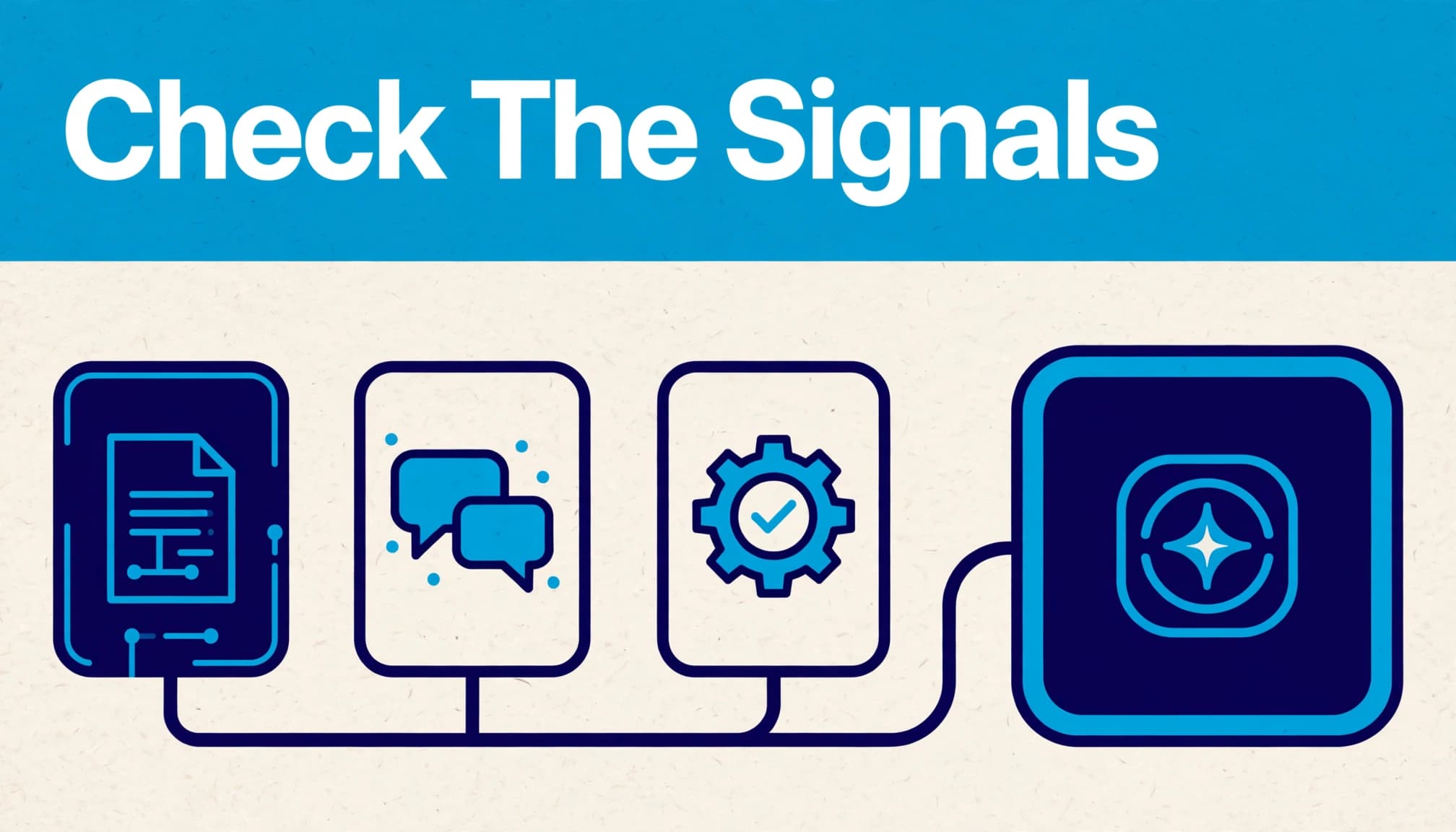
Open the pages cited in the answer and use competitor research to compare them with your own service pages. Does a competitor explain an integration that your site barely mentions? Is your service page vague about who the work suits, what you deliver or which limitations apply?
Check your case studies and public profiles too. If your site says you serve manufacturers but an older directory profile describes a broader offer, the information conflicts. You can’t identify every input behind an AI answer, including any role training data may have played, but you can correct material buyers can verify.
Use ChatGPT search optimisation guidance when reviewing how your commercial pages describe the offer. Use search-backed prompts to test the same buyer question that exposed the gap.
Check access before rewriting copy
Check technical accessibility first. Make sure priority pages load, can be indexed where appropriate and aren’t blocked by accident. For ChatGPT search, OpenAI says OAI-SearchBot is used to surface websites in its search results. Its documentation also explains what opting out means for appearance in search answers.
These checks won’t guarantee a recommendation. They do prevent you from spending weeks improving a page that a relevant search system cannot access.
Fix the evidence behind commercial answers
Once you’ve identified a gap, make the smallest useful improvement to address it. A buyer asking about a service needs a clear answer on the relevant page, not a broad post that circles the subject.
Make the offer easy to verify
State who the service is for, what problem it solves, how delivery works and where its limits are. Put important facts near the questions they answer. A case study can support a performance claim, while an up-to-date service page can clarify what you still sell.
Use AI content briefs focused on lead quality to bring sales questions into the brief before writing. Then apply quality checks to AI-assisted SEO content so unsupported claims and outdated details don’t make it onto the page.
Good SEO work remains the foundation. Google says useful, accessible content and standard search practices support its generative features. It doesn’t prescribe a special AI-only markup shortcut in its generative AI optimisation guidance.
Correct conflicting information beyond your site
Update business profiles and other pages you control if they show an old company name, service or price. Where an independent publication has made a material error, request a correction. Consistent, verifiable evidence can support brand authority and help buyers assess your business.
Valid schema markup can clarify information already visible on a page, but it doesn’t guarantee inclusion in an AI answer. Once changes are live, keep the original prompt set and look for a pattern over time rather than celebrating one favourable response.
Measure whether visibility supports pipeline
The commercial question isn’t simply, “Were we mentioned more?” It’s whether relevant buyers found the right information and whether more became qualified enquiries. Those are different measures, so report them separately.
Keep exposure and outcomes apart
Record mentions and citations against the search-backed prompts tested, and save historical data for your benchmark. Review visibility trends across checks, rather than relying on one result.
In GA4, review identifiable referrals and organic traffic where the source is available, then check what those visitors did. Mentions without a measurable click won’t appear in referral totals. Connect enquiries to qualified leads, opportunities and pipeline in your CRM.
Use AI search reporting tied to pipeline for a visibility report that pairs answer-level and commercial measures. Keep conventional search visibility measures distinct from AI answer measures. An AI answer may influence consideration without producing a measurable click, so don’t present referral totals as the full effect.
Check what else changed
If enquiries rise after you improve a service page, note other changes before claiming credit for AI citations. PR coverage, paid spend, seasonal demand, pricing and sales capacity can all affect the result.
Use SEO reporting tied to commercial results alongside your AI benchmark, and compare historical data with CRM outcomes. If an answer makes a serious false claim about compliance or pricing, track its resolution separately as a brand safety issue. That needs an owner and a prompt review, even if traffic hasn’t moved.
Keep AI search alongside proven demand channels
An answer gap may reveal language your customers use that your marketing misses. Competitor research can show how others describe similar offers. Test relevant wording in landing pages and paid campaigns, then judge it by lead quality.
For example, Google Ads can test demand for a high-intent service query while you improve the organic page. PPC data may show which wording attracts accepted enquiries and informs competitive positioning with relevant buyers. For earlier-stage messages, Facebook Ads can provide another controlled test with a defined audience.
None of those channels proves an AI mention caused a lead. They do help you make better decisions about the offer and language you put in front of buyers.
Key takeaways
- Test a fixed set of buyer questions each month, and save full answers across the platforms your prospects use.
- Separate brand mentions, citations, accuracy and qualified leads. A favourable AI visibility score doesn’t replace those details.
- Fix wrong commercial facts first, then improve weak pages and conflicting public information.
- Compare monthly changes with historical data, CRM outcomes and other marketing activity before assigning credit.
Frequently asked questions
How do AI search tools choose which brands to mention?
There isn’t one selection rule across ChatGPT, Gemini, Perplexity and Google AI Overviews. Platforms use different systems and may produce different answers to the same question. Your practical job is to make relevant information accessible, accurate and supported by evidence, then test how your brand appears.
What’s the difference between a brand mention and a citation?
A mention names your business in the answer. A citation links to, or attributes information to, a source. You could be mentioned without a link, or have a page cited without a clear recommendation. Record both so you know what the buyer actually saw.
Can AI search visibility prove return on investment?
Not by itself. A mention can influence a shortlist without a traceable visit, while an identifiable referral can be followed through to an enquiry or opportunity. Use both kinds of evidence, but reserve revenue claims for outcomes your tracking can support.
Turn answer gaps into better buyer information
If buyers can get a shortlist without visiting your site, a ranking report cannot show the whole picture. Check the answers, correct the facts that affect decisions and give prospects clearer evidence wherever they find you.
If you want help connecting that work to qualified enquiries, talk to Flow20 about a Digital marketing approach that joins search visibility, paid testing and pipeline measurement.



2 Comments
[…] B2B team, the better question is whether the information still answers what buyers ask now. Review where your brand appears in AI search as part of checking AI visibility and the accuracy of each cited page. A recent citation pointing […]
[…] by checking how your business appears for real buying questions. Flow20’s guide to finding and fixing AI search visibility gaps gives you a way to spot where an answer leaves you out or gets your offer […]