
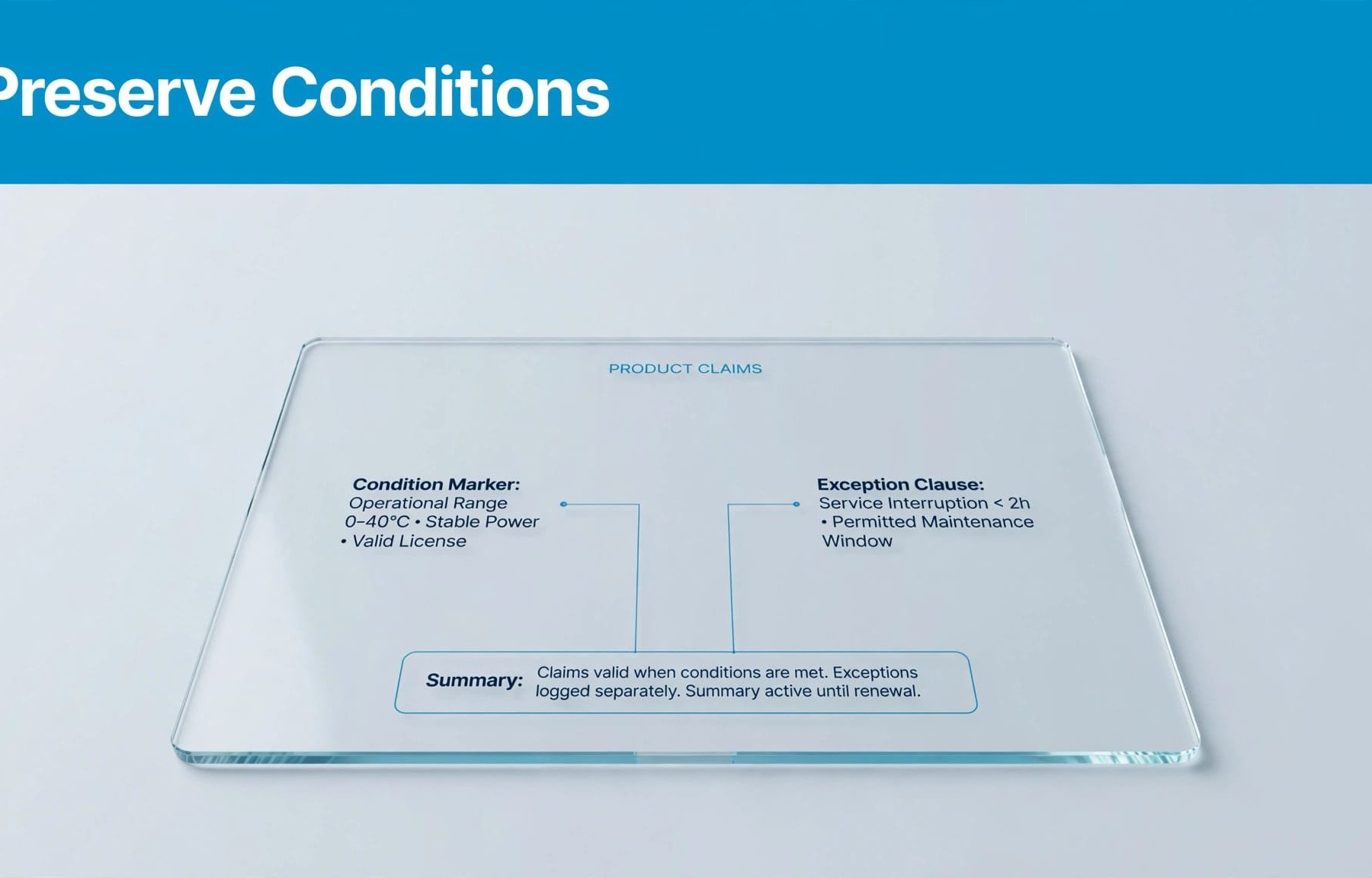
You can improve LLM summarisation by keeping each product claim attached to its limits, eligibility rules and exceptions. Start with approved evidence, preserve the conditions during compression, and test whether the shortened answer still supports the same buying decision.
A summary can sound sensible whilst promising more than your product provides. That matters when buyers use it to compare plans, shortlist suppliers or estimate implementation work.
Start by identifying which details change the meaning of your offer.
Why product conditions can be lost in short summaries
Shortening product information creates pressure to remove details. Some details are background; others define whether a claim is true.
Compression can change the commercial promise
Words such as “only”, “unless” and “up to” often carry more commercial meaning than the benefit statement beside them. Removing them can turn conditional availability into a general promise.
Microsoft Teams guest access, for example, depends on organisational settings. A summary that presents guest access as unrestricted misses an important implementation condition.
For your business, that distinction affects lead quality. You can waste PPC budget attracting buyers whose requirements your product doesn’t meet under the available terms.
Retrieval can separate the claim from its qualification
A retrieval system may select a paragraph about a feature without selecting the exclusion elsewhere on the page. The model then receives incomplete evidence before summarisation begins.
Research on generative multi-document summarisation distinguishes LLM-based and retrieval-augmented approaches. Both still require attention to which evidence supports the answer.
For an assistant you control, inspect retrieval and generation separately. A missing condition may require better source selection rather than a different writing prompt.
Build summaries around qualified claims
Treat a benefit and its material conditions as one unit. Your summary can remove repetition, but it shouldn’t widen eligibility, strengthen a commitment or erase an exclusion.
Use the following distinctions when deciding what must survive compression.
| Condition | What the summary must retain | Risk if omitted |
|---|---|---|
| Plan eligibility | Which subscription or licence includes the feature | Buyers assume universal availability |
| Usage limit | The cap, measurement period and relevant scope | A limited allowance sounds unlimited |
| Integration dependency | Required configuration, connector or customer work | Compatibility sounds automatic |
| Geographic coverage | Supported territories and relevant exclusions | Availability appears broader |
| Service commitment | Response target, service hours and exclusions | A target becomes an unconditional promise |
| Version or date | Which release or period the statement covers | Historic terms appear current |
The rule is straightforward: retain anything that could change a buyer’s decision. Pricing conditions, geographic coverage and implementation responsibilities deserve more attention than small differences in your company introduction.
Your B2B SLA response times need this treatment. Being able to submit a support request doesn’t establish when a response is due, or whether a resolution deadline exists.
Also preserve logical relationships. If eligibility requires two conditions together, the summary mustn’t suggest either condition is sufficient. Keep “and” and “or” aligned with the source.
When space is tight, remove secondary benefits before removing these qualifications.
Give the model current, connected evidence
Clear documentation makes accurate summaries easier to produce. A consistent business identity helps establish who the information describes, but it doesn’t settle whether a product claim is current.
Keep version boundaries visible
Give each important claim an approved source, applicable product version and review date. Internal fields such as last_reviewed and valid_until can help your team manage that evidence.
The same issue appears when LLMs handle conflicting product versions: an old PDF and a current pricing page can contribute incompatible details to one answer.
Don’t erase genuine historical customer experiences because your product has improved. Keep their dates clear and add current evidence so buyers can distinguish earlier limitations from today’s offer.
Put qualifications beside the claim
Place the limitation in the same paragraph, table row or clearly connected section as the feature. A footnote several sections away is easier to miss during retrieval.
Your SEO work should keep product documentation and supporting evidence accessible and accurately indexed. Essential conditions shouldn’t exist only inside images or downloadable sales material.
Review headings, badges and image text too. A careful paragraph cannot repair an unsupported headline that promises unrestricted availability.
Give LLM summarisation a controlled brief
If you control the summarisation workflow, define accuracy before asking for readable copy. “Summarise this product page” leaves too much room for the model to decide which details matter.
Extract the claims before rewriting
First, ask the model to identify the product claim, supporting passage and attached conditions. Then generate the summary using those extracted relationships.
Keep plan names, limits, units, exclusions and dependencies together. Require source references for important factual statements so a reviewer can trace the wording.
A useful instruction is:
Preserve eligibility, exclusions, limits, dates and dependencies attached to every included claim. Don’t replace conditional wording with an unconditional promise. State when the supplied evidence doesn’t answer the question.
This gives you something more useful to review than a fluent paragraph with no connection to its evidence.
Allow a longer or incomplete answer
A strict word limit can conflict with accurate qualification. Let the model use another sentence when a material condition won’t fit.
If you need a shorter answer, reduce the number of claims. Don’t compress several conditions into vague wording such as “restrictions apply”.
Also distinguish unavailable information from unavailable functionality. If approved documentation doesn’t describe an integration, the assistant should say the evidence doesn’t establish support. It shouldn’t conclude that the integration is impossible.
For public answer engines, you can’t impose these instructions. Improve the source content and measure the answers they produce.
Test summaries before publication
Test the meaning of the answer, not just its readability. A fluent summary can still mislead a buyer.
Score consistency and completeness separately
SummEval’s 2021 evaluation separates consistency, relevance, coherence and fluency. Its consistency dimension concerns factual agreement with the source.
For your product summaries, add a separate measure for retained conditions. An answer can contain supported statements whilst omitting the restriction needed to interpret them.
Record unsupported additions, missing material conditions, changed scope and conflicts between versions separately. Don’t combine everything into a single quality score that hides the reason for failure.
For an owned workflow, block publication when a summary broadens eligibility, removes an exclusion or upgrades a service target into a guarantee.
Use repeatable buyer questions
Build a fixed question set covering pricing, integrations, implementation, geographic availability and support. Include questions about exclusions, not just feature availability.
Run those questions across the platforms your buyers use, such as ChatGPT Search, Perplexity and Google AI Overviews. Record the prompt, date, UK location, platform, available model details, answer and cited sources.
Repeat important tests because one successful answer doesn’t establish reliability. Keep the original benchmark stable, then place new questions in a separate group.
If you use another model to score answers, keep its rubric and version consistent. Human reviewers should also sample apparently successful outputs, not just flagged failures.
Separate search visibility from answer accuracy
Being retrievable, being cited and being summarised accurately are different outcomes. Measure them separately.
Google’s guidance for AI Overviews and AI Mode points to ordinary Search eligibility: pages must be indexed and eligible to appear with a snippet. It doesn’t require special AI-only schema or files.
OpenAI also distinguishes OAI-SearchBot, which supports search discovery, from GPTBot, which concerns content that may be used in training. Neither crawler control establishes whether a summary preserves your product conditions.
Your product page structured data should match visible content. Markup can describe facts, but it can’t guarantee that an answer includes every qualification.
The same distinction matters when optimising content for AI-driven search. Visibility is useful only alongside accurate representation.
Track brand mentions, citations and factual errors as separate fields. When Google doesn’t display an AI Overview, record its absence rather than treating it as an inaccurate answer.
Keep qualified enquiries and sales outcomes separate too. An increase in citations doesn’t establish an improvement in commercial performance, and a repeatedly wrong answer remains wrong.
Set a practical governance process
Give someone responsibility for the product facts, someone responsibility for presentation, and someone authority to approve publication. In a small team, one person can hold several roles.
Review when the underlying facts change
Use scheduled reviews alongside event-based triggers. A revised plan, hosting change, new integration requirement or altered implementation process should trigger a review of affected summaries.
Update related product pages, sales decks, downloadable documents and campaign materials together. Otherwise, an older source can keep the previous claim circulating.
Your B2B case studies also need clear boundaries. Keep the customer’s original results and dates, whilst distinguishing them from what your current product promises. A successful deployment doesn’t establish the same outcome for every buyer.
Apply approved conditions across campaigns
Use the same approved facts in Google Ads and Facebook Ads landing pages, comparison content and sales enablement.
Short formats need fewer claims, not broader promises. If a headline drops an eligibility condition, the landing page may attract enquiries that your sales team cannot progress.
Record each issue with its source, owner, reviewer and review date. Prioritise mistakes that change a buying decision before cosmetic wording differences.
AI can handle extraction, drafting and repeated comparisons. Your product and marketing teams remain accountable for approving the commercial meaning.
Start with the limitations buyers depend on
Reliable LLM summarisation preserves the relationship between a claim and the conditions that make it true. Clear evidence, controlled instructions and repeatable testing give you a practical way to protect that relationship.
Start with one important product page. Identify its buying-critical conditions and test whether summaries retain them across your priority buyer questions.
If you need help connecting accurate product content with search visibility and qualified enquiries, speak to our Digital marketing team.