
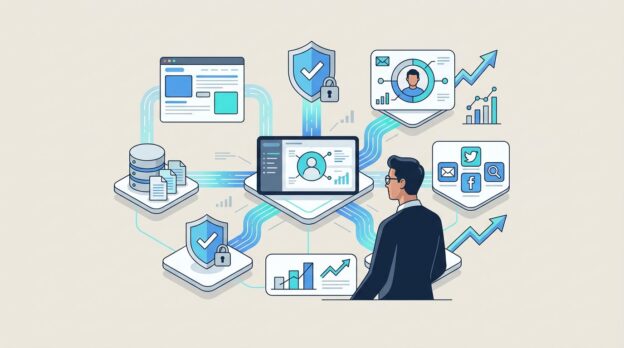
Every lead you generate leaves a trail of useful information, yet many businesses let it disappear between their website, CRM and advertising accounts. First-party data marketing gives you a way to turn those direct customer signals into more relevant campaigns and better commercial decisions.
You already own the most useful starting point: the information people share when they visit, enquire, buy, subscribe or speak with your team. The challenge is collecting it with permission, joining it up, and using it to improve lead quality rather than chasing bigger traffic figures.
Key Takeaways
- First-party data comes directly from your customers and website visitors, so it is more relevant than rented audience lists.
- Consent, clear data ownership and accurate CRM records are the foundations of useful marketing data.
- You can use direct customer signals to improve paid search, SEO, social advertising and conversion rates.
- Track qualified enquiries, sales and revenue alongside media metrics, not clicks alone.
- Start with a small number of valuable data points, then improve how they move between systems.
Why first-party data marketing matters more now
First-party data is information you collect directly through your own channels. It may include contact forms, newsletter subscriptions, product enquiries, purchases, website behaviour, sales calls, customer service records and stated preferences.
This matters because the information relates to real people who have already interacted with your business. You know which service page they viewed, whether they requested a quote, and whether your sales team accepted or rejected the lead. That is far more useful than a broad third-party segment claiming that someone may be interested in your industry.
Third-party cookies have not vanished entirely. Chrome continues to allow them by default, although Safari and Firefox block them by default. Still, privacy rules, consent choices, mobile tracking restrictions and browser changes have made cross-site targeting less dependable.
Your marketing should not rely on data you do not control. A first-party data strategy gives you a more stable foundation because it centres on relationships you have earned.
A thousand anonymous clicks cannot tell you which leads became customers. A well-kept CRM can.
When your sales team records the outcome of every enquiry, you can see which keywords, adverts and landing pages drive profitable work. That shifts the conversation away from impressions and towards cost per qualified lead, conversion rate and revenue.

What counts as first-party data in lead generation
You do not need an enormous data warehouse before you can benefit. Start with the information that helps you understand intent and sales value.
Website analytics can show which pages a visitor read, how they found your site and whether they completed a key action. Forms reveal what service they need, their location, business size or preferred contact method. Email activity can show which subjects prompted interest, whilst call records may expose the questions that appear before a sale.
Your CRM usually contains the strongest commercial signals:
- Lead source, campaign and landing page
- Service requested and estimated deal value
- Sales status, such as qualified, quoted, won or lost
- Reason a lead did not progress
- Repeat purchases, renewal dates and customer lifetime value
For example, a B2B consultancy might find that leads from a generic “contact us” form convert poorly. However, people who download a pricing guide and later request a consultation may close at a much higher rate. That insight should influence your follow-up sequence, paid targeting and website content.
The OneTrust first-party data playbook rightly places consent and governance at the centre of this work. Collect only data you can explain and use responsibly. Tell people what you are collecting, why you need it and how they can change their preferences.
A large database full of incomplete records creates false confidence. A smaller dataset with accurate source data and sales outcomes gives you something you can act on.
Build a usable data foundation before adding more tools
Many businesses have a website platform, analytics package, email system, CRM and several ad accounts. The issue is rarely a lack of software. It is that each system uses different names, fields and definitions.
Begin by agreeing what a lead means. A newsletter sign-up, an enquiry and a booked discovery call should not sit in one undifferentiated total. Define stages that reflect your sales process, then make those stages visible to marketing.
Next, check whether every form captures the right information. A lead source field should pass into your CRM. Your sales team should have a simple way to mark an enquiry as qualified or unqualified. You also need a reason code for leads that are unsuitable, such as wrong location, insufficient budget or a service you do not offer.
This basic framework helps you spot expensive mistakes. If a campaign sends 100 enquiries but only five fit your ideal customer profile, you can fix targeting or landing page messaging. You should not assume the campaign worked because the form completions looked healthy.
Set rules for your data as well:
- Ask for consent in plain language and keep a record of it.
- Limit access to people who need the information for their work.
- Remove duplicate contacts and correct obvious errors regularly.
- Agree one definition for each key metric across marketing and sales.
- Review retention periods so you do not keep personal data without reason.
First-party data marketing works when people trust the process. Poor consent practice can damage your reputation, while poor data hygiene can send the wrong message to the wrong person.
Turn customer signals into stronger campaigns
Once your data is reliable, you can use it to make each channel more accountable. Paid search is often the quickest place to start because intent is visible. Import qualified leads and closed sales where your systems allow it, then assess campaigns by the outcomes that matter after the initial conversion.
A Google Ads agency can use those sales signals to focus budgets on searches that generate valuable enquiries, rather than terms that merely attract cheap clicks. A specialist PPC agency should also examine the landing page and sales follow-up, since these affect the true cost of acquisition.
SEO benefits in a different way. Review the pages that bring in high-quality enquiries, then build more useful content around the questions those prospects ask. An SEO agency can connect Search Console data, conversion data and CRM outcomes to find search opportunities with commercial intent.
Your owned data also helps you avoid generic personalisation. You might send different email content to a prospect who requested a proposal and a customer approaching renewal. On-site messages can reflect the page category a returning visitor has shown interest in, provided you have a clear legal basis and respect their choices.
Research from Piwik PRO on first-party data value highlights its role in improving accuracy and personalisation. The important point is practical: use data to remove friction and make the next step more useful for the person considering your service.
Use paid social data without losing sight of lead quality
Social platforms can generate demand before someone is ready to search. However, platform reports cannot tell the full story unless you feed sales outcomes back into your evaluation.
For B2B campaigns, a LinkedIn advertising agency can build audiences around job role, seniority, sector and company type. Your first-party data then helps you compare campaign leads with the profiles that your sales team actually accepts. If you work with a LinkedIn agency, ask how it measures pipeline quality after form submission.
Facebook and Instagram can support remarketing, lead generation and audience testing. A Facebook Ads agency should separate people who engaged with an advert from those who became qualified prospects. Otherwise, you may optimise towards low-cost form fills that never turn into sales conversations.
Do not upload every contact list to every platform. Use only properly consented information, apply the platform’s privacy controls and exclude existing customers when a prospecting campaign does not need to reach them.
Make first-party data a regular commercial habit
The strongest first-party data marketing programmes are not built in one reporting session. They improve through a regular cycle of checking, learning and changing one thing at a time.
Review campaign performance with sales at least monthly. Ask which lead sources produced meetings, proposals and revenue. Look for patterns in deal value, sales cycle length and lost reasons. Then use those findings to adjust bids, targeting, page copy and follow-up.
Your website also deserves attention. Faster pages, straightforward forms and clear service information make it easier for people to share their details. If you want broader support across search, paid media and conversion improvement, explore Flow20’s lead generation services.
The goal is not to collect every possible signal. It is to collect the right information, protect it properly and use it to make better decisions.
First-Party Data Gives You a Clearer View of Growth
Your most valuable marketing asset is the evidence your customers give you directly. When you connect consented website activity, campaign sources and CRM outcomes, you can see which efforts create genuine opportunities.
First-party data marketing gives you a practical way to spend with more confidence and improve the experience for potential customers. Better data will not replace sound targeting, helpful content or a responsive sales team, but it will show you where each of them needs work.


