
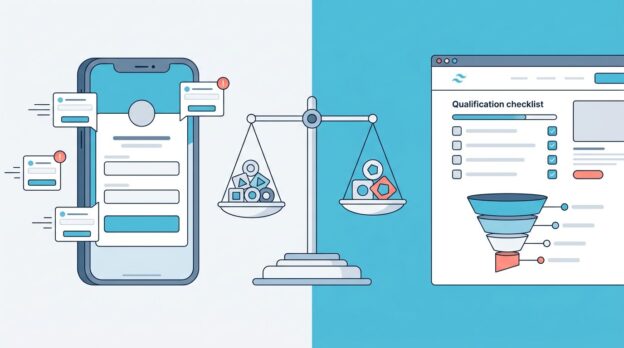
A cheap enquiry can become an expensive distraction when your sales team spends time chasing people with little intent. That is why Meta lead ads should never be judged on cost per lead alone.
Meta’s in-app forms often produce more submissions because people don’t need to leave Facebook or Instagram. However, a landing page can give you more control, stronger qualification and better sales conversations. Your cheapest channel depends on what happens after the form is completed.
Key Takeaways
- Meta lead ads often lower the initial cost per lead because the form is quick and partly pre-filled.
- Landing pages can produce fewer enquiries, yet those prospects may be more ready to buy.
- Track qualified leads, booked meetings and revenue alongside cost per lead.
- Use lead forms for simple, mobile-first offers and landing pages for higher-consideration services.
- Run a fair test before shifting budget, because your own sales data matters more than platform averages.
Why Meta lead ads often look cheaper
Meta lead ads keep the person inside Facebook or Instagram. When someone taps your advert, an Instant Form opens within the app. Their name, email address and phone number may already be filled in from their Meta profile.
That reduced effort usually lifts completion rates, particularly on mobile. Someone can submit an enquiry within seconds, which makes this format useful when you need volume for a newsletter, event registration, brochure download or entry-level consultation.
A WordStream analysis of Facebook lead ads and landing pages found that lead ads achieved a higher average conversion rate, 12.54% compared with 10.47% for landing-page campaigns. Yet the same analysis found a lower average cost per action for landing pages, at $13.26 compared with $17.98 for lead ads.
Those figures are a useful warning. A smoother form does not automatically mean a lower cost per useful result. Audience, offer, creative, targeting and follow-up speed can all move the outcome.

Meta lead ads are often cheaper when your advert reaches a broad cold audience and asks for only basic information. The lower barrier also attracts people who are curious but not ready to speak to a business.
A £12 lead that never answers the phone is more costly than a £35 lead that books a consultation and becomes a customer.
This does not make Instant Forms a poor option. It means you need a realistic definition of a lead before you declare a campaign successful.
Landing pages add friction, but they can filter prospects
A landing page asks more from a visitor. They must leave Meta, wait for your site to load and decide whether your offer is credible enough to complete the form. Some will drop out, so your reported cost per lead can rise.
In return, you control the journey. You can explain your service, show case studies, answer objections, display pricing guidance and place customer reviews near the form. That context helps serious prospects decide whether you are a fit before they submit their details.
| Factor | Meta Instant Form | Dedicated landing page |
|---|---|---|
| First action | Form opens within Meta | Visitor leaves Meta for your website |
| Completion effort | Usually low | Higher, depending on page and form |
| Information available | Limited space for explanation | Full control over proof and messaging |
| Best for | Simple offers and fast volume | Complex services and considered decisions |
| Qualification | Form questions only | Questions, copy, proof and page behaviour |
The distinction matters most for businesses with longer sales cycles. If you sell B2B software, professional services, financial advice or high-value home improvements, a prospect may need evidence before they enquire. A well-built page can separate genuine demand from casual interest.
You also get better tracking options. Website forms can connect page engagement, call bookings, chat activity and CRM outcomes. If your team uses a multi-step sales process, that extra information helps you spot where leads stop progressing.
For a broader view of how intent changes across channels, read Flow20’s guide to lead quality of SEO versus PPC. The same principle applies here: the first conversion is only one part of the buying journey.
Compare Meta lead ads by qualified lead cost
Cost per lead is easy to find in Ads Manager. It is also easy to misread. A campaign that generates 100 enquiries at £10 each looks stronger than one generating 40 at £25 each, until you review the sales outcomes.
Start by agreeing what counts as qualified. For one business, that may mean a decision-maker at a company with 20 or more staff. For another, it might mean a homeowner in a service area with an appropriate budget.
Then measure the same stages for each campaign:
- Cost per form completion
- Cost per qualified lead
- Lead-to-meeting rate
- Cost per sales opportunity
- Closed revenue and customer acquisition cost
A lead form may win on the first line and lose on every line after it. Meanwhile, a landing page campaign can look expensive in Meta while delivering better meetings and profitable sales.
Feed those outcomes back to Meta where possible. If your CRM identifies accepted leads, booked calls or won opportunities, use that information to improve your reporting and optimisation. You need a regular conversation between marketing and sales, otherwise the account will keep chasing the easiest form fills.
Speed also affects lead quality. Contact a new Instant Form lead quickly, ideally with a useful and direct response. A person who submitted after a few taps may forget the advert within an hour. A delay of several days can make a sound campaign appear weak.
Choose the format that fits your offer
Use Meta lead ads when the next step is simple and low commitment. They work well for a callback request, local service quote, webinar, downloadable guide or early-stage offer. Keep the form short, but add one or two questions that reveal whether the person fits your target customer.
For example, a London business could ask for postcode, service required and preferred project timing. Those answers can reduce wasted sales calls without turning the form into a lengthy questionnaire.
Choose a landing page when people need reassurance before they act. It is usually the better option if you have a specialist service, a higher price point or strict eligibility criteria. Match the landing-page headline to the promise in the advert. If your advert offers a free audit, the page should lead with that audit, not a generic homepage message.
A comparison of Meta lead forms and landing pages also highlights the familiar pattern: forms tend to win on ease, while a website journey gives you more room to qualify and persuade.
Mobile performance deserves close attention. Most Meta traffic arrives on a phone, so your page should load quickly, use readable text and place the form or call to action without excessive scrolling. A strong offer cannot rescue a slow, confusing mobile page.
Run a test that gives you a useful answer
You cannot compare formats fairly if you also change the audience, creative and offer. Build two campaigns around the same core message, targeting and budget. One should use an Instant Form and the other should send people to a dedicated page.
Let the test collect enough leads to reveal patterns. A handful of enquiries can distort the results, especially if one unusually large sale lands early. Review performance over a period that matches your normal sales cycle.
Keep a simple record of changes. Note when you altered creative, added a qualifying question, changed follow-up rules or refreshed the audience. This stops you blaming the form type for a result caused by a different change.
If results show high click-through rates but weak form completion, your advert and destination may not match. If leads are cheap but sales reject them, tighten the offer or add qualification. When click-through rates are modest but close rates are high, test broader creative angles without watering down your message.
A good PPC agency will examine that full route from advert to sale rather than report clicks in isolation. The same approach applies across paid social, search and organic activity.
The format is only one part of the result
Meta lead ads can deliver cheaper initial enquiries, particularly for simple offers and mobile audiences. Landing pages often earn their higher cost by giving prospects more reasons to trust you and more chances to self-qualify.
Your best option is the one with the lowest cost per qualified customer, not the lowest figure in Ads Manager. Test both formats, follow every lead through your CRM and let sales outcomes decide where budget belongs.
For support across the full acquisition journey, speak with a Google Ads agency, an SEO agency, a specialist LinkedIn advertising agency, or a Facebook Ads agency.


