

Your pricing page says one thing, an old directory says another, and an AI answer repeats the directory. AI search accuracy depends on which information a system finds and how well its answer reflects that evidence. A citation or confident answer isn’t proof that a brand claim is correct.
For a B2B brand, check important claims against current evidence, correct material you control and test what prospective buyers see. Don’t assume a citation means the answer is right.
Why AI search accuracy suffers when sources disagree
AI search tools can draw on several sources when answering a question about your business. Your service page might say you work with UK manufacturers, whilst an older profile describes you as a general IT provider. Both may still be accessible. A system can produce a convincing answer that blends them.

The sources may answer different questions
Your homepage, product documentation, review profiles and partner listings each have a different purpose. A short directory description might be enough for a broad category question, but poor evidence for contract terms or current integrations.
Imagine you sell procurement software. Your website now positions it for multi-site retailers, but a partner listing still calls it a tool for independent shops. Ask an AI tool who the product suits, and the answer may favour whichever description it retrieves. That could affect whether a buyer puts you on their shortlist.
A citation doesn’t settle the dispute
A source link tells you where to check, but citation accuracy depends on whether the linked page supports the claim. OpenAI’s guidance on ChatGPT search warns that results and citations can be incomplete, outdated or incorrect.
Check the exact sentence a citation appears to support. If an answer claims you offer a particular integration, but the cited page only mentions a planned release, you’ve found a factual error, not a visibility win. That’s where AI SEO quality control becomes more useful than counting mentions alone.
How an AI answer reaches a brand claim
You can’t assume ChatGPT, Perplexity and Google AI overviews use identical sources or select them in the same way. Unlike traditional search engines, AI search engines can produce conversational responses, but methods vary by product. Generative artificial intelligence depends on both finding evidence and writing an answer. Problems at either stage can change what buyers see.
Retrieval finds material that looks relevant
Some systems may use retrieval-augmented generation, or RAG, to bring outside information into the answer process. Semantic search can use vector embeddings to match related ideas, rather than relying only on identical keywords. Other retrieval methods may also be involved.
That can help when a buyer asks multi-layered queries in their own words. Natural language processing may help interpret the wording, while semantic search and vector embeddings can support a more relevant match. A further retrieval-augmented generation step may still surface an old, broadly relevant page instead of a precise, current one.
Available material may also depend on content licensing agreements. Algorithmic bias could influence results, but shouldn’t be assumed to explain any specific answer.
If your product has changed, make the new position clear on the pages buyers and search systems can access. Search engine optimisation fundamentals still matter here: useful content has limited value if important pages are difficult to discover.
Generation can combine claims that don’t belong together
Across AI search engines, large language models may produce a response from the material available. A model might draw a product feature from one page and a customer segment from another. Each detail may look plausible on its own, whilst the combined description is wrong. A model may be hallucinating if it makes a claim unsupported by the material found.
This is why AI’s impact on brand strategy is a practical content issue. Product names, audience descriptions and service boundaries need to agree across the places where you publish them. Clear positioning gives an answer engine less conflicting material to work with.
What the evidence says about AI search accuracy
There is good reason to inspect AI answers rather than take fluent wording at face value. The Tow Center for Digital Journalism tested eight generative artificial intelligence search tools on their ability to identify news articles. In its AI search citation study, the tools collectively gave incorrect answers to more than 60% of the tested queries.
That figure describes those tools and news-source tests. It can’t be applied with precision to B2B brand questions, so using it as an error rate for your campaigns would be misleading. The lesson for your team is narrower and more useful: check whether an answer’s evidence supports its claims.
Brand questions also differ in risk. An imprecise category description may be irritating. Incorrect pricing, a retired service or a claim about regulatory compliance could mislead a buyer. Prioritise checks by the likely commercial consequence, rather than treating every awkward phrase as equally urgent.
Audit what buyers are being told
Start with questions a real prospect would ask before contacting sales. Include your brand name, category comparisons, implementation concerns and objections that come up in calls. Avoid filling the test set with prompts nobody would use.
Compare each answer with an agreed source
Give your team one approved reference for current products, service areas, pricing rules and any claims requiring evidence. Compare each answer with reliable sources that provide current, verifiable evidence, then record what it says and where its citations lead.
A simple audit makes different problems easier to separate:
| What you find | What to check | First action |
|---|---|---|
| An outdated offer | Your site and third-party profiles | Update the source that still publishes it |
| A confused brand identity | Names, locations and product descriptions | Make the distinctions explicit |
| An unsupported claim | The cited passage and approved evidence | Correct your page or challenge the claim |
| No mention | Relevance to the buyer’s question | Check whether your content answers it |
Prioritise a wrong claim that could change a buying decision. Call it misinformation only when it’s demonstrably false; stale, incomplete or conflicting information needs a different diagnosis. An accurate omission may call for better content, while an incorrect compliance statement needs prompt review.
Follow the source trail
Save the full answer, not only a screenshot of your brand name. Note the cited URLs, publication dates where available, and the exact wording that caused concern. Check whether a third-party page is still live before asking its owner to change it.
Where you control the source, assign an owner and an update date. Where you don’t, document the discrepancy and request a correction. This gives communications and sales teams a clear record if the same claim appears again. It also helps you separate a content issue from a wider reputation problem.
Make your brand information easier to verify
You can’t instruct every answer engine to prefer your latest page. You can reduce ambiguity in the material it may encounter. Start with pages that describe what you sell, who it’s for and what a buyer should expect.
State the offer plainly on the right pages
Give each important service or product a clear page with a current description. Explain what it does, who it suits, and where its limits are. Keep naming consistent across navigation, page copy and supporting documents.
If you no longer serve independent shops, don’t leave that positioning in a downloadable brochure linked from your site. Update the brochure or remove it responsibly. Make the distinction between the old and current offer plain enough for a person skimming the page.
This work sits alongside SEO, not outside it. Accessible pages and useful answers help buyers find you through conventional search as well. The same discipline applies when using AI applications in digital marketing to draft or review content: a person still needs to approve the facts before publication.
Back important claims with specific evidence
Buyers may ask about integrations, security, sector experience or implementation time. Give them something checkable: current documentation, a dated case study, a clear methodology or a properly qualified statement. Don’t make an answer engine infer a guarantee from a vague sales claim.
Look beyond your own website, too. Review relevant directory entries, partner pages and company profiles. Ask for corrections where descriptions have drifted. The goal is consistent evidence, not identical promotional copy everywhere. For your own site, why search visibility matters remains connected to this work: strong pages need to be findable before they can help a buyer.
Measure patterns, not one favourable answer
An answer can change with wording, platform, date or account state. Natural language processing may affect how prompts are interpreted, but it won’t explain every changed answer. One run shows what appeared in that test, not how often buyers see the same result.
Keep the test conditions visible
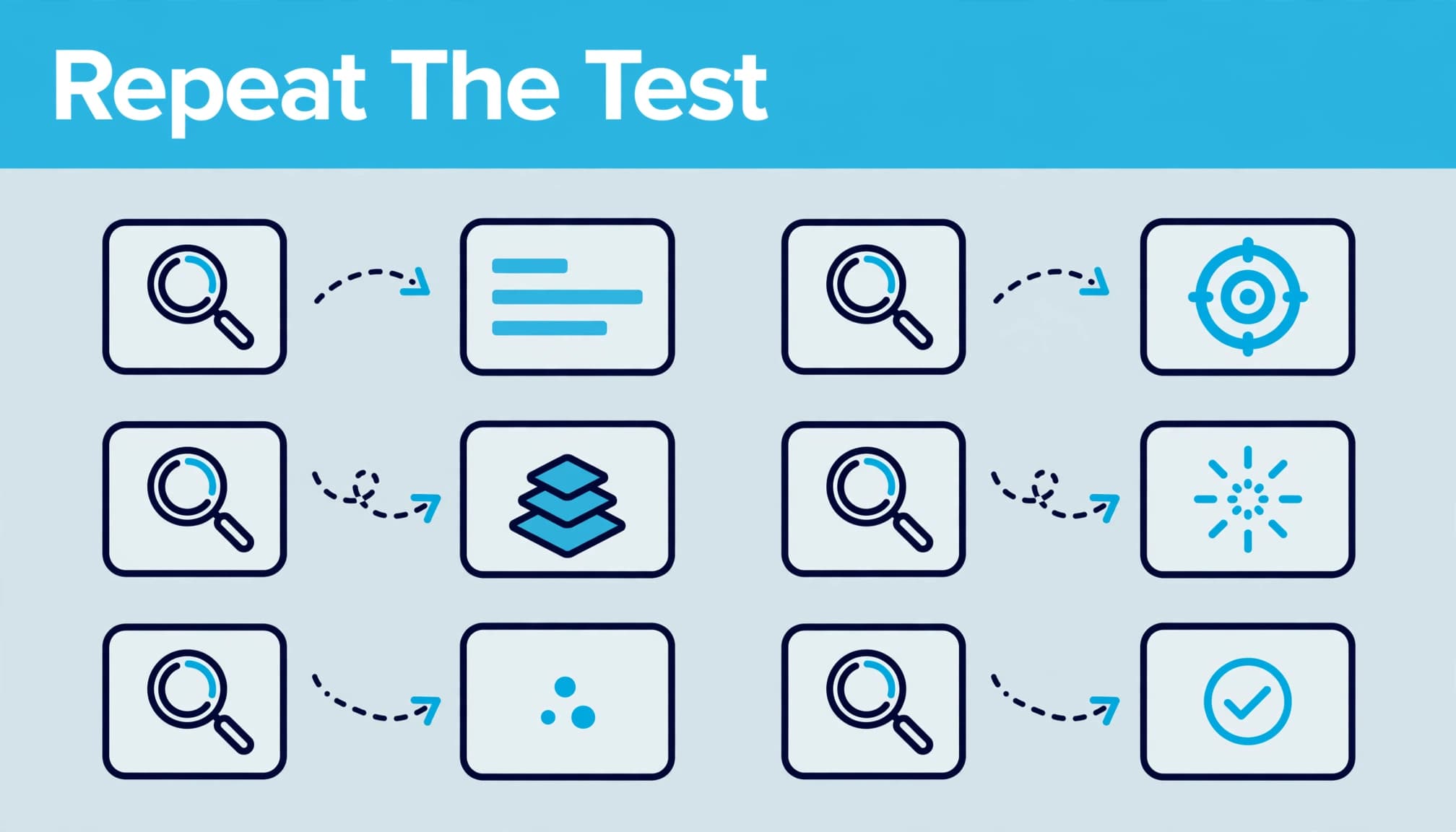
Save each prompt, full answer, date, country, platform and available model details. Record whether you were signed in, any settings that could affect the result, and relevant tracking data. Test the same buyer questions again under comparable conditions, keeping results from different AI search engines separate. Include wording variations that test how semantic search may interpret related buyer questions.
For a routine benchmark, monthly checks are manageable. Test sooner after a pricing change, service launch or serious reputation issue. AI search reporting is most useful when your team can compare like with like and explain why a number moved. A visibility platform can offer another source of sampled observations, but not definitive evidence.
Separate accuracy from measurement precision
Accuracy asks whether a claim is correct against a reliable, current reference. Measurement precision asks how confidently your observed sample describes the answers you tested. Repeating a prompt gives you a better view of variation, but a consistently repeated answer can still be wrong.
Track mentions, citations and factual errors separately. A brand mention does not mean your page was cited. A citation does not prove a click. Show the number of answers reviewed beside any percentage, so a small sample doesn’t look more decisive than it is.
A stable AI answer is useful to measure, but stability isn’t evidence that its brand claims are true.
For an example, suppose your brand appears in four of 20 recorded answers. Report the four appearances and the 20 tests, with the prompts and platforms used. That result describes your sample, not your share of every AI answer a potential buyer might receive. Automated SEO reporting can sit beside this benchmark, but organic rankings and AI answer presence should remain separate measures.
Connect answer quality to commercial outcomes
If an AI tool describes your service incorrectly, first fix the information buyers may find. Then watch whether clearer wording improves qualified enquiries, rather than declaring success because citations rose.
Use Search Console, GA4 and CRM records alongside your answer audit. Look for identifiable referral visits and follow them through to useful sales conversations. Keep unclicked AI visibility as a possible influence, not attributed revenue.
Paid activity can add context. Google Ads and PPC may test which service language attracts qualified demand, whilst Facebook Ads may support a different stage of consideration. Record campaign changes when reviewing brand searches or enquiries. A joined-up view of AI, PPC and SEO helps you avoid crediting one channel for every change.
Key takeaways
- Check whether AI answers describe your current offer correctly and whether their citations support important claims.
- Fix conflicting information on your own pages and relevant third-party profiles, starting with errors that affect buying decisions.
- Repeat a fixed set of buyer questions, and report mentions, citations, accuracy and commercial outcomes separately.
Frequently asked questions
Why might two AI search tools describe the same brand differently?
They may retrieve different pages, respond to different parts of a question or combine information differently. Check the full answers and cited sources before deciding which page needs attention. Your current website copy may be accurate whilst an older partner profile is still shaping the other answer.
Does an AI citation mean my brand information is trusted?
A citation identifies a source you can inspect; it isn’t a guarantee that the answer is accurate or that your brand was recommended. Compare the cited passage with the claim, then check whether the page itself is current. Keep citations separate from brand mentions and measurable visits in your reports.
Conclusion
An AI answer can sound certain even when it has assembled your brand story from conflicting pages. Clear, current evidence gives buyers a better account of what you do and gives your team a sensible basis for checking what AI search says.
Start with the claims that could affect a sale, test them consistently, and connect the findings to qualified demand. If you need help aligning that work with your wider Digital marketing, speak to Flow20 about the pages, reporting and campaigns that matter most to your business.