
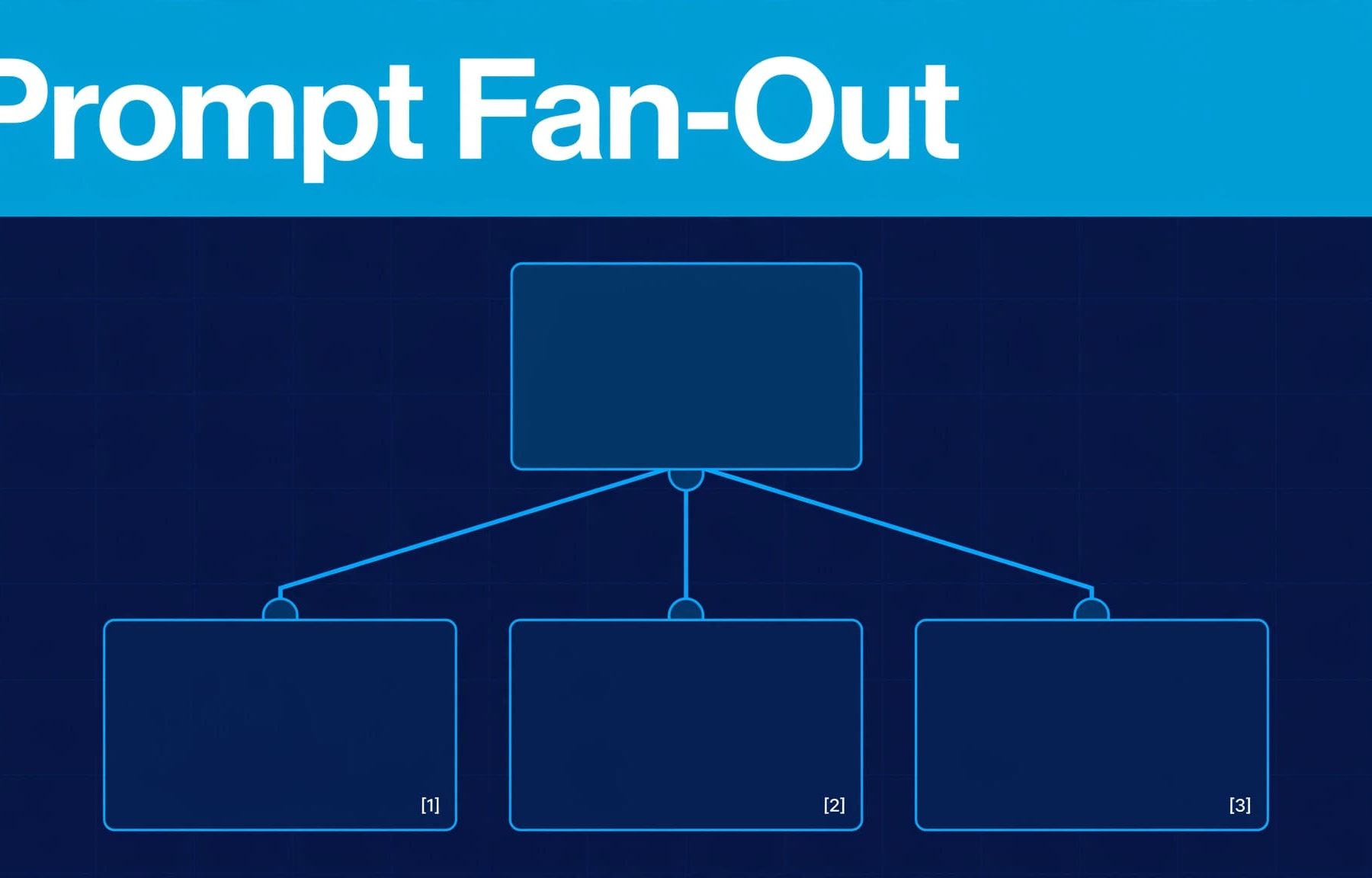
One prompt can produce several searches behind the scenes, so checking where you rank for its exact wording can give you a false sense of AI visibility. Prompt fan-out testing gives you a better view: test real buyer questions, record the answers and cited sources, then compare results across related prompts over time.
You don’t need to reverse-engineer every search platform to do this well. You need a sensible prompt set and a repeatable testing method to see what buyers encounter across related prompts. This gives you a more reliable view of AI search visibility, while keeping a mention, a citation and a customer outcome distinct.
How prompt fan-out changes what you test
One question can open several search paths
Google says AI Overviews and AI Mode may use query fan-out across related searches. A question about payroll software, for example, could call for information about UK pricing, pension auto-enrolment, integrations and support. The answer might draw on sources found through several of those searches.
That matters because your page could rank well for “payroll software” yet be absent when the answer needs evidence about integrations. The reverse is possible too: a detailed integration guide could supply useful information without ranking highly for the original, broad question.

Keep the mechanics and the observations separate
Reciprocal Rank Fusion, or RRF, is one way to combine ranked lists. A document appearing near the top of several lists earns a stronger combined score than one appearing well in only one. The original RRF research explains reciprocal rank fusion, but it doesn’t establish that Google AI Mode, ChatGPT Search or Perplexity uses it for a particular answer.
Google documents query fan-out, not a complete ranking formula. Other platforms expose even less of their retrieval process. An answer alone doesn’t reveal whether a system uses retrieval augmented generation or another method. Test what buyers can see: the answer, the brands named and the sources shown. Treat guesses about hidden sub-queries as hypotheses.
Find prompts that reflect real demand
Start with Search Console, then check the wording
Open the Performance report in Google Search Console and apply this custom regex filter: ^(?:\S+\s+){9,}\S+$. It surfaces long-tail queries containing 10 or more words, which can help you find detailed questions. It won’t identify every conversational search, and a long query isn’t automatically an AI prompt.
Review the matching queries by page and country. Look for constraints a buyer would care about, such as team size, location, budget or software compatibility. Flow20’s Google Search Console SEO guide is useful if you need to connect query patterns with the pages already receiving impressions.
Search Console shows searches involving your site, not every question your market asks. Low-volume queries may be missing. Don’t use an empty report as proof that demand doesn’t exist.
Check what people ask before they search
Compare those queries with natural language questions from sales-call notes, support tickets, site-search logs, People Also Ask results and relevant forum discussions. A customer asking “Will this work with our existing HR system?” may reveal a more useful test than another variation of “best payroll software”.
Keep the original customer wording where you can. Then remove duplicates and questions outside your offer. This is where an AI keyword strategy for SEO content helps: you can connect customer questions to a topic without treating every wording variation as a new content target.
Group prompt fan-out tests by buyer intent
A long list of prompts becomes difficult to interpret quickly. Use search intent mapping to group questions around one buying problem, then separate the buyer funnel stages. Here’s an illustrative set for a UK payroll software provider.
| Buyer stage | Example prompt | What the test should reveal |
|---|---|---|
| Research | How does payroll software handle pension auto-enrolment for a UK team? | Whether the answer explains the requirement accurately and cites useful guidance |
| Comparison | Which UK payroll tools integrate with our accounting software? | Which suppliers appear and what evidence supports the comparisons |
| Decision | What should a 50-person business check before changing payroll providers? | Whether the answer covers migration risks and names relevant suppliers |
Run several natural variations within each cluster, covering different sub-query types rather than repeating one prompt with a single word changed. Include practical buyer constraints, such as “UK”, “50 employees” or a named integration, when they fit the question.
Don’t assume commercial search intent always causes more fan-out than informational intent. A short price question may need little exploration. A technical how-to question with several conditions may need much more. Complexity and available evidence are better reasons to investigate than funnel stage alone.
If the answers expose missing comparisons or questions your site doesn’t address, use AI content gap analysis to decide which pages need work.
Run a test you can repeat next month
Keep the conditions as steady as possible
Choose the platforms your customers use, such as Google AI Overviews, ChatGPT Search and Perplexity. Save the exact prompt, date, UK location, platform and model, where available. Note whether a Google AI Overview appeared. Keep fresh sessions or account settings consistent when practical.
Test each prompt more than once if a result will influence a content decision. Answers and citations can change with location, personalisation, model updates and date. A single screenshot tells you what appeared once; a monthly LLM search visibility benchmark gives you a firmer basis for comparison.
Capture the answer, not only the score
For every result, record whether your brand appears, whether your own domain is cited and whether a third-party source mentions you. For Google results, record AI Overview citations, competing brands, source URLs and relevant answer wording. Check factual accuracy before marking a result as positive.
These are different observations. Your site can be cited without your business being recommended. Your brand can be named without a link to your site, perhaps because another source discusses it. Neither outcome proves which sources the system considered internally.
Give serious errors their own flag. An answer that repeats an old price or describes the wrong service deserves attention before a small change in mention rate. Use the same review criteria across the prompt set so your team isn’t scoring a disappointing answer differently from a favourable one.
Measure clusters instead of chasing individual answers
Use metrics that describe what appeared
For each cluster, measure ai brand visibility through brand mention rate, the share of tested answers that name your business. Track own-domain citation frequency separately as the share that links to your site. A third measure, answer accuracy, tells you whether that visibility is helping or misleading buyers.
You can also record how many buyer subtopics your content covers: pricing, integrations, implementation and support, for example. Call this topic coverage, rather than claiming to measure Google’s hidden fan-out queries. Your tests can reveal gaps in answers and citations, but can’t give you a complete list of searches run behind the scenes.
Break results out by platform, and use competitor citation analysis to see which brands and sources each one favours. Combining ten ChatGPT answers, ten Perplexity answers and Google results into one percentage hides useful differences in source selection.
Connect visibility with business evidence
Google announced generative AI performance reports in Search Console in June 2026. They add a useful view of Google’s AI search features, but don’t measure your visibility across ChatGPT or Perplexity.
Compare platform observations with Search Console, GA4 and CRM data. Look for identifiable referrals, qualified enquiries and opportunities. Answer and citation observations don’t, by themselves, measure zero-click rate. Keep the limits clear: a citation doesn’t prove a click, and a lead arriving later doesn’t prove which AI answer influenced them. Flow20’s guide to AI search reporting for pipeline measurement shows how to keep those signals alongside commercial outcomes.
A higher citation count is only good news if the answer describes your offer accurately and reaches the questions your buyers ask.
Turn missing citations into better content
Start with prompt clusters where buyers have a clear need and your site has useful information. If comparison answers repeatedly cite competitors for implementation detail, review your page. Does it explain the process, timescales and limitations in plain language? Is the information on a crawlable page?
For a service business, your homepage might explain your expertise but say little about who the service suits. Improve the relevant service page through content optimization, adding direct answers, current facts and evidence. Cover related buyer questions usefully to build topical authority through semantic SEO. Flow20’s guide to optimising B2B service pages for AI search gives you a practical starting point. Google’s guidance for AI features still points to accessible pages and useful content; structured data doesn’t guarantee inclusion in AI answers.
If the system names your business but cites someone else, review the information available beyond your site too. Outdated directories or unclear third-party descriptions may be worth fixing. A clear AI search entity profile makes it easier to spot conflicting names, services and locations.
Put AI visibility in the wider marketing plan
Treat work informed by AI search testing as generative engine optimization, not a separate campaign with its own success story. If buyers ask comparison questions, your SEO work can improve the pages that answer them. If high-intent demand needs attention whilst those pages develop, PPC can give you another route to qualified traffic.
Keep channel roles distinct. Google Ads can test commercial wording and landing-page response, whilst Facebook Ads may help you reach relevant audiences. Neither channel proves why a brand appeared in an AI answer. Record major changes in paid spend, content and pricing before crediting a movement in AI visibility to one action.
Key takeaways
- Build your prompt set from customer questions and search data, then group it by topic and buyer stage.
- Track mentions, citations from your own domain, third-party sources and factual accuracy separately.
- Compare clusters across repeatable tests. Don’t treat one answer or an inferred sub-query as a stable ranking.
- Use CRM outcomes to assess commercial progress, while treating AI brand visibility as a leading indicator.
What to do next
The useful result of prompt fan-out testing is a clearer picture of what buyers see and where your evidence is thin. Start with one important topic, test a manageable set of questions and fix the most serious accuracy or content gap first.
If you’d like help connecting those findings to leads, talk to Flow20 about Digital marketing built around measurable business outcomes.