
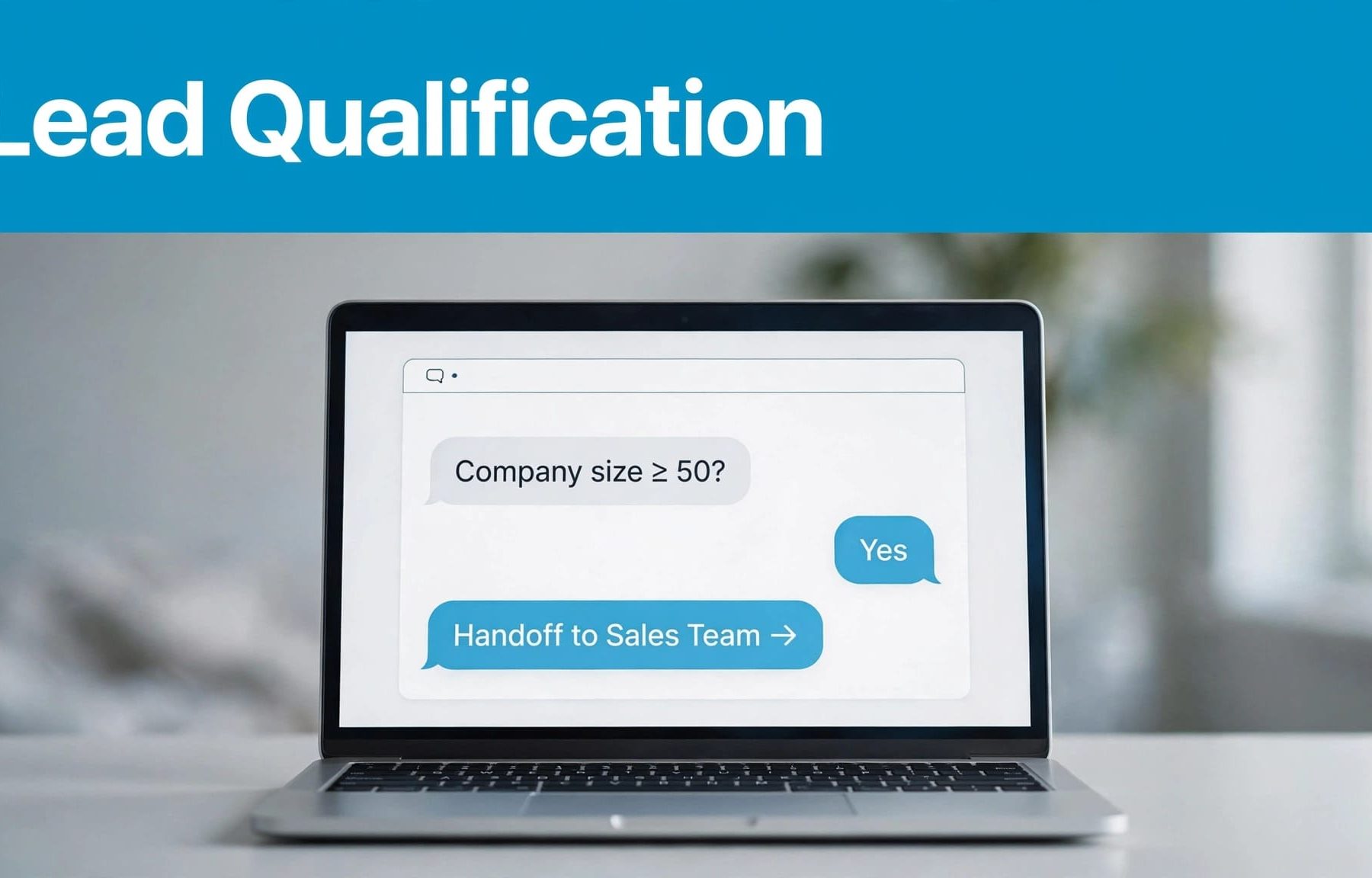
B2B website chatbots help you answer B2B buyers’ questions, assess website visitors’ company fit and buying intent, then route suitable enquiries to your sales team. Start with a short conversation, explicit scoring rules and a reliable human handoff. Judge success by sales-accepted opportunities, rather than chat volume.
Your chatbot should make the next step easier without forcing every visitor into a demo. The starting point is deciding which conversations deserve sales attention.
Key takeaways
- Ask questions only when the answers change qualification, routing or follow-up.
- Keep contact forms and human support available alongside automated conversations.
- Connect chat records to CRM outcomes so you can measure lead quality, meetings and revenue separately.
Give B2B website chatbots one commercial job
Help buyers research before asking for details
A B2B chatbot supports longer buying cycles, multiple stakeholders and company-level requirements. Use it for conversational marketing by answering useful questions before requesting contact details. Qualification questions need more context than a consumer product recommendation.
Forrester reported in 2017 that 68% preferred researching independently online. That’s historical research, not a current UK benchmark, but it supports answering questions before requesting contact details.
Start with suitability, implementation, pricing conditions and integrations. Visitors arriving after AI-assisted research may already understand the basics, which also matters when qualifying AI-driven ad traffic.
Keep forms available
Corvexa cites Abmatic’s analysis of 1.2 million identified B2B sessions for its claim that more than 97% never submitted a form. It also cites Wonderchat’s 2026 benchmark: chat conversion of 15% to 25%, against 2% to 3% for forms.
Those figures don’t establish what your website will achieve. Definitions, traffic and qualification standards matter.
Your B2B contact page should remain available as an alternative lead capture route, without requiring visitors to open chat. Someone ready to send a brief shouldn’t have to complete a conversation first.
The distinction resembles LinkedIn forms versus landing pages: easier submission can increase volume without improving commercial suitability.
Build your lead qualification rules
Ask questions that change the next step
Start with the visitor’s task: “What are you trying to improve?” Then ask about company context and timing when those answers affect your response.
If someone asks about Salesforce implementation, establish whether they need migration, configuration or ongoing support. An explanation of CRM software won’t move the conversation forward.
Ask one question at a time. Request an email address when you can explain its purpose, such as sending a proposal or confirming a meeting. The same restraint applies when building LinkedIn Lead Gen Forms.
Don’t make an exact budget compulsory when the buyer is still establishing requirements.
Separate company fit from buying intent
Use this simple lead scoring model for your pilot:
- Award two points for a service match and two for target-company fit.
- Add one point when the buying timetable suits your delivery capacity.
- Give another point when the visitor requests a commercial next step.
Route scores of five or six to sales only when both fit conditions are met. Keep suitable researchers on a useful information route instead of pushing immediate booking.
These are proposed operating rules, not established benchmarks. Adjust them against sales acceptance and opportunity creation.
Your audience segmentation can inform company-fit criteria, but browsing behaviour alone shouldn’t establish purchase readiness. Store the underlying answers alongside the score so sales can understand the decision.
Choose tools by workflow, not demonstration quality
Assess lead qualification, meeting booking, CRM integration, human handoff, intent detection and deployment flexibility. A convincing demonstration doesn’t prove these work in your environment.
Qualified’s Piper suits evaluation when website conversations and meeting generation are central. Intercom’s Fin deserves consideration when approved knowledge and customer service are major requirements. HubSpot’s chatbot builder is another option when your qualification and routing already sit within HubSpot.
For a smaller business, a rules-based flow may be enough. Conversational AI handles open-ended exchanges, while a fixed flow follows set questions. An AI sales agent may handle qualification and meeting requests, so choose a tool that fits your chatbot use cases.
Test whether a tool can update existing CRM contacts, preserve campaign source, assign ownership and recover from failed calendar bookings. Include implementation, integration maintenance and human review in your cost comparison.
Whether visitors arrive through SEO, PPC or referrals, they should enter the same qualification process. Keep source attribution separate so you can compare acquisition quality later.
Read reported chatbot results carefully
These chatbot examples show different outcomes, but they aren’t directly comparable: sales conversion and service resolution answer different questions.
These published figures cover several different jobs:
| Company or deployment | Reported outcome | What you should distinguish |
|---|---|---|
| Salesforce’s Piper | More than 60 meetings weekly on average; 6% conversion | Bookings versus accepted opportunities |
| Demandbase using Qualified | 3.4 times more meetings year on year; qualified meeting rate increased from 2.6% to 8.8% | Traffic changes and qualification definitions |
| Fin’s inbound sales operation | About 85% automated, roughly 12,750 of 15,000 monthly conversations; 10 SDRs handle the remainder | Automated handling versus sales success |
| Vanta using Fin | Previous tool resolved about 49%; ongoing Fin full-resolution rate reported at 71% | Test performance versus live resolution |
| Rippling using Decagon | 32% increase in deflection across more than 12 product lines | Relative improvement versus absolute deflection |
| Docker Docs AI | Around 1,000 daily queries after its May 2024 launch, with source-document links | Answer volume versus lead generation |
Salesforce’s published Piper results date from its April 2026 launch. The published excerpt doesn’t define the conversion denominator.
Vanta’s 400-conversation comparison reported roughly 73% resolution for Fin. That test result and its 71% ongoing figure describe different measurements.
SiteGPT collates several of these vendor-reported examples. Treat them as directional evidence, rather than independent comparisons.
The same caution applies to Gartner’s reported forecast of over US$15 trillion in AI-intermediated B2B spending by 2028. Market-wide spending forecasts don’t establish your likely return.
Define human handoff before switching on
Let visitors reach a person directly
Escalate when someone requests a person, asks for contractual commitments or raises a question outside approved knowledge. Repeated misunderstandings should also trigger an exit.
Let visitors contact a person without first meeting a qualifying score.
Pubosphere’s small 2021 review found chatbots on eight of 25 CRM websites and reported requested human escalation on 66% of those bots. It’s an old, narrow sample, but it highlights a practical requirement.
Gartner predicts 75% will favour human-prioritised sales experiences by 2030. Keep automation useful without making access to people difficult.
Make booking a complete handoff
Offer relevant appointments only after explaining what the meeting covers. Respect availability, time zones and account ownership.
Send the salesperson or sales development representative the visitor’s question, qualification answers, source page and unresolved issues. Requiring the buyer to repeat everything wastes the work your chatbot just completed.
Outside staffed hours, state when a response is due and provide an alternative contact route. Never imply that a live agent is available when nobody is monitoring the queue.
Launch safely and measure commercial outcomes
Bound the knowledge and protect personal data
For a small deployment, limit the approved knowledge base to service pages, FAQs and documentation. Assign an owner to each source and exclude outdated offers.
Tell visitors they’re speaking to an automated assistant. Explain data use, retention and recipients in your privacy information. Define CRM access permissions and contractual data-processing responsibilities.
Prevent the bot from requesting passwords, payment details or unnecessary sensitive information. Preserve consent choices when tracking AI advertising leads; server-side collection doesn’t remove privacy obligations.
Test unsupported questions, personal-data requests and attempts to override instructions before launch.
Compare against a baseline
Record a pre-launch baseline for eligible sessions, accepted leads, attended meetings and opportunities. Compare equivalent pages and traffic sources, ideally using a controlled split.
Pubosphere suggested prompting after roughly 50% scroll depth and avoiding early email requests. Use those as test ideas, not universal rules. Keep mobile navigation unobstructed.
Measure self-service and customer service resolution separately from sales qualification and outcomes. Review transcripts weekly for wrong answers, unnecessary questions, failed handoffs and rejected leads.
For Google Ads and Facebook Ads, pass meaningful downstream outcomes back where supported. Don’t make every chat opening a primary conversion.
Our guidance on Google Ads broad match applies the same principle: bidding improves when its signals reflect commercial quality.
Questions about B2B chatbot qualification
Can your chatbot book demos directly?
Yes, when it has calendar integration, availability rules and an assigned meeting owner. Track booking completion and attendance separately. A calendar link displayed in chat isn’t evidence that an appointment was successfully created.
Should your chatbot replace sales representatives?
Use it alongside your team. It can answer approved questions, collect context and arrange next steps. Your salespeople should handle uncertain suitability, commercial negotiation and complex requirements. Give them the conversation history so the handoff actually saves time.
Build around the sales process you want
Your qualification rules should make suitable enquiries easier to recognise and act on. Start with one high-intent journey, review rejected leads and expand only when the evidence supports it.
Digital marketing performs better when acquisition, qualification and follow-up share a clear definition of success.
Speak to our team about AI chatbot development built around your lead qualification process, CRM and sales handoff.