
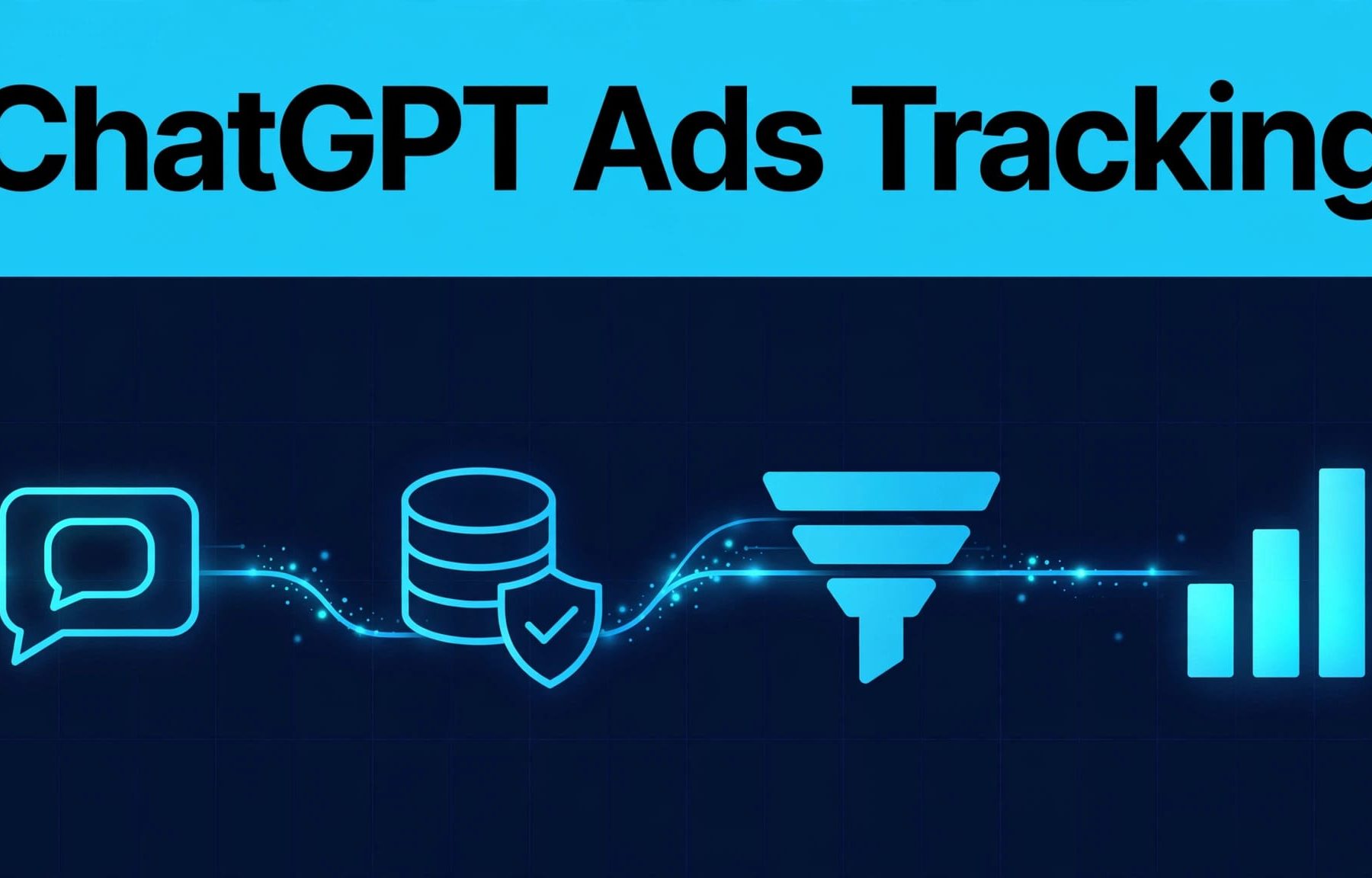
ChatGPT ads tracking works best when you treat OpenAI reporting as one useful layer, not the final answer. Tag every paid landing-page URL, record consented first-party data, connect leads to your CRM and judge the campaign by qualified pipeline and revenue. The key caveat is simple: a ChatGPT click may later appear as direct traffic, branded search or another channel, so last-click reporting will miss part of the journey.
For UK teams, this means building the measurement path before spend begins. You need clear consent choices, sensible conversion definitions and one agreed way to compare ChatGPT activity with PPC, search and paid social.
Key Takeaways
- Treat OpenAI reporting as one useful measurement layer, then compare it with GA4, CRM stages and finance-confirmed revenue.
- Tag every paid landing-page URL, preserve first-touch and latest-source data, and collect only the consented first-party information needed for a defined purpose.
- Use the OAIQ pixel and Conversions API together where appropriate, while recognising that consent choices, ad blockers, device changes and long buying cycles can still create attribution gaps.
- Keep paid ChatGPT activity separate from unpaid referrals, branded search and direct traffic, and judge performance by qualified leads, opportunities, pipeline and revenue rather than clicks alone.
- Set a baseline and test incrementality before increasing budget, keeping established search, paid social and SEO activity in view.
What ChatGPT ads tracking can and cannot measure
OpenAI’s current documentation describes a browser-based Measurement Pixel, which may be referred to as the OAIQ pixel, alongside a Conversions API for website conversion measurement. These tools can help connect a paid interaction to events on your own site, but they don’t make conversational advertising a fully visible user journey.
A prospect may see an advert, return later through a Google search, then complete a form on another device. Your reporting needs to recognise that gap rather than hiding it inside “direct” traffic.
Use documented platform diagnostics
Platform metrics can show whether an advert is attracting attention. Impressions, clicks, spend, click-through rate, documented CPC bidding information and reported conversions can reveal a weak message or landing-page problem.
Record CPC bidding only where current platform documentation confirms it is available. Neither ChatGPT Ads Manager nor a self-serve Ads Manager should be presented as confirmed functionality unless current authoritative OpenAI documentation verifies availability for the relevant market and campaign type.
These signals support conversion tracking, but aren’t proof that a campaign generated revenue. Compare them with GA4 engagement, CRM stages and finance-confirmed sales.
Reported conversions may differ because of attribution windows and other measurement rules. Treat platform results as directional evidence rather than a final commercial verdict.
OpenAI’s ChatGPT Ads Measurement Pixel documentation confirms that the browser SDK can measure website events that may be attributed to ChatGPT ads. Keep your campaign reporting grounded in those documented capabilities, especially while the product continues to develop.
Don’t expect conversation-level data
Advertisers shouldn’t plan around user-level data such as private prompts, chat history, memory or individual conversation transcripts. An ad library shouldn’t be treated as a confirmed source of campaign or conversation-level evidence unless OpenAI documents it.
The sensible model is less dramatic, but more useful: your advert attracts a visitor, your landing page collects consented information, and your CRM tells you whether that lead was worth having.
That puts more pressure on the page itself. A generic services page makes attribution and qualification harder. A focused page with one offer, clear proof and one next step gives you a cleaner signal.
Build first-party data into the landing page
First-party data is information collected through your own website, forms, CRM and sales process. It gives you a record you control, rather than relying on a browser cookie or an advertising platform to fill every gap.

Capture the source at the point of conversion
Pass source, medium, campaign, landing page and first-touch date into hidden form fields. Store those values against the contact in your CRM, alongside the latest known source. Both matter.
Use tagged destination URLs for paid landing pages. Keep a consistent naming convention and store the resulting values with the lead record.
These campaign parameters describe the visit, while consented CRM data records what happens after conversion. Preserve both the first-touch source and latest-source value, rather than overwriting the original source.
Use a clear naming format such as:
| Field | Example value | Why it matters |
|---|---|---|
utm_source | chatgpt | Identifies the traffic origin |
utm_medium | paid_ai | Keeps paid AI traffic separate |
utm_campaign | payroll-software-demo | Shows the offer and buyer context |
| Landing page | /payroll-demo | Connects campaign activity to page performance |
| First-touch source | chatgpt / paid_ai | Preserves the earliest recorded visit |
UTM parameters support consistent reporting, but they don’t provide complete attribution on their own.
Avoid labels such as test, campaign2 or spring-new. They make sense for a week, then become useless when someone reviews performance six months later.
Consent also matters. Under UK GDPR and PECR, your cookie and tracking setup needs to reflect the data you collect and why you use it. Collect and retain only the user-level data needed for a defined purpose.
Record browser events through an OAIQ pixel only after the relevant consent choice, and follow the documented implementation. The same applies to site-side event tracking for form starts, submissions and booked consultations. Get specialist legal advice where your setup involves personal data, consent management or server-side event matching.
Give sales a useful role
Your form should capture only what helps qualify the enquiry. For a B2B campaign, that may include company size, service need and expected timing, rather than a longer form filled with fields nobody uses.
Ask sales teams to retain free-text notes when a prospect says they found you through ChatGPT or another AI tool. It isn’t perfect evidence, but it can explain a lead that analytics labelled as direct. This approach works particularly well alongside B2B lead tracking in GA4, where website acquisition data is linked to later commercial stages.
Pixel and server-side events: use both where appropriate
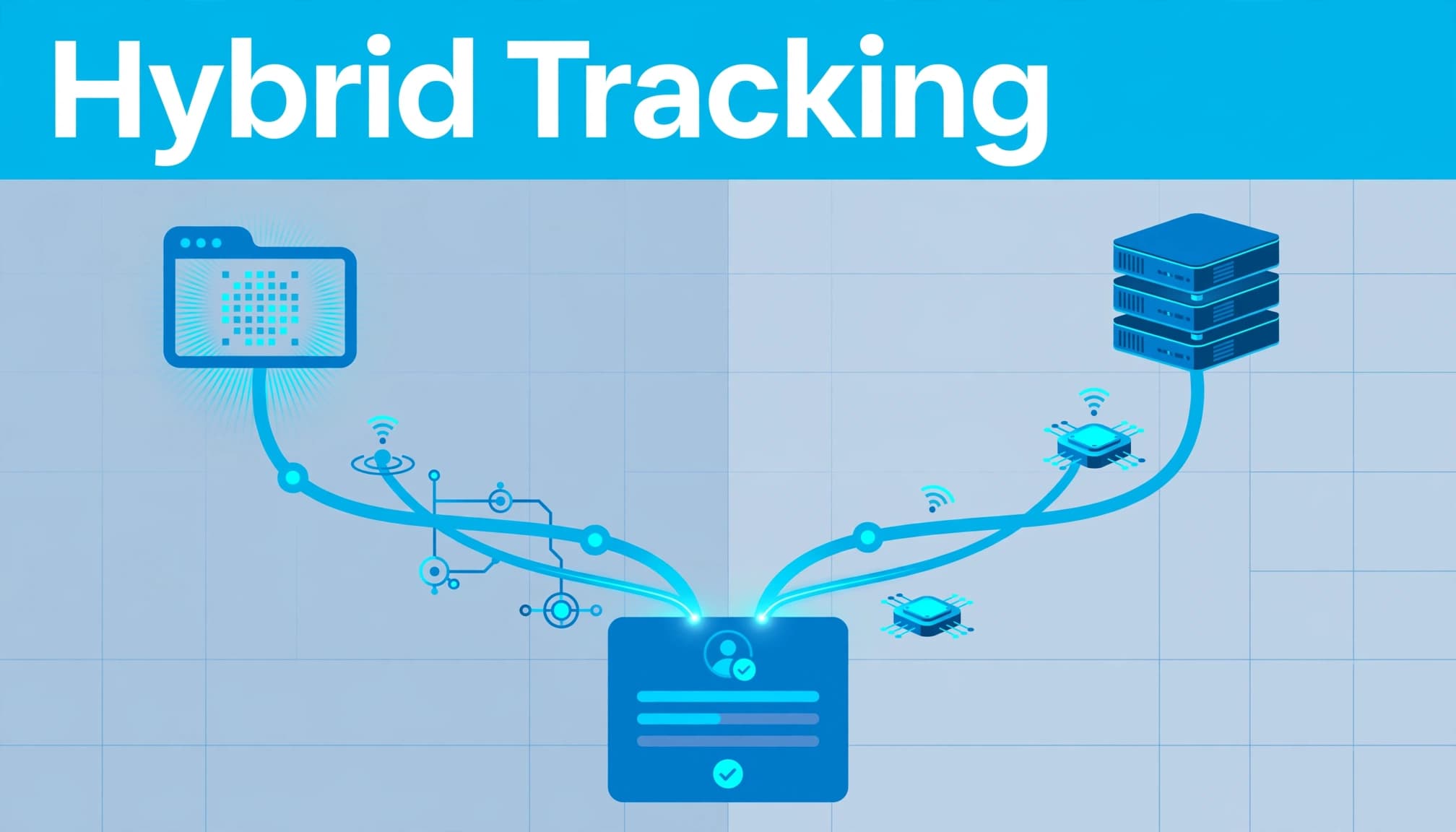
Client-side and server-side events answer different parts of the same question. The OAIQ pixel captures browser activity, while server events come from your company’s systems. Used together, hybrid tracking can provide stronger coverage, provided you configure event matching properly and respect consent choices.
What the client-side pixel does
The OAIQ pixel runs in the visitor’s browser. It can record actions such as a completed lead form, registration or purchase after the relevant consent is in place.
Site-side event tracking helps confirm that a landing page receives visitors and that important actions are recorded. Browser measurement through the OAIQ pixel can be affected by ad blockers, browser restrictions, deleted cookies and users moving between devices.
Start with conversion events that carry commercial meaning. A landing-page view helps diagnose traffic delivery. It should not carry the same weight as a booked consultation or completed order.
What server-side events add
Unlike site-side event tracking, server events can come directly from your own systems. The Conversions API lets your server send an event after an action occurs, such as when a form is accepted by your CRM or a payment is confirmed.
OpenAI’s conversion tracking guidance describes pixel-based measurement and Conversions API support. If the same action is sent through both routes, use the same event ID to support event deduplication.
Hybrid tracking improves signal coverage, but it doesn’t solve every attribution gap caused by consent, device changes or long buying cycles. The OAIQ pixel and server-side processing must honour consent signals where applicable.
Google Tag Manager can help organise client-side tags, triggers and consent settings. It isn’t a reason to assume every platform integration is officially supported. Validate your implementation against current OpenAI documentation and test it in a controlled environment before launch.
For the wider setup, server-side tracking can connect initial enquiries with qualified leads, opportunities and eventual revenue through server-side conversion tracking.
Separate paid AI traffic from referrals and direct visits
AI discovery is not one channel. A paid ChatGPT ad click, an unpaid ChatGPT referral and a person who searches for your brand after an AI conversation are different signals.
Create a GA4 custom channel grouping before the campaign starts. Keep paid ChatGPT activity, unpaid ChatGPT referrals, Google AI-related visits, branded search and direct traffic separate. An OAIQ pixel conversion shouldn’t be used alone to classify unpaid referrals or branded search.
Use hybrid tracking to consider platform, analytics and CRM evidence together. These sources support one another, but they aren’t interchangeable. Where a current official ad library is available, it may add context, but it won’t show private prompts or prove a later visit came from a specific advert.
Set a baseline before spending
Review at least several weeks of existing data before you launch. Record branded search volume, branded search conversions, share of search, ad presence rate, conversion rate and opportunity rate.
Define ad presence rate as the percentage of a fixed set of relevant queries where your advert appears. It is a comparison metric, not an official OpenAI reporting field. Use consistent attribution windows when setting the baseline, and don’t treat these measures as proof of incremental impact.
Introduce branded search lift as a directional measure of changing demand. If branded searches rise after activity begins, that might suggest increased awareness. It does not prove that the advert caused every extra visit.
A business selling HR software might see more direct visits after a ChatGPT campaign, but those visitors could also be responding to a webinar, LinkedIn activity or a new partner referral. Branded search lift can have several simultaneous causes, so keep the explanation proportionate to the evidence.
Competitive intelligence and query monitoring can help describe competitor visibility. Compare share of search across the same query set, but remember that these signals can’t reveal private prompts or establish causation. Auction conditions and CPC bidding can also affect paid-channel comparisons.
Review assisted journeys, not only last clicks
Use GA4 path exploration, CRM source fields and sales feedback to investigate leads that began with paid AI traffic but converted elsewhere. Compare platform, GA4 and CRM results carefully, since their attribution windows may differ.
Post-enquiry surveys can help too, with a simple question such as, “How did you first hear about us?” Branded search lift remains a directional indicator, not proof that a specific campaign created the demand.
This is where marketing attribution for revenue growth becomes more useful than a single dashboard conversion total. You are looking for a fair comparison between channels, not a story that gives all credit to the final click.
Create a reporting framework that sales trusts
Each system should answer a different question. Browser and server events can be reconciled through hybrid tracking, while the Conversions API adds server-side conversion signals. Neither replaces CRM or finance reporting.
| Reporting layer | Main question | Measures to review |
|---|---|---|
| Ads Manager | Is the advert producing interest? | Spend, impressions, clicks, CTR, CPC bidding information where documented, reported conversions |
| GA4 | Does the page create useful action? | Site-side event tracking, engaged sessions, form starts, form submissions |
| CRM | Are the leads commercially worthwhile? | Qualified leads, meetings, opportunities, pipeline |
| Finance | Is acquisition improving? | Closed revenue, blended CAC, blended ROAS |
Reconcile the numbers monthly
Platform data, GA4, CRM records and finance reports will rarely match exactly. They can use different time zones, attribution windows, conversion definitions and reporting dates. Platform, GA4 and CRM dates may also differ when attribution windows are applied differently.
Reconcile the figures monthly. Check whether the form submission exists in the CRM, whether sales accepted it, and whether it became an opportunity. When the numbers differ, investigate the reason rather than adjusting the report until it looks neat.
Even with hybrid tracking, browser, server and platform records may still disagree. Use the same conversion definitions across Google Ads, ChatGPT activity and Facebook Ads. If one channel counts a content download and another counts a sales-qualified lead, the comparison won’t hold up.
Test incrementality before increasing budget
Attribution gives credit across recorded touchpoints. Incrementality asks whether the campaign created demand that would not have happened otherwise.
Start with one offer, one landing page and a fixed test budget. Keep established search, paid social and SEO activity running as a benchmark. Set performance budgets against an agreed cost per qualified lead, opportunity or other commercial outcome. Hold the main message steady long enough to collect lead-quality feedback, then change one variable at a time.
Where volume allows, compare regions, periods or controlled audience groups. Review CPC bidding alongside cost per opportunity, because cheaper clicks don’t necessarily produce better opportunities. A higher click-through rate is not a reason to scale if the cost per opportunity or pipeline quality is weak.
Make the landing page earn the click
Conversational discovery can mean a visitor arrives informed but undecided. Your landing page should carry on the conversation without pretending it knows the exact prompt they used.
Match the page to the buyer problem
If the advert refers to reducing poor-quality leads, the page should explain how you improve lead quality. Don’t send that visitor to a broad agency overview and hope they find the relevant service.
Use the same language around the problem, include credible proof, and give one obvious action. This is the practical side of optimising PPC landing pages.
Keep your established channels in view
ChatGPT advertising should sit beside established demand-capture activity, not replace it. SEO can support share of search, while paid search captures comparison-stage demand.
For relevant buyer queries, an ad presence rate can act as a directional diagnostic for consistent paid visibility. It isn’t a confirmed platform report. Compare CPC bidding as one cost variable, but judge traffic by qualified enquiries, not clicks alone.
A good test also protects your existing benchmarks and performance budgets. If ChatGPT traffic produces lower-quality enquiries than comparable campaigns, the data gives you a clear reason to refine the offer or review spend.
Frequently asked questions
How can you track ChatGPT ad conversions accurately?
Use tagged destination URLs, consent-aware analytics and CRM source fields. Define conversion events consistently across browser, server and CRM systems. The OAIQ pixel and Conversions API are complementary documented measurement routes, but neither exposes private prompts or guarantees revenue attribution. Then record qualified leads, opportunities and revenue stages in your CRM.
Why can ChatGPT-originated journeys be classified incorrectly?
Referrer data and UTM parameters can be lost when someone switches device, copies a link, changes browser settings or returns later. This can cause a ChatGPT-originated visit to appear as direct traffic. Treat it as incomplete evidence, then review first-touch fields, surveys and CRM notes for context.
Can server-side tracking replace landing-page analytics?
No. Hybrid tracking can improve event coverage, but it can’t replace landing-page analytics, CRM records or finance-confirmed outcomes. Reports may also differ because attribution windows don’t always match later commercial results. Use browser and server-side signals alongside landing-page analysis and sales data.
Build a measurement system that supports better decisions
ChatGPT ads tracking is most credible when it connects platform activity with your own consented data and sales outcomes. Server-side tracking connects website activity with CRM records and commercial outcomes, while consistent attribution windows improve comparisons without removing attribution gaps. Clicks and reported conversions can guide optimisation, but qualified pipeline and revenue should decide whether the channel earns more budget.
Flow20 can help you assess Digital marketing activity, landing-page performance, CPC bidding and CRM reporting in one practical view. If you want an AI advertising test that can be measured properly, start with a conversation about your tracking, PPC and growth priorities.