
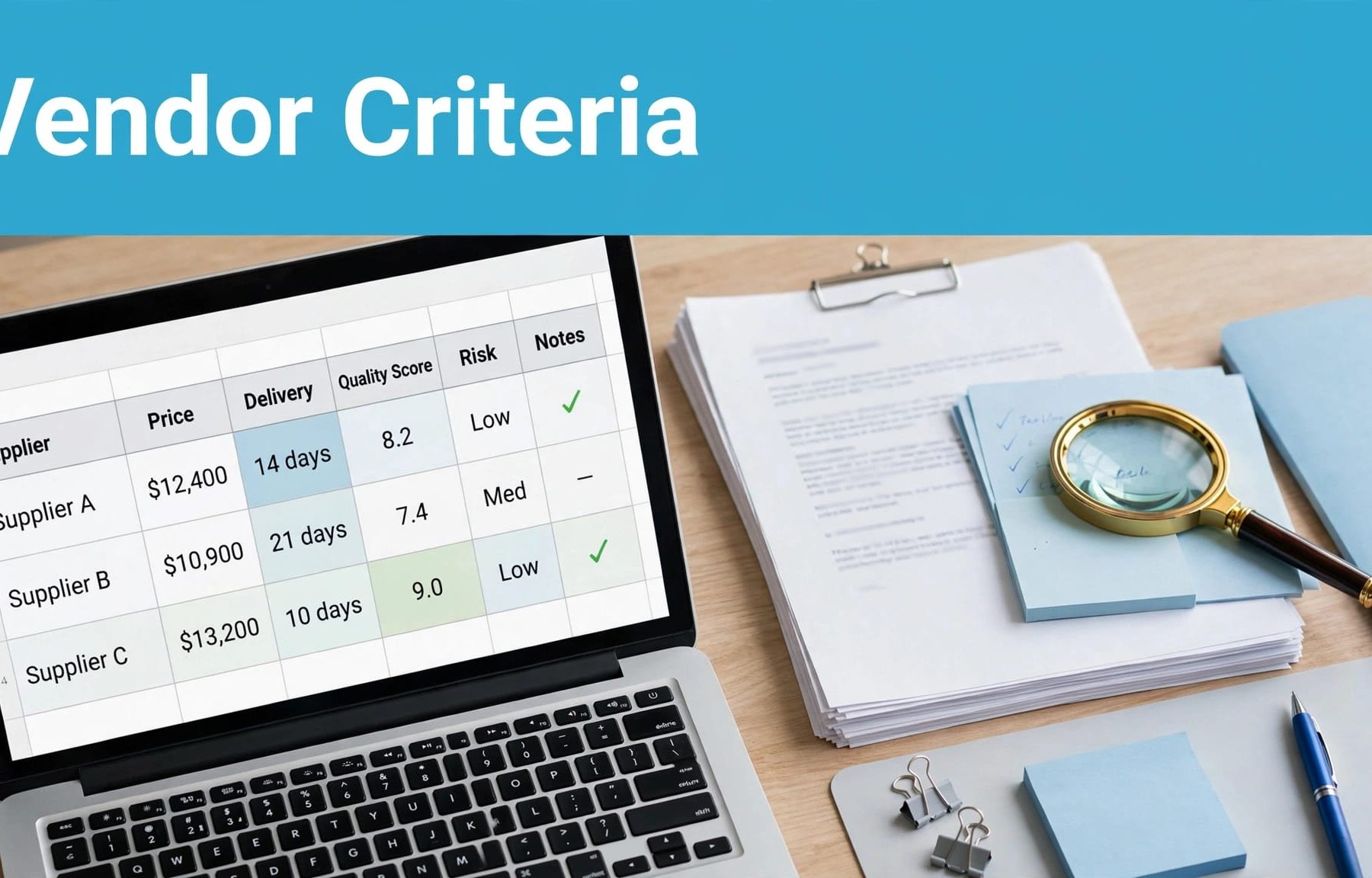
Your B2B procurement page should explain your vendor evaluation criteria, the evidence behind each claim, and the commercial terms buyers need to compare suppliers. For AIO, or artificial intelligence optimisation, make those answers accessible and clear enough to remain useful outside your page’s visual layout.
A buyer shouldn’t need three sales calls to discover who handles implementation or what the quoted fee excludes. Start with the decisions they need to make, then give each decision a clear answer and supporting evidence.
Define what your procurement page helps evaluate
A procurement page gives your buying team a practical route through suitability, risk, delivery and commercial approval. Its job is to explain where your offer fits.
Address the different buying responsibilities
Your finance contact needs the full cost. IT needs integration and security information. Procurement needs contract terms, responsibilities and evidence that your business can deliver.
These questions overlap, but they aren’t interchangeable. Our guide to AI search recommendations by buyer role explains why the information supporting a recommendation needs to match the person asking.
Use those responsibilities to organise your page. A buyer researching Salesforce compatibility shouldn’t have to work through broad performance claims before reaching technical requirements.
Separate supplier suitability from tender assessment
In UK public procurement, conditions of participation assess a supplier’s legal and financial capacity and technical ability. Award criteria assess the tender against the stated requirements.
The government’s competitive tender assessment guidance explains that distinction and the need for transparent assessment.
Those rules concern contracting authorities, rather than every private B2B purchase. On your commercial page, the useful principle is separating evidence about your business from evidence about your proposed solution.
Build vendor evaluation criteria buyers can compare
Start with criteria that affect whether a buyer can approve your offer. Broad claims such as “excellent service” leave too much room for interpretation.
The following framework gives you a starting point, rather than a mandatory checklist.
| Criterion | Buyer question | Useful evidence |
|---|---|---|
| Functional fit | Does this solve our required task? | Capabilities, use cases and limitations |
| Integration | Will it work with our systems? | Supported connections, data flows and setup requirements |
| Security | Can we accept the data risks? | Controls, certification scope and contractual commitments |
| Delivery | What will implementation involve? | Responsibilities, dependencies and handover process |
| Support | What happens when something fails? | Coverage, escalation routes and response commitments |
| Total cost | What will we pay across the contract? | Fees, exclusions, renewal terms and exit costs |
Choose the rows that matter to your offer. Software procurement needs different detail from buying a marketing service.
For an integration involving Salesforce, naming the platform is only the first step. Explain the connection method, which records move, any configuration requirements, and who maintains it.
This is where intent-led keyword clustering helps your content planning. Group questions around the decision they support, so compatibility answers stay together rather than becoming scattered pages with slightly different keywords.
Explain how criteria affect the decision
A useful evaluation framework tells buyers what matters and how evidence affects the outcome. Publishing a list without explaining its use leaves the decision process unclear.
Identify requirements that cannot be traded away
Some requirements determine whether a supplier can proceed. Others help compare suppliers that already meet the basics.
If a particular data-processing arrangement is mandatory, explain that requirement separately from preferences about reporting or account management. A strong presentation shouldn’t compensate for an unacceptable contractual condition.
On a supplier page, state the relevant capabilities and limitations directly. Avoid describing every feature as equally important when your buyer needs to identify the conditions that could prevent approval.
Explain relative importance where it applies
When you publish a formal evaluation process, describe the importance of each criterion and how assessors award points. Explain any minimum thresholds or disqualification rules.
UK procurement guidance allows relative importance to be expressed through percentage weightings, ranking or another stated method. Your methodology needs to make the decision understandable.
The government’s bid evaluation guidance provides practical context for using criteria consistently. For your commercial website, explain the trade-offs buyers should consider without presenting your preferred approach as their procurement policy.
Make cost and delivery terms visible
Price comparisons become unreliable when suppliers include different things. Your page should explain the charging basis, included work, additional charges and contract conditions.
For a marketing service, distinguish agency fees from advertising spend. Explain whether setup, creative production, tracking implementation and ongoing reporting sit within the same scope.
Where you publish prices, state their VAT treatment. Where pricing depends on scope, identify the actual cost drivers rather than leaving “contact us” as the entire answer.
Delivery needs the same clarity. Describe what your team handles and what the buyer must provide, including approvals, system access and data preparation.
A delivery timescale without buyer dependencies can create a misleading comparison between suppliers.
Your implementation information should also explain handover, ongoing support and exit arrangements. Buyers need to understand how work continues after launch and what happens when the relationship ends.
Use AI content gap analysis to identify unanswered questions across these commercial details. The useful gap is often a missing explanation of responsibility, rather than another introductory article about the service.
Keep the page focused on information that affects approval. You don’t need to publish confidential contract negotiations to explain your standard scope.
Attach evidence to each supplier claim
Your page becomes easier to assess when evidence sits beside the claim it supports. A separate collection of badges rarely gives procurement enough context.
Define the scope of technical evidence
ISO/IEC 27001 certification concerns an information security management system within a defined scope. Your page should explain that scope rather than implying every product, office and activity is covered.
Integration documentation should identify supported functionality and limitations. Service commitments should describe coverage and escalation arrangements, not rely on phrases such as “premium support”.
Some evidence belongs behind controlled access. You can still explain publicly what documentation is available and what it covers without publishing sensitive security reports.
Use customer evidence for the question it answers
A case study about campaign performance can support your delivery claims. It doesn’t establish your security controls or contract terms.
Explain the work, relevant conditions and measured outcome. Where a result depends on budget, timeframe or customer participation, include that context.
Independent feedback adds another perspective. Our guide to B2B vendor reviews and AI recommendations explains how reviews can support, challenge or qualify your website’s claims.
Keep the evidence proportionate. A customer praising responsiveness supports a service observation, but it doesn’t prove a contractual response-time commitment.
Structure answers for AI search
Your procurement content should make sense when a buyer reads one passage rather than the entire page. State the service or product name, answer the question, then explain conditions.
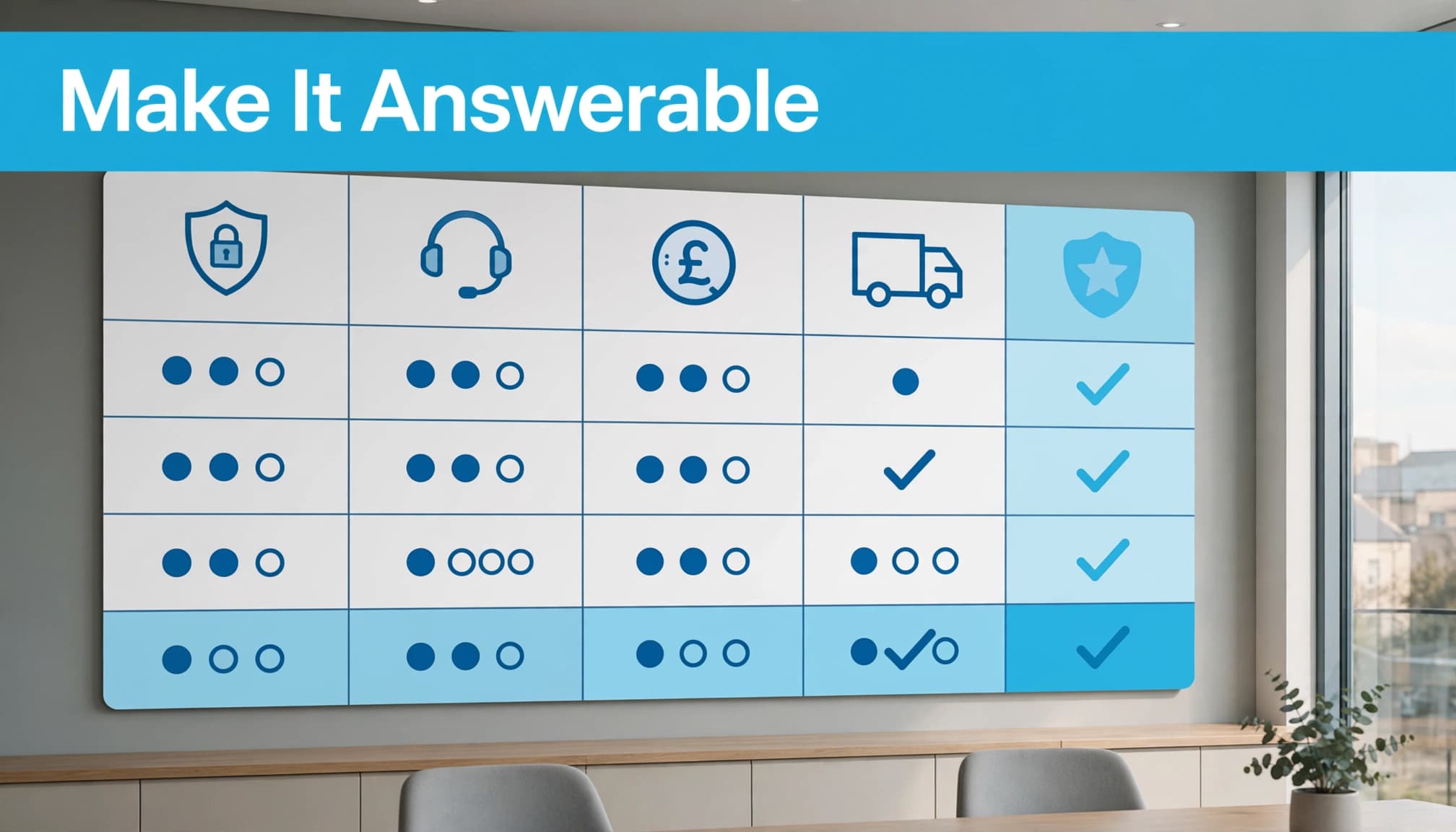
A heading such as “Implementation responsibilities” gives more context than “How it works”. Under it, explain who configures the system, prepares data, approves changes and provides support.
Keep key facts in accessible page content. A downloadable procurement pack can provide detail, but your main answers shouldn’t require a form submission or chatbot conversation.
For Google AI Overviews and AI Mode, supporting pages must be indexed and eligible to appear with a Search snippet. Google’s AI-feature guidance keeps established SEO practices at the centre of that work.
Our guidance on long-form content for AI search complements this approach: organise detailed material around recognisable questions.
Tables need meaningful headers, explicit units and clear conditions. Put exceptions beside the affected fact, because a footnote elsewhere can be lost when information is extracted.
Keep product names and commercial claims consistent across procurement, pricing, implementation and security pages. Contradictions make comparison harder for buyers and give search systems conflicting information.
Connect procurement content to your campaigns
Your procurement page needs to support the promise that brought the buyer there. If an advert promotes managed delivery, the page should explain the management responsibilities.
For PPC, use search-term and enquiry data to identify recurring concerns about price, suitability and implementation. Those concerns give you practical priorities for improving the page.
Traffic from Google Ads may arrive with a specific commercial question. Keep the answer visible rather than sending visitors through a general company introduction.
With Facebook Ads, visitors may need more context about your offer before reviewing detailed procurement information. Give them a clear route between the service explanation and the evidence supporting it.
The same distinction matters when choosing LinkedIn forms or landing pages. A short form can capture an enquiry, whilst a procurement page helps a buying team assess the supplier.
Keep campaign promises, page content and sales follow-up aligned so buyers receive the same explanation throughout.
Measure usefulness alongside visibility
An AI mention tells you that your business appeared in an answer. It doesn’t tell you whether the buyer understood your offer or became a qualified opportunity.
Record the questions and answers
Use a manageable set of questions about vendor evaluation criteria, costs, implementation and suitability. Record the platform, wording, date, cited pages and description of your business.
Look for inaccurate explanations as well as missing mentions. If an answer misstates responsibility for implementation, improve the relevant source content.
Our guide to Google Search Console for SEO helps connect search queries with existing pages. Google includes AI-feature traffic within its overall Web reporting rather than a separate AI-feature report.
Connect page changes to commercial outcomes
Record a baseline before substantial changes. Compare relevant visits, enquiries and sales acceptance where your analytics and CRM setup allow.
A B2B SEO content audit helps you identify missing answers and weak evidence before adding more content.
Keep a change log so you can interpret results. If you change pricing information, advertising and enquiry forms together, attributing the outcome to one content improvement becomes difficult.
Judge progress through better-informed enquiries and fewer avoidable misunderstandings, alongside search visibility.
Give buyers a clearer route to approval
Strong procurement pages explain the decision, support claims and expose the conditions that affect suitability. That gives your buying team useful information before the sales conversation begins.
Start with your highest-value procurement page and replace vague claims with clear scope, responsibilities and evidence. Keep the work connected to your wider lead-generation strategy.
If you need support, our Digital marketing services and SEO work can help you connect buyer-focused content with your acquisition strategy.