
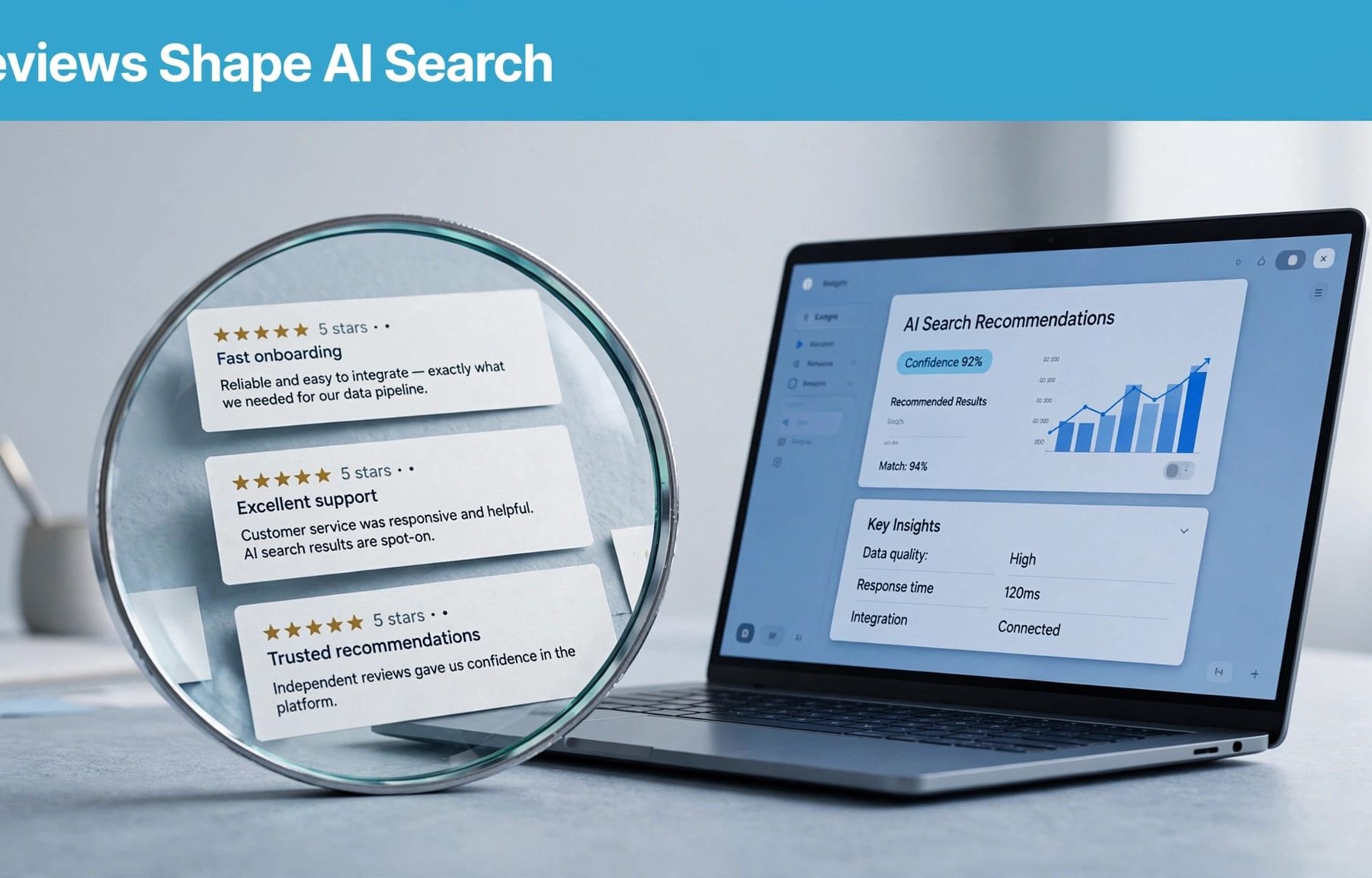
Independent B2B vendor reviews can influence how AI search describes your business, including its strengths, limitations and suitability. You should treat them as evidence to maintain, rather than a guaranteed route into a supplier shortlist.
Your website explains what you promise. Review sites add customer accounts that may support those promises, challenge them or introduce details your marketing misses.
Improving your B2B AI search visibility starts with understanding what buyers are being told and which sources support the answer.
How B2B vendor reviews become evidence for AI answers
A buyer researching software can ask about implementation, integrations, support and competing products in one question. Review pages can contain useful material for several parts of that request.

Retrieval brings customer evidence into consideration
When an AI search service retrieves a review page, customer accounts can supply details your product page doesn’t cover. The generated answer may combine those details with documentation, comparison articles and other sources.
Understanding LLM source retrieval helps you separate finding evidence from writing an answer. A relevant page can be retrieved and still be summarised inaccurately.
Google says supporting pages for AI Overviews and AI Mode must be indexed and eligible to appear in Search with a snippet. It doesn’t publish a platform-specific selection formula.
Citations show observed use, not guaranteed preference
G2’s account of AI search citations reports that it supplied roughly one-third of review citations in Google AI Overviews in analysis attributed to Profound. The measurement period isn’t specified in that account.
Treat that as a platform-reported observation, not proof that Google favours G2 or that your listing will appear.
A citation also doesn’t reveal every source considered. Check whether the linked page supports the claim beside it before treating the answer as reliable.
Choose review sites around your buyers
Start with where your customers already research suppliers. A software review platform and an agency directory serve different buying decisions, even when both appear in AI answers.
Use this comparison to prioritise your work.
| Platform | Relevant buying context | What you should check |
|---|---|---|
| G2 | Business software comparisons | Product category, customer context and current features |
| Capterra | Software discovery and evaluation | Listing accuracy, requirements and buyer feedback |
| TrustRadius | Business technology evaluation | Detailed experiences, limitations and implementation feedback |
| Clutch | Agency and professional-service selection | Project scope, client feedback and service specialisms |
SE Ranking’s review-platform citation analysis includes Gartner Peer Insights, G2, Capterra, Software Advice and TrustRadius. Use it as a research starting point, rather than assuming every platform influences every buyer question.
For example, if you sell CRM software, inspect answers comparing Salesforce, HubSpot and Microsoft Dynamics 365. Record which review sources appear for requirements relevant to your product.
Your ChatGPT search optimisation priorities should follow those observations. Maintaining two relevant profiles properly is more useful than opening ten you won’t update.
What useful reviews tell buyers about your business
A star rating gives you a quick summary. The written account helps you understand whether the reviewer had requirements similar to your prospective customer.
Specific experiences clarify suitability
Useful B2B vendor reviews explain what the customer needed, how they used the product and where it worked well. They may also identify implementation effort, integration constraints or support issues.
When you compare CRM systems, praise for an attractive interface tells you less than an account of migrating records and training a sales team. The second account gives you practical evaluation criteria.
Use recurring review themes to improve your AI optimisation for service pages. Answer the same questions with current documentation and evidence you can substantiate.
Limitations can affect the recommendation
Pay attention when reviews repeatedly mention a problem your website barely addresses. Buyers may see that concern in an AI-generated comparison before speaking to you.
A dated complaint still needs context. If you have changed the product, publish the current position clearly and respond through the review platform where appropriate.
Don’t claim that balanced reviews automatically improve AI visibility. Their practical value is that they help buyers assess fit and give you a clearer picture of objections your sales content should address.
Keep review profiles aligned with your own evidence
Old listings can create avoidable confusion. Your website may describe your current offer whilst a directory still lists a retired service, an outdated product name or incorrect support hours.
Start with your company name, domain, product descriptions and contact details. A consistent AI search entity profile helps establish which business the information describes.
Then check claims that could change a buying decision. Pricing, integrations, geographic coverage and implementation arrangements deserve more attention than a slightly different company introduction.
Don’t remove genuine historical experiences because your product has improved. Add current evidence and make dates clear so buyers can distinguish the earlier experience from today’s offer.
Your SEO work should also keep important product and evidence pages accessible, useful and accurately indexed. A complete review profile can’t compensate for vague documentation on your own site.
Use AI SEO quality control to check the revised claims across product pages, case studies and campaign materials. Structured data should match visible content, but review markup doesn’t guarantee AI citations.
Build an honest, repeatable review programme
You don’t need customers to write search-friendly testimonials. You need genuine feedback from people who have used your product or service.
Ask after a meaningful milestone, such as completed onboarding or delivery of an agreed project. That gives the customer something concrete to discuss.
A practical process is straightforward:
- Invite a representative range of customers, including those whose experience wasn’t entirely positive.
- Ask about their requirements, experience and limitations without supplying the answer.
- Follow the platform’s rules on incentives and disclosure.
- Assign someone to review feedback, respond appropriately and pass recurring issues to the relevant team.
Avoid asking only satisfied customers or tying rewards to positive ratings. Check each platform’s policy before running a campaign.
Keep customer permissions and confidentiality in mind. A useful review doesn’t need sensitive operational details, private support records or information covered by a client agreement.
The commercial benefit extends beyond search. Reviews can show you why customers choose you, what slows adoption and which promises need clearer wording. Feed those findings into onboarding, product development and sales enablement rather than leaving them with marketing.
Measure what AI answers tell your buyers
You can start with a spreadsheet. Choose a fixed set of buyer questions covering comparisons, integrations, implementation and support, then test them across the platforms your audience uses.

Record answers and sources separately
For each check, save the prompt, date, UK location, platform and model where available. Record whether your brand appears, whether your domain is cited and whether a review page mentions you.
Keep Google AI Overviews separate from organic rankings. Record whether an overview appeared at all, rather than counting its absence as a factual error.
Your AI search audit should include the answer’s wording and accuracy. Open the sources and confirm that they support the recommendation.
A third-party citation can describe your brand without sending the buyer to your website.
Compare repeated observations with commercial outcomes
Repeat important questions because answers and citations can vary between runs. Keep ChatGPT, Perplexity and Google findings separate; an improvement on one doesn’t establish an improvement elsewhere.
Monitoring software can speed up collection, but spot-check live answers. A visibility score can’t tell you whether the system has repeated an old price or misunderstood your service.
Connect AI search reporting with identifiable referral visits, qualified enquiries and CRM outcomes. Ask prospects how they researched their shortlist.
Treat unclicked visibility as a possible influence. Don’t assign revenue to a citation simply because an enquiry arrived shortly afterwards.
Turn review findings into marketing improvements
When an AI answer describes your business poorly, inspect the cited evidence before publishing another article. The problem may be an incomplete review profile, weak product documentation or conflicting descriptions.
Compare your pages with the sources shown. If competing vendors explain implementation requirements and you offer only broad benefits, improve that existing page first.
Use B2B vendor reviews to identify recurring questions, then check whether those questions also appear in sales conversations and search data. That gives you a stronger basis for content decisions than copying every phrase an AI answer produces.
Your PPC activity can help test which service language attracts qualified demand. Feed useful enquiry data back into your product pages, whilst keeping paid campaign results separate from observed AI mentions.
Review your Google Ads landing pages when pricing, features or terms change. Buyers shouldn’t encounter one offer during research and another after clicking an advert.
Apply the same accuracy checks to Facebook Ads, including remarketing creative. Record campaign changes alongside your review work so you don’t credit AI visibility for results that paid media helped produce.
Make independent evidence part of your visibility strategy
Independent reviews can influence how AI search presents your business, but they don’t guarantee a recommendation. Your priority is accurate, useful evidence that helps buyers judge whether you fit their requirements.
Maintain relevant profiles, resolve conflicting claims and inspect the answers your prospects may see. Judge progress through answer quality and qualified enquiries, not citation counts alone.
Speak to Flow20 about your Digital marketing priorities and build an audit that connects review evidence, AI visibility and lead generation.