

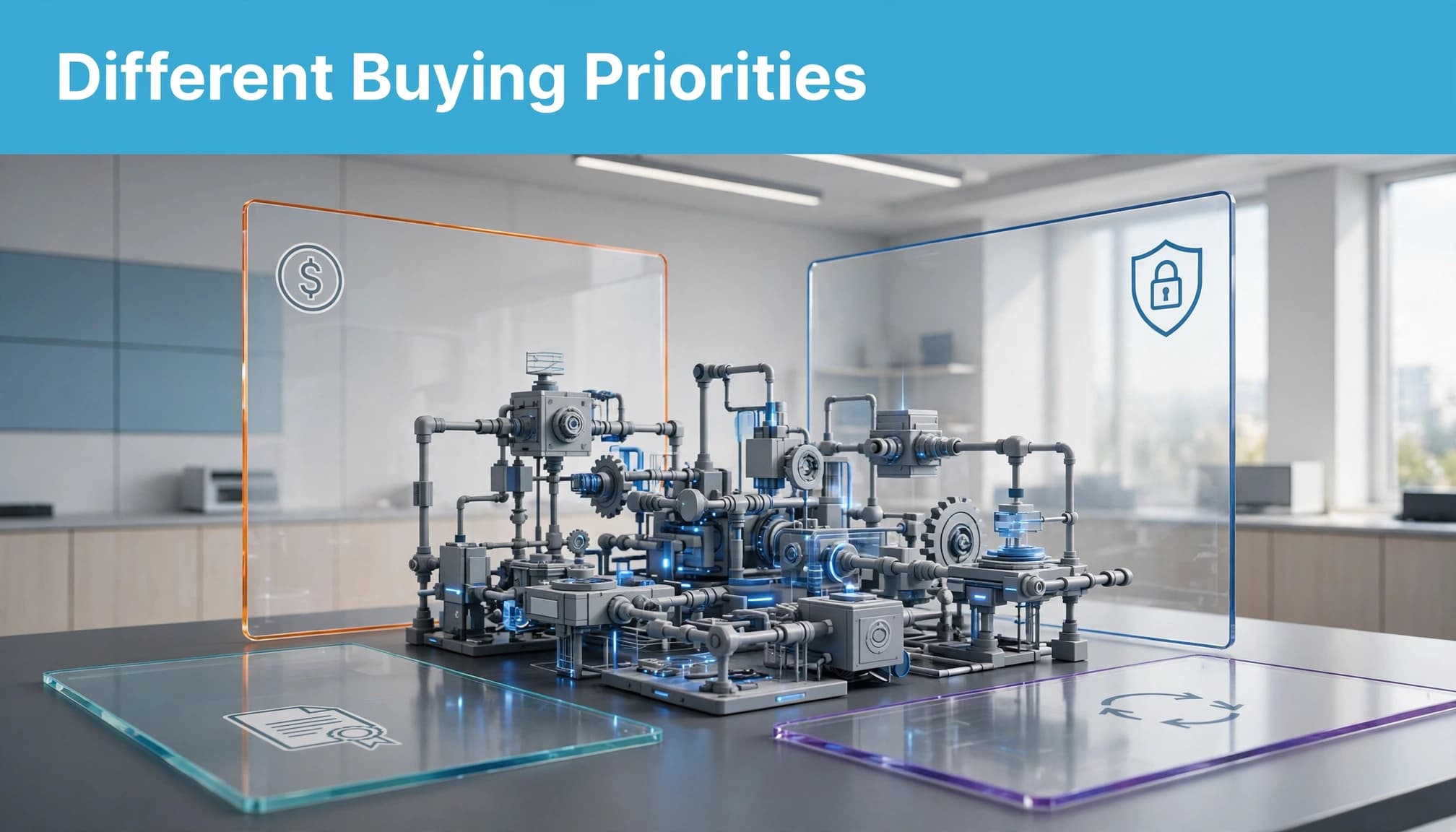
AI search recommendations can differ because finance asks about cost and payback, IT about integration and security, procurement about terms, and operations about everyday delivery. What matters is the context available to the tool, rather than a fixed recommendation for every job title.
Your content needs to answer those different questions with evidence, whilst keeping the underlying product facts consistent. Start with what changes the answer, then build around the decisions each buyer needs to make.
What changes an AI search recommendation?
A job title doesn’t describe the whole purchase. Budget, existing systems, implementation deadlines and the question itself all affect what a useful answer should cover.
The context you provide
Compare “recommend a CRM” with “compare CRM options for a finance director assessing implementation costs and ongoing expenditure”. The second question gives the tool a clearer brief.
You can also supply requirements without naming a role. Asking about single sign-on, data migration and access controls describes an IT-led evaluation. Asking about renewal terms and supplier responsibilities describes a procurement-led one.
Our B2B AI search glossary distinguishes the search experiences and measurement terms involved. That distinction matters when you compare recommendations, because a generated answer, a source citation and a website visit are separate things.
The information the system can access
Some products document additional context sources. ChatGPT can use relevant saved memories and past chats when those features are enabled. Relevant personal context may also help it formulate a search query.
Microsoft 365 Copilot can draw on work information through Work IQ, including emails, files, chats and meetings. Access and settings affect the information available.
These features support contextual answers. They don’t establish a universal system that ranks suppliers differently for every buyer role. Treat role-based differences as something to observe through controlled questions, rather than something you can assume.
How AI search recommendations vary by buyer role
The same supplier might appear in several answers, but the explanation could change. You therefore need to assess both the shortlist and the reasons given.

These are useful starting points for organising buyer questions.
| Buyer role | Main evaluation question | Evidence your content should provide |
|---|---|---|
| Finance | Does the expected return justify the full cost? | Pricing basis, implementation costs, assumptions and payback calculations |
| IT | Will this work safely with our existing systems? | Integration documentation, access controls, data handling and technical limitations |
| Procurement | Can we agree acceptable terms and responsibilities? | Contract structure, renewal conditions, service commitments and supplier obligations |
| Operations | Will this improve the work without creating avoidable disruption? | Workflow explanations, training requirements, rollout steps and support arrangements |
These priorities overlap. Finance can care about implementation risk, whilst operations can care about cost.
Use the roles to organise your content, not to reduce people to four rigid personas. Buying stage matters too: an early research question needs a different answer from a final supplier comparison.
Finance and procurement need commercial detail
Commercial buyers need enough information to compare options fairly. A headline subscription price rarely answers the whole question.
Finance evaluates the complete cost
If you’re producing finance-focused content, explain what the buyer would pay for and what affects that expenditure. Cover licences, implementation, migration, training and ongoing support where they apply.
For Microsoft 365 or Salesforce evaluations, a useful finance-led question is: “Which cost categories should our business include in its comparison?” That’s more useful than asking for the cheapest product without describing requirements.
Show the assumptions behind any return-on-investment calculation. Time saved only becomes a credible financial benefit when you explain the activity, frequency and cost basis. Separate measured results from estimates, and state whether a saving releases budget or creates additional capacity.
Procurement evaluates the agreement
Procurement needs to understand what happens after the initial purchase decision. Your content should explain responsibilities, service commitments, renewal arrangements and exit provisions.
A question such as “What should procurement compare in a CRM supplier agreement?” calls for a different answer from a feature comparison. Contract scope and delivery responsibilities become more relevant.
Make those details easy to find. If implementation comes through a partner, explain which organisation supplies the software and which delivers the project. Avoid vague partnership language that leaves the buyer unsure who is accountable when something goes wrong.
IT and operations need implementation evidence
Technical suitability and everyday usefulness are connected, but they aren’t interchangeable. A system can satisfy an IT requirement whilst creating unnecessary work for its users.
IT evaluates technical fit and risk
Your IT-focused pages should describe supported integrations, authentication, permissions, data handling and relevant limitations. Separate native functionality from custom development and third-party connections.
If a buyer asks about connecting Salesforce with existing systems, a generic claim about “easy integration” gives them little to assess. Clear documentation about the connection, dependencies and ownership gives them a better starting point.
Apply the same discipline to security claims. Explain the scope of a certification or assessment rather than treating its name as a blanket promise. Keep product editions and versions clear, so an answer doesn’t combine capabilities that aren’t available together.
Operations evaluates everyday delivery
Operational buyers need to understand how the work changes. Explain the task, the people involved, the exceptions and the support available during adoption.
Salesforce lead routing is a useful example. The operational question concerns how incoming enquiries reach the appropriate salesperson, including what happens when ownership is unclear. The IT question concerns how the configuration and connected systems support that process.
Build B2B use-case pages around these tasks. Include rollout dependencies and training requirements where relevant. Practical detail helps a buyer judge suitability without assembling the answer across several unrelated pages.
Build content around decisions, not job titles
Creating a separate page for every role can produce repetitive content. Start with the questions that require genuinely different answers.
Gartner’s research on rep-free B2B buying highlights demand for buying without a sales representative. Your website therefore needs to support meaningful evaluation before a conversation happens.
Use sales notes, customer questions and CRM records to identify recurring decisions. Then use AI keyword clustering to group questions by intent, rather than by shared vocabulary alone.
“CRM implementation costs” and “CRM migration responsibilities” may involve the same project, but they need different evidence. A single detailed implementation page could answer both, with clear sections and links to supporting documentation.
Keep the work within your SEO strategy. Improve existing commercial pages before creating another collection of lightly differentiated articles.
A B2B SEO content audit helps you identify missing answers, weak proof and outdated claims. Prioritise incorrect pricing, unsupported security statements and conflicting product descriptions before adding more copy. Clearer content improves the information available to buyers, but it doesn’t guarantee an AI recommendation.
Test recommendations without over-reading the results
You need a repeatable comparison, not a collection of favourable screenshots. Start with one purchase category and keep the core requirements consistent.
Use this sequence to separate role context from other changes:
- Run a baseline question that describes the business need without naming a buyer role.
- Create finance, IT, procurement and operations versions, keeping the product category and business requirements unchanged.
- Record supplier mentions, cited sources, recommendation reasons and factual errors across repeated runs.
Where possible, keep account settings and conversation history consistent too. Otherwise, differences may reflect more than the role wording.
Our AI search competitor analysis provides a useful framework for comparing your presence with suppliers buyers would genuinely consider.
A change in the explanation isn’t the same as a change in the shortlist. Record both.
Note the platform, date, exact prompt and relevant settings. Compare initial answers separately from follow-up conversations, since additional questions introduce new context.
Review the benchmark monthly, with new questions in a separate group. That preserves your original comparison whilst allowing the research to develop.
Keep mentions, citations, identifiable referral visits and qualified opportunities separate. A citation shows source selection. It doesn’t establish that the recommendation generated revenue.
Connect role-specific content with acquisition
The questions you uncover should improve more than AI search visibility. They can sharpen landing pages, paid campaigns and the information your sales team uses.
Use PPC to test commercially relevant wording against qualified enquiry outcomes. A cost-focused message and an implementation-focused message can attract different requirements, even when they promote the same service.
With Google Ads, search terms and conversion data can help you identify which questions lead to useful conversations. Don’t treat click volume alone as evidence that a message works.
Your LinkedIn sales funnel strategy should also reflect the decision stage. Early research content needs a different next step from a supplier comparison.
If you use Facebook Ads for retargeting, keep the message connected to the relevant buyer concern and assess lead quality.
Paid visibility doesn’t guarantee inclusion in AI answers. Its practical value here is helping you understand demand and improve the information buyers encounter.
Turn buyer questions into a clearer content plan
Useful AI search recommendations depend on the question and the context available. Your strongest response is consistent product facts supported by evidence for each buying decision.
Choose one priority service or product. Map the finance, IT, procurement and operational questions, then improve the pages that leave those questions unanswered.
Digital marketing support from our team can help you connect that work with SEO, paid acquisition and qualified enquiries. Start with the buyer decision you need to support.