
LLMs interpret B2B product requirements by extracting attributes, recognising conditions and comparing available evidence. They can distinguish mandatory specifications from preferences, but your application must enforce hard limits because a prompt alone doesn’t guarantee compliance.
The practical risk is that an assistant recommends something which sounds suitable but misses a requirement buried in your brief. Start by separating what must pass, what improves the ranking and what still needs evidence.
How LLMs parse product requirements
Extract attributes and conditions
An LLM processes your request as tokens and uses learned patterns, instructions and supplied context to interpret it. It can turn buyer language into fields such as capacity, integration, software edition, budget and deployment location.
“Supports Salesforce” might become an integration requirement. However, that phrase doesn’t establish which Salesforce edition, which records move or whether synchronisation works both ways.
OpenAI’s prompt engineering guidance supports giving models explicit instructions and relevant context. A structured response makes extracted requirements easier to inspect, but correct formatting doesn’t prove the values are correct.
Keep assumptions visible
Ask the model to return missing information and conflicting statements alongside extracted requirements. Otherwise, it may fill a gap with something plausible, then carry that assumption into its recommendation.
This matters when assessing B2B product compatibility, where a version number or connector type can determine whether a product fits.
Everyday logic also needs testing. Relative dates such as “Friday next week” can produce inconsistent interpretations. A small proof of concept in a Python notebook helps establish boundaries before those interpretations become product requirements.
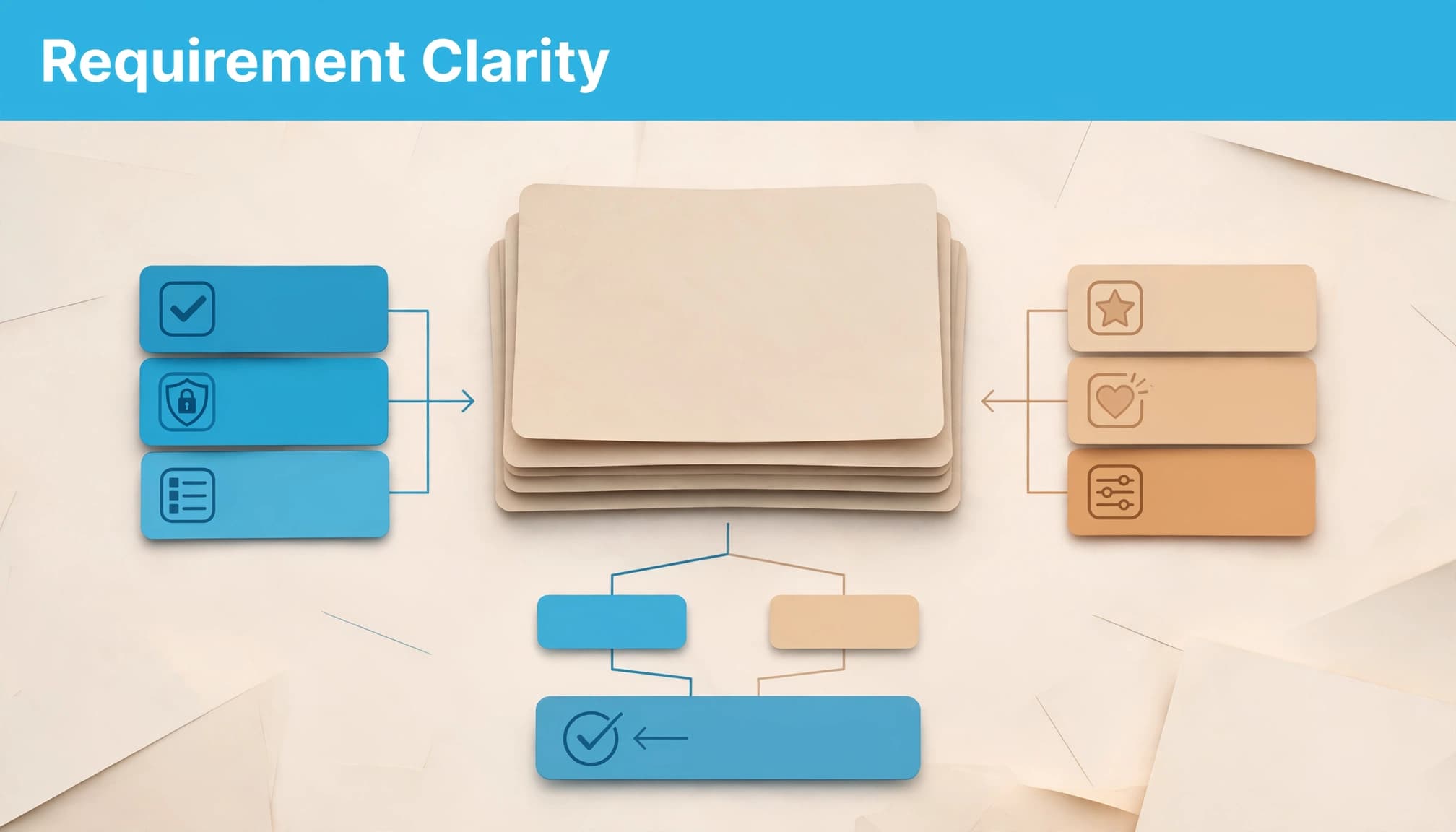
Write minimum specifications as pass-or-fail rules
Consider the brief: “We need affordable support software that works with Salesforce, handles 100 users and preferably keeps data in the UK.”
“Affordable” has no ceiling. “Works with” leaves the integration undefined. UK hosting could be a preference or an approval condition.
The ambiguity leaves the assistant to guess whether UK hosting is mandatory or preferred, so a clearer purchasing requirement separates these decisions:
| Requirement | Classification | Clearer wording |
|---|---|---|
| User capacity | Mandatory minimum | The quoted plan must support at least 100 named users. |
| Integration | Mandatory | It must synchronise contacts both ways with Salesforce Enterprise every 15 minutes or less. |
| Budget | Mandatory maximum | Total recurring charges, including required integrations, must not exceed £1,200 monthly, excluding VAT. |
| Hosting | Preference | Prefer UK hosting; report alternatives separately rather than treating them as compliant. |
These are example buyer requirements, not supplier capabilities or market prices.
If UK hosting is compulsory, change “prefer” to “must” and define whether that covers backups and support access. Don’t leave the model to decide.
Keep commercial qualifications attached too. B2B cancellation terms can change the practical cost of an apparently affordable option.
A missing specification should remain “unknown”. It shouldn’t become a pass because the supplier’s other features look strong.
Turn requirements into evidence-led recommendations
Research the exact requirement
Research should follow the extracted fields. “Salesforce integration” is too broad when you need two-way contact synchronisation on a particular edition.
Ask for evidence covering the product, plan, version, capability and limitations. Record the source and retrieval date.
The distinction between live search and training data matters here. An assistant without connected retrieval cannot inspect today’s supplier documentation simply because you ask for current information.
For your own SEO content, publish those conditions together so buyers don’t need to assemble the answer across several pages.
Filter before ranking
Apply mandatory requirements first as deterministic pass-or-fail filters in the application. Then compare preferences such as interface quality, onboarding support or reporting flexibility. A prompt alone can’t guarantee these checks.
A useful comparison records “pass”, “fail” or “unknown” against each requirement. Unsupported claims stay unknown. If nothing qualifies, the recommendation should say so.
This makes AI search competitor analysis more useful than a generic feature comparison. It also gives your PPC landing pages a clear job: explain suitability before asking for an enquiry.
Build LLM product requirements into your PRD
An LLM product uses a language model within a customer-facing or internal workflow, such as answering support questions or comparing suppliers.
Your business requirements document, or BRD, explains the business need. Your product requirements document, or PRD, defines what the product should do. It should prioritise behaviour and outcomes over implementation detail, whilst recording necessary technical constraints.
The product manager should agree with stakeholders which constraints are mandatory, which are preferences and who owns unresolved decisions.
Use this ordered structure in the product requirements document (PRD):
- Describe the product overview, problem and intended outcome.
- Define goals, non-goals and commercial priorities.
- Identify user personas, permissions and decision responsibilities.
- List functional requirements, including mandatory minimum specifications.
- Describe the user experience, clarification flow and fallback screens.
- Write a narrative showing the intended workflow.
- Set success metrics, evaluation measures and launch gates.
- Record technical considerations, data boundaries, assumptions, constraints and dependencies.
- Specify milestones, sequencing and approval owners.
- Add user stories with measurable acceptance criteria.
A suitable story is: “As a procurement manager, I want recommendations filtered against mandatory requirements, so that I don’t shortlist unsuitable suppliers.”
Complement that story with accuracy, groundedness, hallucination rate, latency and cost measures. Track product outcomes, such as successfully resolved enquiries, separately.
In the PRD, keep evidence, goals, questions, conflicts, decisions and confidence in separate fields. A polished paragraph shouldn’t hide an unresolved assumption or make an unsupported decision look settled.
Define acceptance tests before implementation
Traditional acceptance criteria aren’t enough because identical inputs can produce different outputs. Your PRD must define how that variability will be measured and controlled.
Write Given, When and Then scenarios
For a supplier-comparison assistant, use Gherkin-style conditions covering supported answers, missing evidence and conflicting evidence.
Uvik describes the following illustrative pilot thresholds. They’re examples, not industry standards.
| Given | When | Then | Illustrative pilot gate |
|---|---|---|---|
| Representative questions and approved evidence | The assistant answers | Answers meet the approval rubric and cite supporting evidence | At least 90 approved answers out of 100 |
| Evidence needed for a mandatory requirement is missing | A buyer requests a recommendation | The assistant asks for clarification or hands off | At least 29 correct handoffs out of 30 |
| Approved sources conflict | The assistant compares specifications | It flags the conflict for review | All 20 cases flagged |
Repeat important cases across runs. One successful response doesn’t establish reliable behaviour.
Score quality and operational performance
Use a simple evaluation rubric across accuracy, usefulness, tone alignment and safety or appropriateness. Score each dimension 0 for unacceptable, 1 for partial and 2 for meeting the requirement. Define approval rules before testing.
Measure groundedness by checking whether each material claim is supported by approved source passages. Define hallucination rate explicitly, for example as the proportion of answers containing an unsupported material claim.
Accuracy needs its own assessment: an answer can faithfully repeat outdated documentation and still be wrong.
Track p95 latency, the response time within which 95% of requests finish. Record total cost per approved answer, including retrieval, tool calls and human review.
Set data and agent boundaries before building
Document permissions and failure behaviour
Specify approved data sources, retrieval permissions, privacy constraints, retention rules and model access boundaries in the PRD. These affect the product’s behaviour and shouldn’t wait for a later compliance review.
Document failure modes before implementation too. Missing evidence, contradictory specifications, unavailable tools and unauthorised requests each need a defined fallback.
Name the human escalation route and record what information accompanies the handoff. NIST’s generative AI risk guidance provides a broader framework for managing these risks across the system’s lifecycle.
Bound what agents can do
An AI agent needs explicit tool permissions, autonomy limits, approval requirements, retry limits and audit records. Guardrails should cover inputs, retrieved material, outputs, tool usage and high-impact actions.
Write bounded criteria using “Must”, “Should” and “Must not”. It must apply mandatory filters accurately. It should clarify or escalate when evidence is insufficient. It must not fabricate specifications, perform irreversible actions without approval or retry indefinitely.
Use observable evidence gaps as escalation triggers. A model’s self-reported confidence isn’t proof that its recommendation is dependable.
Draft the PRD without outsourcing your decisions
Spend 10 to 15 minutes on strategic thinking before prompting. Identify the user, commercial objective, hard constraints and unresolved decisions.
A Fireside PM comparison ranked Claude first for PRD writing, followed by ChatPRD, Gemini, ChatGPT and Grok. Treat that as one writing review, rather than evidence that a tool understands your requirements better.
Use a slot-filling prompt:
“Collect the ten PRD fields above. Ask about missing mandatory requirements. Keep evidence and assumptions separate. Don’t invent supplier capabilities or acceptance thresholds.”
Google Cloud’s prompting guidance supports clear instructions and context, but your product owner still owns the decisions.
Record the model identifier and version, prompt version, retrieval configuration, source snapshot and evaluation dataset. Rerun tests after changes and keep approval and rollback records. Align documentation with your B2B product release notes.
Carry approved limitations into your Google Ads and Facebook Ads copy too. Changing channels shouldn’t change what your product promises.
Frequently Asked Questions
How should mandatory product requirements be written?
Write each requirement as a measurable pass-or-fail condition, such as a minimum user capacity or a maximum monthly cost. Define the product, plan, version and capability where they affect whether the requirement is met.
How should an assistant handle preferences and mandatory requirements?
Apply mandatory requirements as pass-or-fail filters before ranking suitable options. Use preferences to compare options that pass, and report alternatives separately when they don’t meet a preference.
What should happen when evidence is missing or conflicting?
Record the requirement as unknown rather than treating it as a pass. The assistant should ask for clarification or hand the case to a human when missing or conflicting evidence affects a recommendation.
What should an LLM product requirements document include?
A PRD should define the workflow, mandatory specifications, data boundaries, failure behaviour and measurable acceptance criteria. It should also record evidence, assumptions, unresolved questions, evaluation measures and approval owners.
Make the minimum specification enforceable
Useful LLM product requirements make mandatory conditions explicit, preserve uncertainty and connect recommendations to evidence. Your application enforces the limits, whilst your evaluation process measures how reliably the assistant works within them.
Start with one buying workflow and test the cases most likely to produce an unsuitable recommendation.
Speak to our Digital marketing team about making your product content clearer for buyers and AI-assisted research.