
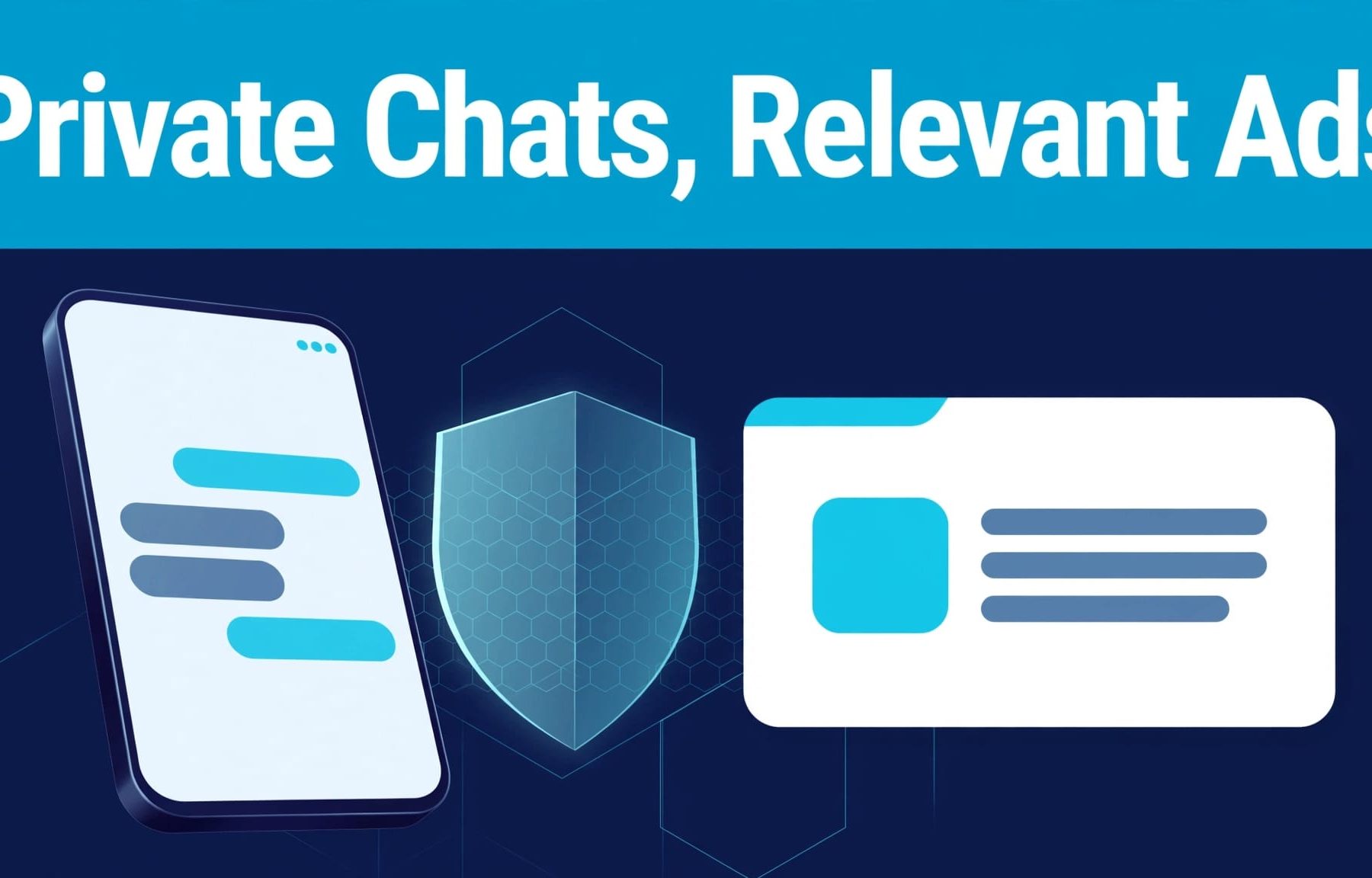
ChatGPT ads targeting can use the subject of your current conversation to show a relevant advert, but OpenAI says advertisers cannot read your private chats. That distinction matters: the platform may use context to decide whether an ad fits, while the business paying for it sees campaign results, not your prompt.
If you advertise, you need a way to reach useful buyer moments without assuming you can target exact questions. If you use ChatGPT, you deserve to know what stays private. Start with how the ad is selected.
How ChatGPT ads targeting uses conversation context
OpenAI says an advert can relate to the conversation taking place. In its initial test, the conversational assistant displayed clearly labelled ads beneath its answer in the conversational interface, separate from the response. The test doesn’t confirm every ad format, and “sponsored cards” isn’t a confirmed ChatGPT format unless current official materials use that term. OpenAI also says advertising does not influence the answer itself.
The topic can be relevant without being shared
Imagine you ask how a small consultancy could manage recurring invoices. An advert for suitable accounting software might be relevant to that task. The advertiser does not need your question, your chat history or your name to understand why that placement could work.
This is the distinction in OpenAI’s explanation of its ad test: conversations remain private from advertisers, even though the current conversation can inform ad relevance. Private from advertisers does not mean the platform ignores the conversation when choosing an advert.
An advert is separate from the answer
A sponsored placement sits outside the generated answer and carries a label. You should therefore judge an advert on its own claim and destination page, rather than treat its appearance as a recommendation from ChatGPT.
For a business, that puts more work on the creative. If your message only makes sense after the assistant has made your sales argument, it is too dependent on something you do not control.
What advertisers can and cannot learn
OpenAI says it does not share conversations with advertisers or sell customer data. Its ChatGPT ads FAQ explains eligibility, privacy and the controls available to users.
That still leaves an important distinction between an interaction inside ChatGPT and one on your own website.
Before someone clicks
An advertiser can review campaign-level delivery and performance figures, such as impressions and clicks. Those figures can show whether an advert attracts attention. They do not reveal the individual prompt that led to an impression.
You should not build a media plan around getting a list of people’s questions, reading their memory or retargeting someone because of a private chat. For the broader principle, our guide to AI ethics in PPC advertising covers why useful targeting still needs clear data boundaries.
After someone visits your site
A click changes the picture. If someone lands on your site, your analytics may record the visit, subject to its settings and applicable consent requirements. If they submit a form, you receive the details they choose to provide.
That is first-party information collected on your site, not access to their ChatGPT conversation. For a UK campaign, check your UK GDPR and PECR obligations before using non-essential tracking or passing conversion data between systems. Make your form clear about what you collect and why.
Who sees ChatGPT ads, and where?
OpenAI’s US ad test is planned to begin on 9 February 2026, according to its announced plans. Under current eligibility information, ads are intended for logged-in adults on Free and Go plan users. Plus, Pro, Business, Enterprise and Education users are excluded, as are accounts identified as belonging to under-18s.
A UK rollout is planned for August 2026. Check OpenAI’s latest official information before putting a launch date in a client plan. Eligible users won’t necessarily see an advert in every conversation.
The initial ad placement was below an answer. Check current ad formats in Ads Manager rather than assuming this is still the only option.
| Channel | Main relevance signal | What the advertiser should plan around |
|---|---|---|
| ChatGPT ads | Conversation context and conversational intent | The buyer’s problem and a suitable next step |
| Search ads | A search query and campaign settings | Keywords, search intent and the landing page |
| Social ads | Platform audience and delivery settings | Audience, creative and the offer |
The practical difference is control: broad eligibility and audience targeting settings don’t provide access to private chat data. Don’t assume conversational advertising comes with a familiar search-term report.
Plan for buyer context, not access to prompts
You cannot choose a private chat to read, but you can identify the problems your customers bring to a buying decision. Start with consumer research from sales-call notes, customer emails and questions people ask on your own site.

Write around a real task
Suppose you sell software to UK finance teams. “Accounting software” is broad. “Help a small consultancy manage recurring invoices and reconcile payments” describes a clearer task, without relying on anyone’s private details.
Use that distinction when writing your advert and landing page. Explain the problem you solve, who the offer suits and what happens after the click. A page that opens with unrelated product features makes the visitor do the matching work themselves.
Some marketers call these descriptions context hints. Treat the term with care. The official campaign setup information used here does not establish a universal targeting field by that name or an exact-match control for conversational prompts.
Keep the message and page aligned
If your advert offers help with late B2B payments, the destination page should deal with late payments. Landing page relevance matters: sending visitors to a general homepage makes it harder to tell whether a weak result came from the audience, the message or the page.
Test one message change at a time. The same discipline applies to testing Google Ads copy without wasting spend: keep the offer and conversion goal steady while you assess the wording. ChatGPT ads targeting may be context-led, but controlled creative tests still need a fair comparison.
What buying and targeting controls are confirmed?
OpenAI has confirmed cost-per-click (CPC) bidding and expanded measurement options for ChatGPT ads. Check the relevant account interface, which may be labelled OpenAI Ads Manager, for campaign objectives, budgets and creative elements. Setup information lists an ad title, copy, image, landing-page URL and available ad formats.
Those are useful starting points. They don’t justify assuming every targeting or bidding feature mentioned in an early agency guide is available to your account.
Build your forecast around verified settings
Check your account’s current options before forecasting spend. A reported average CPM describes delivery costs; it doesn’t confirm that you can buy ads on a CPM basis. Don’t budget around conversion-optimised bidding, custom audiences, country controls or a particular auction model unless your settings and terms confirm them. The same applies to a second-price auction, product feed ads, oCPC bidding and automated bidding: confirm each in your live account or current official documentation.
There is no dependable universal CPC or return on investment benchmark to substitute for your own test. A click price only becomes useful when you know how many clicks turn into qualified business.
Match the channel to the buying stage
A person researching a problem may be earlier in the journey than someone searching for a provider by name. Keep your established Google Ads activity as a demand-capture benchmark rather than moving budget on the strength of a promising click-through rate.
The same applies to Facebook Ads. For performance marketing, compare channels against the same accepted-lead and sales definitions, while recognising that their audiences may be at different stages. Track organic AI visibility separately, as it is a benchmark, not a paid targeting control.
Measure the result after the click
Ads Manager figures can show whether the campaign delivered and whether people clicked. They can’t tell you whether it created profitable demand. Set up the measurement path before you spend.
Connect ad activity to qualified leads
Tag paid destination URLs consistently, then record the source in your analytics and CRM where consent allows. Use conversion tracking to measure meaningful actions, such as a completed consultation request, rather than treating a page view as a lead.
OpenAI’s measurement materials describe conversion tools, including a browser-based pixel and a Conversions API. Check OpenAI Ads Manager to see what’s available in your account and how each event is counted. Our Google Ads conversion tracking guide explains the wider principle: a recorded conversion needs to match an action your business values.
Review Ads Manager impressions, clicks, spend and reported conversions, comparing like with like across ad formats. Consider these alongside site engagement, accepted leads, opportunities and revenue. If the sales team rejects most enquiries, a low CPC hasn’t solved your acquisition problem.
Allow for journeys you cannot see perfectly
Someone might see your advert, leave, then search for your brand days later before booking a call. Depending on your attribution model, that final visit might be credited to branded search or direct traffic. Device changes and consent choices can create further gaps.
Keep paid ChatGPT visits separate from unpaid ChatGPT referrals in your reporting. Compare results with your existing Google Ads performance measures, but don’t expect either dashboard to show every influence on a long buying journey.
Run a test that can earn more budget
Start with one clear offer, a relevant landing page and a fixed spend cap. Record your existing cost per qualified lead, opportunity rate and click-through rate first. This gives you a commercial baseline for assessing performance marketing.
During the test, check that tracking works and enquiries match the customers you want. Once those basics are sound, change one variable at a time, including ad formats only if they’re confirmed as available. Rewriting the advert, offer and page together may improve results, but you won’t know which change helped.
Keep PPC and SEO running as useful benchmarks, alongside organic AI visibility. ChatGPT activity might add demand, or take credit for people who would have found you anyway. Organic visibility alone doesn’t prove campaign incrementality. Where your volume allows, compare periods or groups carefully, then review opportunities and eventual revenue before increasing spend.
Be cautious with claims about winning industries. A good result for one retailer or software firm doesn’t predict yours. Treat brand awareness as a separate objective, not a substitute for qualified leads or revenue. Offer quality, sales cycle, landing-page relevance and measurement all affect the return you’ll see.
Key takeaways
- ChatGPT can use the current conversation as context for an advert, but OpenAI says advertisers cannot read private chats.
- Plan around buyer problems and verified account settings, not assumed access to prompts or unconfirmed targeting controls.
- Judge a pilot by qualified leads and revenue alongside clicks, while respecting consent and attribution limits.
Frequently asked questions
Can an advertiser see why I was shown an ad?
An advertiser may see campaign performance, but OpenAI says it doesn’t give advertisers your conversation. If you click and submit details on the advertiser’s website, that business can receive the information you provide there.
Do all Free and Go plan users see ads?
Not necessarily. Eligibility and availability may vary, so check OpenAI’s current official information to see whether Free and Go plan users are included.
Can you target exact ChatGPT questions like search keywords?
Don’t assume so. OpenAI says ads can be relevant to a conversation, but that doesn’t establish exact-match prompt bidding or a search-term report. Build your message around a clear customer task and verify the controls in your account.
Are ChatGPT ads cheaper than Google Ads?
There’s no reliable universal comparison. CPC alone misses lead quality and sales outcomes. Compare both channels using the same conversion definitions and a review period long enough for your customers to make a decision.
Make relevance prove its value
The useful privacy distinction is straightforward: ChatGPT may use conversational context for ad relevance, while the advertiser does not receive the private conversation. That gives you a way to plan helpful ads, not a shortcut to someone’s personal information.
If you are considering a pilot, speak to Flow20 about a Digital marketing plan that connects the advert, landing page and qualified leads before you commit more budget.