
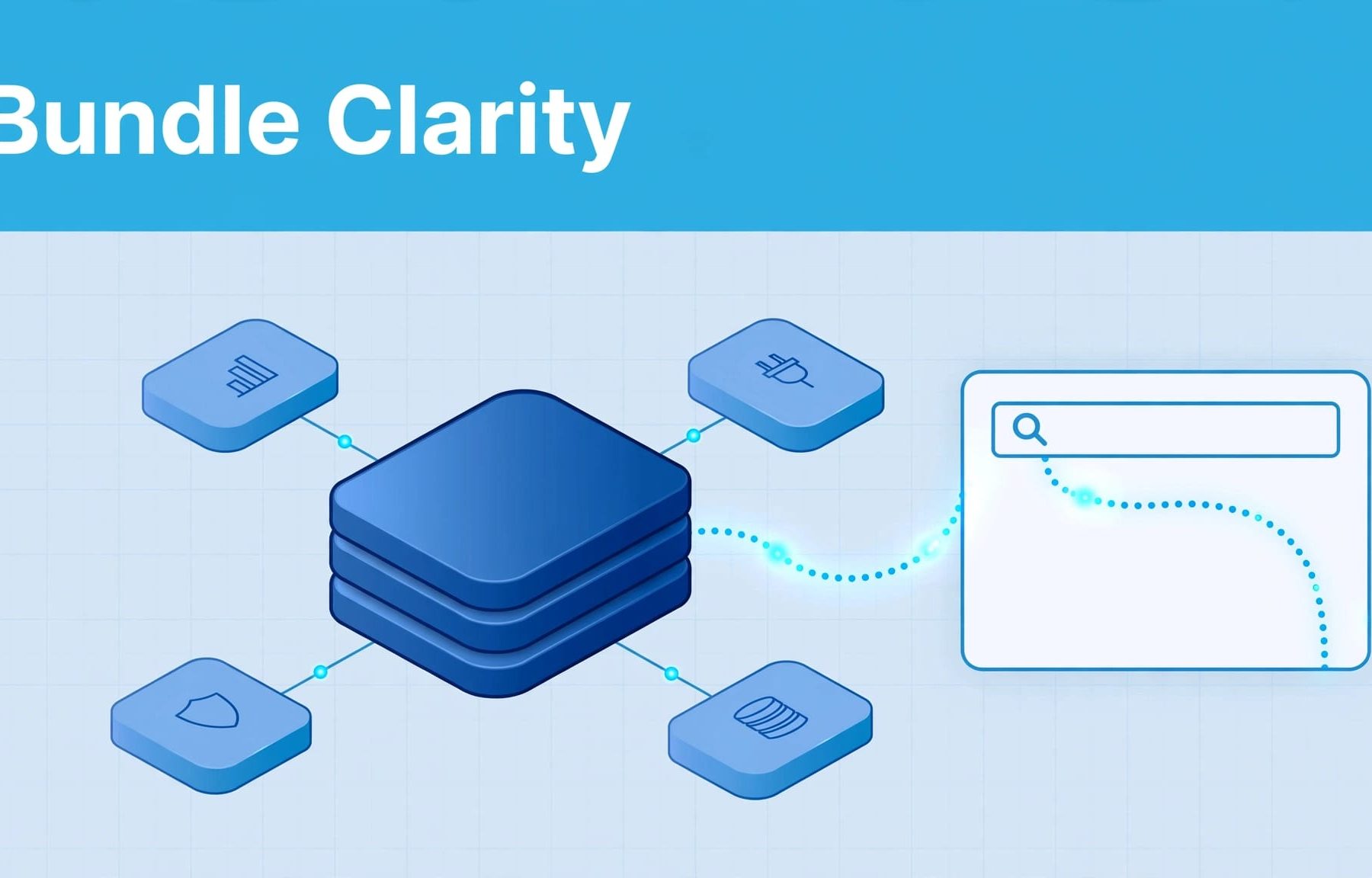
AI search retrieves information about your products, combines it with other sources and explains which package appears to fit a buyer’s requirements. Clear details on inclusions, optional extras, pricing and dependencies improve the evidence available, but accurate content doesn’t guarantee a recommendation.
Forrester’s 2026 business-buying findings draw on a 2025 survey of nearly 18,000 global business buyers. The survey found that 94% of B2B buyers use AI during purchase research. AI-driven search makes clear bundle details important before a sales conversation.
Start with the information an AI answer needs to distinguish your package from its add-ons.
Key takeaways
- Describe the core package, optional components and purchasing conditions together, so buyers can understand the complete offer.
- Keep product pages, catalogue records, feeds and structured data consistent, without treating schema as a guarantee of visibility.
- Measure whether AI answers describe your bundles accurately, then connect that visibility with qualified enquiries and pipeline.
How AI search reads your bundle
An AI search answer may combine your product page, documentation, pricing information and third-party reviews. Those sources won’t necessarily describe the same package version.

Retrieval gathers evidence about individual requirements
A buyer researching Microsoft 365 Business Premium alongside migration and ongoing support may have search intent that covers licensing, implementation and service scope. One broad package description rarely answers all three.
AI agents and search-enabled assistants can retrieve material about separate parts of a request, then combine it into one response. This is often called query fan-out, though retrieval and synthesis vary by platform.
Your B2B AI search terminology matters less than the practical consequence: each useful passage should remain understandable when retrieved separately. Include the product name and applicable conditions rather than relying on nearby headings. Product relationships and dependencies can be lost when evidence is retrieved separately.
Synthesis can lose the relationship between components
An assistant may retrieve an add-on page without its explanation that it requires a particular subscription. The resulting answer can describe the capability correctly but recommend an unsuitable configuration.
Keep the required base product, compatible editions and exclusions beside the add-on description. Repeat those conditions where they affect a buying decision.
This is also central to preparing B2B content for AI research. Include enough context in each passage for a reader or retrieval system to understand exactly what the claim applies to.
Why bundle accuracy affects your shortlist
AI-assisted vendor research can change which suppliers buyers consider during the buying journey. G2’s March 2026 original research, a survey of 1,076 B2B software buyers and decision-makers, found that 69% chose a different vendor than initially planned after AI-chatbot guidance.
The G2 survey findings also reported that one-third purchased from a vendor they hadn’t previously heard of. These findings concern software buyers, not every B2B purchasing category, but the commercial implication is clear.
Your business can enter consideration through a detailed buying question rather than a branded search. However, an AI search mention doesn’t mean your offer has been understood.
For bundles, that distinction matters. A recommendation that omits implementation charges or assumes an optional integration is included can create an enquiry based on the wrong expectations.
Treat accurate bundle descriptions as part of AI search visibility. AI visibility depends on whether your bundle is described correctly, not on how often your business is mentioned. Your sales team shouldn’t have to begin a conversation by correcting the package a buyer thinks you’ve offered.
Make inclusions and add-ons unambiguous
Start with a direct package summary. Name the core product, identify who it suits and explain what the buyer receives before introducing optional upgrades.
For each package, make these relationships visible.
| Component | What your page should explain | Commercial detail |
|---|---|---|
| Core package | Included products, features and usage limits | Billing unit and contract term |
| Optional add-on | Additional capability and eligible base packages | Separate charge or pricing basis |
| Implementation | Migration, configuration and onboarding scope | Mandatory or optional service |
| Support | Included support level and available upgrades | Hours, limits and renewal terms |
| Dependencies | Required licences, hardware or integrations | Any additional purchasing requirement |
The useful distinction is between what the buyer receives automatically and what they must select or purchase separately.
Name the eligible base package and state any separate charge for each add-on. This helps AI agents distinguish included features from paid upgrades.
For example, a software edition may include the core licence, while migration support and an integration carry separate fees. List each against the edition it applies to.
Avoid a feature table where a tick could mean either “included” or “available at extra cost”. Write those states explicitly. Where a capability requires an upgrade, name the relevant edition beside it.
An optional module can be correctly described and still produce a misleading answer if its required base licence is missing.
Show prices in pounds where you publish UK pricing. State whether VAT is included, and distinguish per-user charges from account-level fees. Explain annual commitments, minimum quantities and one-off setup costs beside the relevant amount.
For quote-only packages, publish the pricing drivers you can disclose. User numbers, implementation scope and support level are more useful than an unexplained “contact sales” button.
Keep catalogue data and schema aligned
Your website, product feed and commercial documents should describe the same offer. Conflicting records give buyers and AI systems competing versions of the truth.
Maintain a current source for each purchasable option
Give every purchasable variant a stable identifier and landing page where appropriate. Keep its name, availability, pricing basis and compatibility information current.
Separate product facts from promotional language. “Advanced reporting” doesn’t explain whether reporting is included, restricted to particular users, or sold as an additional module.
When a package changes, update related comparison pages and documentation. Keep historical announcements identifiable as historical, with a clear route to the current specification.
A B2B SEO content audit can identify old descriptions and contradictory claims before you commission more content.
Use structured data to reinforce visible facts
Product and Offer markup can describe genuine products and published commercial information. It should match what buyers can see, including prices and availability where those details are supplied.
Don’t mark a quote-only bundle as immediately purchasable or invent a price to complete a field. Keep essential information in accessible page text rather than expecting JSON-LD to replace it.
Accurate, visible product information matters for AI Overviews, and structured data doesn’t guarantee inclusion.
Google doesn’t require special schema for AI Overviews or AI Mode. AEO (answer engine optimisation) and GEO (generative engine optimisation) can guide how you present product information, but neither guarantees visibility. Other platforms have different retrieval methods, and you can’t assume they all use markup identically.
This work belongs within your SEO programme, alongside crawlability, indexability and useful page content.
Put bundle improvements into practice
You don’t need to rebuild your entire catalogue at once. Start with a commercially important package that regularly generates questions about scope or price.
- Collect the questions your sales team answers repeatedly. Prioritise whether components are included, which upgrades are required, and how the complete configuration is priced.
- Rewrite the package summary and comparison table. Put purchasing conditions beside the claims they qualify, rather than in a separate document.
- Connect the package to current add-on documentation, compatibility information and relevant customer evidence. Make those pages accessible without a login.
- Assign an owner to the offer. Give product changes a publishing process that updates the website, feeds, documentation and campaign landing pages together.
Independent evidence also deserves attention. Ahrefs’ analysis of 75,000 brands found that brand mentions correlated more strongly with AI Overview visibility, at 0.664, than backlinks did, at 0.218.
That’s an association, not proof that adding mentions causes citations. Relevant reviews and customer evidence should support accurate product claims, rather than repeat promotional wording.
Use PPC to test which package questions attract qualified demand. Search terms from Google Ads can expose gaps in your descriptions, whilst Facebook Ads enquiries can reveal where prospects misunderstand the offer. Feed those questions back into the page.
Measure accuracy alongside commercial results
A citation dashboard won’t tell you whether an assistant has confused an optional component with an included feature. Your measurement needs to cover both visibility and interpretation.
Test repeatable buyer questions
Build a small prompt set around actual sales questions. Include package comparisons, add-on requirements, implementation costs and compatibility.
Run the same questions across services your buyers use, such as ChatGPT, Perplexity, Gemini and Google AI Overviews. Record the date, platform, prompt, answer and cited sources.
Score inclusion, pricing accuracy, dependency accuracy and source quality separately. A correct brand mention with an incorrect package description shouldn’t count as an accurate recommendation.
Use AI search competitor analysis to identify whether competing suppliers are being described more clearly, rather than copying whichever page happens to receive a citation.
Connect visibility with qualified pipeline
Track AI referral traffic in your analytics, but recognise that zero-click searches can lead buyers to read an answer without visiting your site. A later branded search won’t reveal the earlier AI interaction.
Intent data can indicate buyer interest, but it doesn’t prove that AI search influenced the decision. Some research happens in the dark funnel before an enquiry.
Add a discovery question to enquiry forms or sales conversations, then retain that answer in your CRM. Connect enquiries with sales acceptance, opportunity value and closed revenue.
Use multi-touch attribution to connect available discovery information with CRM and revenue data. Don’t assign precise revenue credit to AI mentions unless the buying history supports it.
Keep platform results separate and review changes over time. Citation rate and answer accuracy are useful diagnostic measures; qualified opportunities show whether the work supports your commercial goals.
Frequently Asked Questions
How does AI search handle B2B product bundles?
AI search can combine information from product pages, documentation, pricing pages and third-party reviews. It may retrieve details about separate parts of a buyer’s request, but can lose the relationship between an add-on and its required base package.
What should a bundle page say about add-ons?
Name the eligible base package and state whether each component is included, optional or separately charged. Explain any dependencies, usage limits and purchasing conditions beside the relevant product details.
Does structured data guarantee visibility in AI search?
No. Product and Offer markup should match the information buyers can see on the page, but accurate structured data doesn’t guarantee inclusion in AI Overviews or other platforms.
How can you measure whether AI search describes a bundle accurately?
Test repeatable buyer questions across the services your buyers use, and score inclusion, pricing, dependency accuracy and source quality separately. Connect available referral and enquiry data with sales acceptance, opportunity value and closed revenue.
Start with the bundle buyers ask about most
Your most useful first step is to make one important package understandable without a sales explanation. Clarify what it includes, what costs extra and which conditions affect the purchase.
Then test whether AI answers preserve those distinctions. Accurate interpretation is a better starting point than chasing mentions alone.
Digital marketing works better when your product information and lead-generation activity agree. Speak to us about improving the package pages behind your next qualified enquiry.