

Claude can help prospective buyers compare suppliers, check claims and pull together market evidence, but only if your content provides clear, current and verifiable material. To prepare for this kind of AI-assisted research, publish direct answers, separate proof from opinion, name the source behind each claim and keep important pages up to date.
This isn’t about chasing a secret ranking formula. Claude has no publicly confirmed content-ranking system for B2B websites. It’s about making your expertise easier to retrieve, assess and explain when a buyer asks a detailed question.
How B2B teams use Claude for research
“Claude research” is useful shorthand for a buyer using Claude to investigate a problem, compare suppliers or check implementation details. Anthropic describes Research capabilities that can search the web, Google Workspace and connected integrations to complete more complex tasks through its multi-agent research system.
That changes the standard for a B2B page. A vague line such as “we improve lead quality” gives little to work with. A page explaining that you manage search terms, conversion tracking and wasted spend for B2B firms gives a clearer, more useful answer.
Claude Science is a separate AI workbench for scientific research, such as computational biology and analysing protein structures. Its research environment may draw on scientific databases and academic research, which use different evidence standards from B2B supplier research. It may matter to life-science businesses and technical teams, but it is not a shortcut for making a service page more credible. Most B2B marketers need stronger public source material before they need a specialist setup for deep research.
A cited page is not automatically a good lead-generation page. It still needs to answer the buyer’s question and give them a sensible next step.
Build source pages that a model can check
Your best commercial pages should work as reliable source documents, not broad brand statements. Start with services, case studies, pricing explanations, implementation pages, sector pages and FAQs that address common buying objections.
Put the direct answer near the top
Open each page with who you help, what you do and the problem you solve. If you run paid search for B2B firms, say that early. Don’t make a prospective client scroll through a long introduction to find it.
A good service page can state the audience, explain the process, show what’s included and set expectations. That structure supports readers, traditional search and AI-assisted research without turning the page into robotic copy.
Use AI content briefs to collect sales-call language, CRM notes, customer interviews and recurring objections before you write. These are the inputs your competitors can’t easily copy.
Separate claims from proof
Every important claim should have a home. Add the supporting case study, source, methodology, date or limitation beside it where practical. A named source, date, methodology and limitation give evidence synthesis a stronger basis than an unsupported marketing statement.
For example, “reduced wasted Google Ads spend” is a claim. Make it stronger by recording the account type, work completed, review period, baseline and metric. Note any limitation too, so sales teams can support the claim later. Avoid publishing rounded promises without this context.

Traditional SEO and AI-assisted research are different jobs
Traditional SEO helps a relevant page rank for a search query. AI-assisted research also asks whether that page is clear enough to retrieve, compare and cite in an answer. The foundations are shared, but the measures differ. A sound research process matches intent, source quality, structure and proof.
Rankings do not guarantee citations
A first-page position may improve discovery, but it doesn’t guarantee that Claude will mention your business for every prompt. AI-assisted research can involve evidence synthesis across several pages, review sites, public documentation and specialist resources, creating citation grounded answers when sources are clear and identifiable.
That is why your SEO work still matters. Crawlable pages, sensible internal linking, accurate titles and matching search intent give systems a stable source to find. Clear explanations and first-hand proof give them something worth using.
Write for buyer questions, not keyword repetition
Keywords still show relevance, especially in titles, headings and opening copy. However, a buyer may ask a longer question: “Which London agency can reduce wasted B2B Google Ads spend without lowering lead quality?”
A deep research answer may assemble information from several sources to address that question. It needs more than one exact-match phrase. It needs evidence about your process, your client fit and your limits. A B2B SEO content audit can identify pages that receive traffic but fail to provide this commercial detail.
Create a practical Claude research workflow
Treat the work as a structured review process. Give it approved inputs, a narrow question and an output format that makes weak evidence obvious.
Start with a bounded question
“Research our market” is too broad. A bounded question makes deep research more useful for a specific decision, such as: “Compare the main UK B2B PPC agency selection criteria for a SaaS business spending £8,000 per month.”
Then provide the pages, documents and facts that Claude may use. State what must not be assumed, including pricing, legal claims, client names and performance figures.
Anthropic’s tool-use documentation shows how tools can return cited results. Citations help trace an answer, but you should still open each source and check its context.
Request evidence, gaps and contradictions
For better evidence synthesis, ask for an evidence table before requesting conclusions. The table and source register create reproducible artifacts that another team member can review.
| Research step | What you provide | What you ask Claude to return |
|---|---|---|
| Define the question | Buyer type, market, decision and exclusions | Clear scope, assumptions and exclusions |
| Supply approved sources | Service pages, case studies and documents | Claims linked to their source |
| Check evidence | Competitor pages and buyer questions | Missing proof, unclear wording and contradictions |
| Check freshness | Publication dates, review dates and current facts | Outdated claims and sources needing review |
| Review the result | Sales feedback and CRM outcomes | Prioritised page improvements and open questions |
| Approve the output | Evidence table and source register | Human review notes and final sign-off |
Save this structure as repeatable research workflows for supplier comparisons or content-gap analysis. A multi-agent research setup can divide collection, comparison and gap analysis into separate tasks, but each task still needs the same source controls.
The same approach can improve campaign planning. Use PPC and Google Ads search-term data to test which messages bring serious enquiries. Feed the findings back into the pages buyers may later research.
Choose the technical setup that fits the job
Most content teams don’t need to build agents on day one. A well-organised source pack, sensible prompts and human review are usually more useful than a complicated technical project.
Use connected systems when the information is controlled
The Model Context Protocol, usually called MCP, is an open standard for connecting AI systems with external tools and data sources. Anthropic explains how MCP supports agent connections, including access to business tools, repositories and APIs.
For a B2B team, MCP can make sense when approved material sits across CRM, product documentation, analytics tools and content-library data pipelines. It needs permissions, source ownership and clear boundaries. Don’t connect sensitive data simply because the integration is available.
Build custom agent workflows only when scale justifies it
A custom Claude Agent SDK workflow can split large research jobs into smaller tasks. A recurring multi-agent research process might collect competitor claims, check sources and compare evidence. This suits research workflows that run at meaningful scale, with reproducible artifacts saved for later review.
It also adds cloud compute, token costs, testing and maintenance. Compute orchestration makes tools, permissions and repeatable tasks harder to manage. Claude Code can support development, but it doesn’t guarantee research quality. Anthropic’s guidance on writing effective agent tools reinforces this: tool quality and evaluation matter as much as the model itself. For many teams, a disciplined content process beats a DIY multi-agent build.
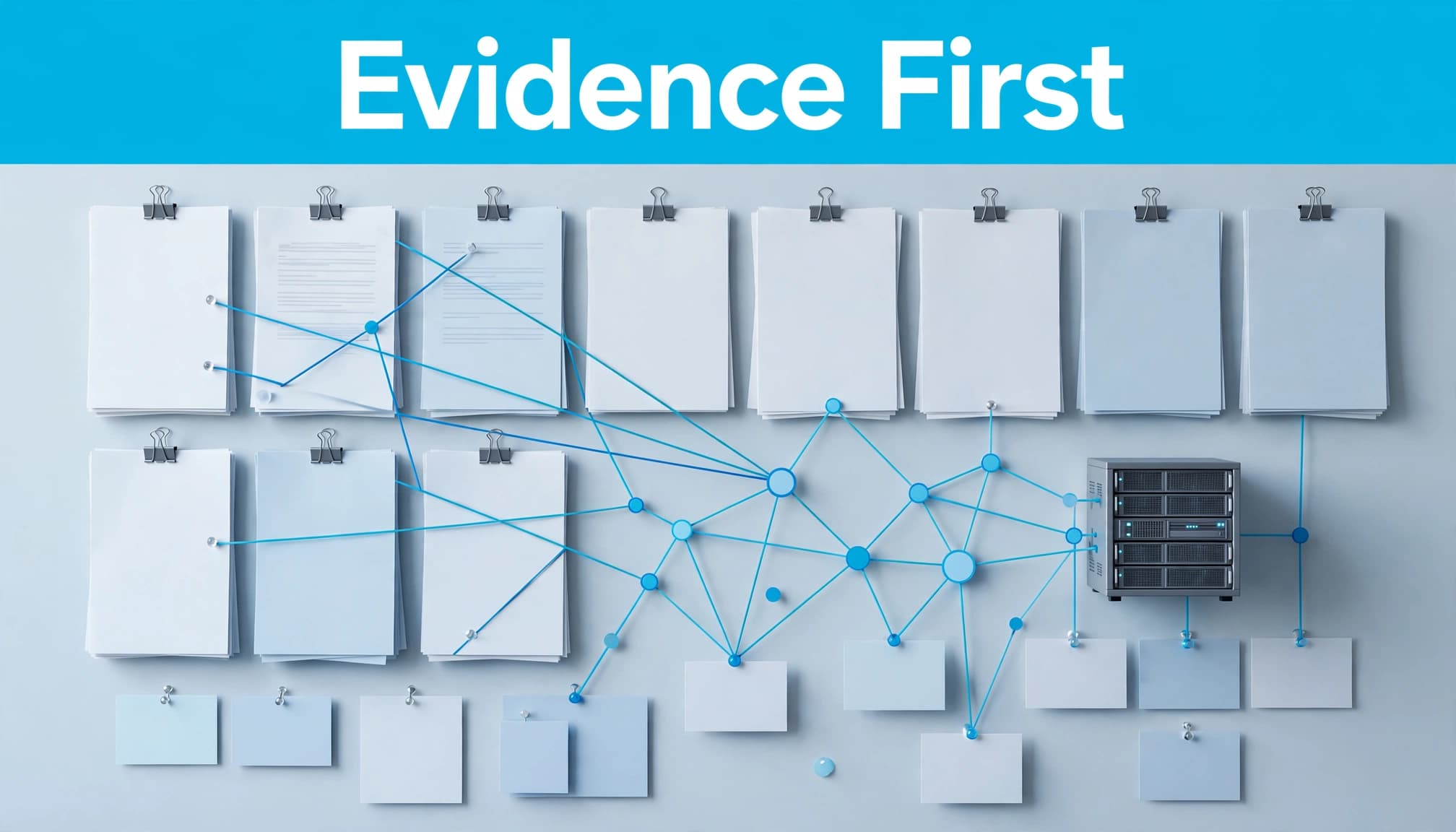
Put governance around claims, access and updates
AI can surface an old price, retired service or unsupported statistic at speed. That is useful feedback, but only if someone owns the correction.
A general hallucination rate won’t tell you whether a specific claim or source is reliable. Check the evidence directly and record the decision.
Give each important source an owner
Assign a named owner, review date, evidence status and access level to every priority page. Record the source date and next review action in reproducible artifacts, such as dated evidence logs, approval notes and research outputs. Your team should know whether a statistic is approved, whether a case study is still current and who can change it.
Avoid sharing individual subscriptions casually between friends or colleagues. Use the plan, team and administrator controls that match your organisation’s needs, particularly where client data or internal research is involved.
Measure commercial outcomes, not mentions alone
Track AI visibility as a useful signal, not proof of revenue. Compare it with qualified enquiries, sales opportunities, pipeline value and closed revenue.
Your AI search reporting should also account for other activity. A rise in branded demand may follow paid media, PR, pricing changes or stronger sales follow-up. Don’t give Claude research credit without evidence.
Key takeaways
- Build B2B pages around direct answers, clear scope and proof that buyers can check.
- Keep claims, sources, dates and ownership visible on commercially important content.
- Use Claude to organise research and expose gaps, not to approve facts on its own.
- Keep traditional SEO strong because accessible, useful pages remain the base material for AI-assisted research.
- Judge success through qualified leads and pipeline, not citations alone.
Frequently asked questions
Can Claude be used for academic research?
Yes, Claude can support scientific research when reliable sources and human validation guide the work. For a deep research task, it can help organise material from scientific databases and screen literature for systematic reviews. However, evidence synthesis still requires checked citations, source context and a documented methodology. Claude Science supports scientific and compute-heavy work, but it doesn’t replace expert review or methodological judgement.
What is the difference between MCP and a custom research architecture?
MCP is a standard way to connect Claude with approved tools and data sources. A custom architecture uses your own logic, often with the Claude Agent SDK, to run repeatable, multi-step work. Start with MCP or a simple source pack unless your research volume and complexity justify custom development.
How should a B2B team check Claude research outputs?
Check each important statement against its source, confirm dates and figures, and ask subject specialists to review regulated, financial or technical claims. You can use Facebook Ads and paid-search tests to assess message relevance, but judge success by lead quality rather than cheap conversions.
Make your expertise easier to trust
AI-assisted research works best when your content is honest about what you do, who you help and what the evidence shows. Strong pages don’t try to impress a model. They make it easier for a real buyer to understand your offer and make a decision.
If you want content, paid media and search activity to support better B2B enquiries, Flow20 can build a practical Digital marketing plan around the evidence your buyers need.