
Last Updated: 10/08/2026
Getting new content to rank well in Google comes down to a handful of habits, done consistently. Research the words your customers actually type into a search bar. Structure your pages so both readers and search engines can follow them. Link your own content together sensibly. Keep publishing fresh material on a schedule you can actually stick to.
None of this is complicated, but it is easy to let slip when you are busy running a business rather than marketing one. This guide walks through the practical steps for optimising your web content, from checking your current visibility right through to earning the kind of backlinks Google trusts. Google still handles roughly nine in ten UK searches, according to Statcounter, so everything below is written with that reality in mind.
Start By Checking Where You Already Rank
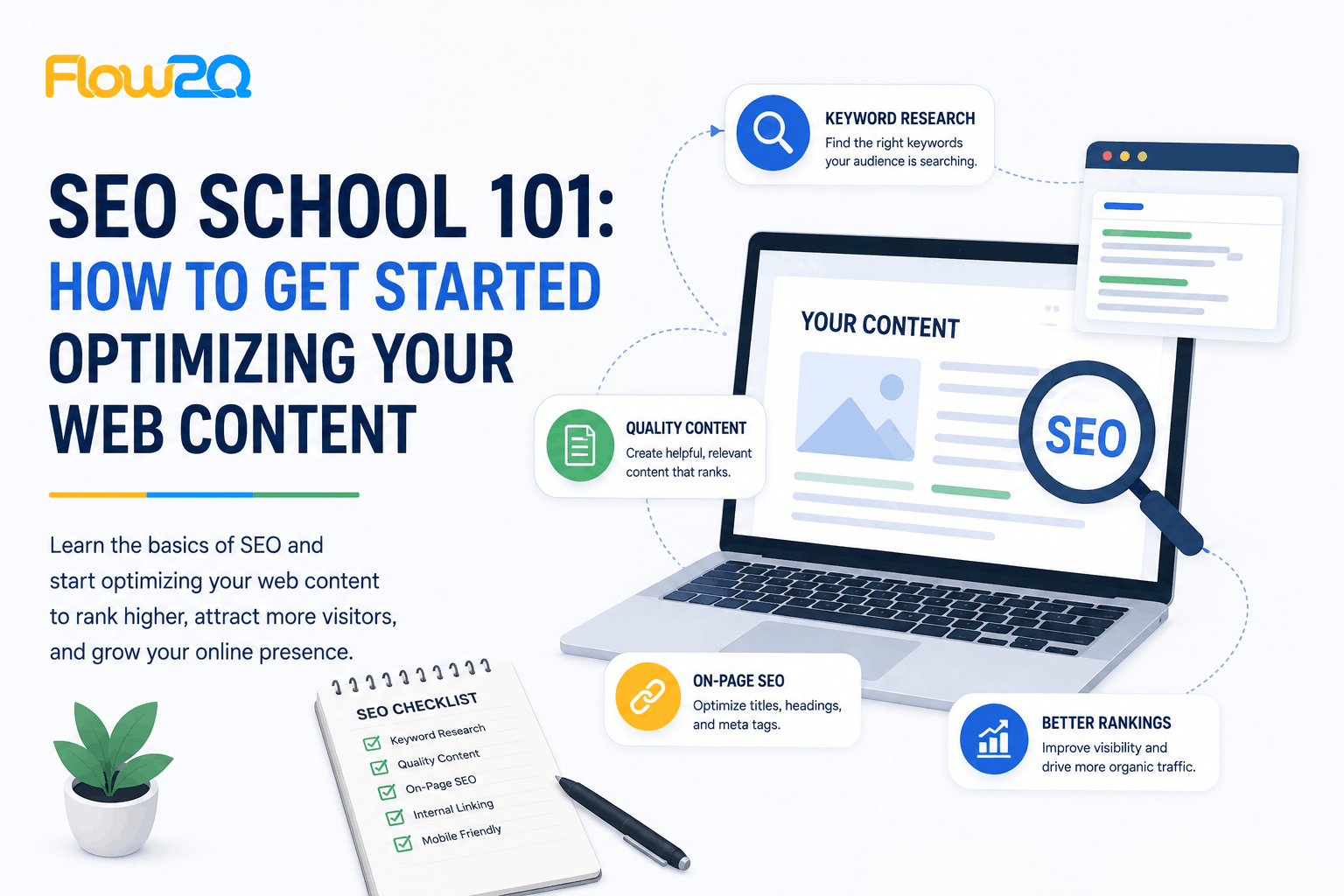
Before you write a single new page, search your own brand name. If your website has been live for more than a few months, you should already sit at the top of page one for it. If you do not, something more fundamental than content is going wrong, and it is worth sorting that out first. We once onboarded a client whose own company name pulled up a directory listing above their actual homepage. Fixing that took an afternoon, and it mattered more to their enquiries than any blog post published that quarter.
Once your branded search is sorted, the real work starts. Most of your traffic will come from people who have never heard of you, searching for the problem you solve rather than your name. That is where the rest of this guide is aimed, and it is also the subject we cover in more depth in our piece on why search engine optimisation matters for a growing business.
Build A List Of Keywords Your Customers Actually Search For
Write down the terms you think a customer would use to find you, then check them against real search data rather than guesswork. Google Keyword Planner is a reasonable free starting point, and Google’s own SEO starter guide is worth reading once in full, since it explains how their systems interpret content in the first place. You will often find the phrasing people actually use is more casual, more specific, or just different from what you assumed inside your own business.
Do not chase every keyword you find. Prioritise the ones with genuine buying intent over the ones with the biggest search volume, since a smaller audience that is ready to purchase beats a large one that is only browsing. If keyword research feels like a full time job on top of your actual job, it is worth reading our thoughts on whether SEO is something you can realistically manage yourself, or looking into our SEO services if you would rather hand the research over. Reddit threads are also an underused source here, and we have written before about using Reddit for keyword research to find the exact language your audience uses when nobody is trying to sell them anything.
Whatever you find, do not let the keyword take over the sentence. Content stuffed with a phrase repeated unnaturally reads badly and Google can tell the difference between writing for people and writing for a crawler.
Link Your Own Content Together Properly
Internal linking is one of the simplest SEO habits and one of the most commonly ignored. Every time you publish something new, look back through your older content for a natural place to link to it, and vice versa. This does two things. It helps visitors find more of what they came for, and it helps Google understand which pages on your site you consider most important. We go into this properly in our guide to link building strategies that actually move the needle.
Use anchor text that describes the destination page rather than generic phrases like click here. A link reading local SEO strategies tells both the reader and Google far more than a link reading read more. It is worth doing this sparingly rather than on every second sentence though, since a page dense with links reads as spammy and pulls attention away from the point you are making. If you are curious why other sites bother linking to you at all, our article on whether backlinks are still important for SEO covers the reasoning, and if your existing posts are not pulling their weight, this piece on getting more readers to your blog is a good next stop.

Keep Your Site Structure Simple To Navigate
A clear, shallow site structure beats a clever one every time. Ideally, any page on your website should be reachable within three clicks from the homepage. Bury your best content five folders deep and neither your visitors nor Google’s crawlers will bother finding it. An up to date sitemap, submitted through Google Search Console, helps make sure nothing important gets missed during crawling.
This matters just as much for smaller, regional sites. If you run a business serving one town or postcode rather than the whole of the UK, structure and internal links become even more important, since you are relying on a narrower set of pages to do the work. We cover this in our guide to local SEO strategies for smaller businesses, and our piece on how to actually get onto page one of Google ties structure back into ranking directly.
Use Search Friendly URLs
Your URL is one of the first things both a reader and a search engine sees, so make it count. A URL like flow20.com/blog/seo-basics-content tells you exactly what is on the page. A URL full of random numbers and characters tells you nothing. Keep URLs short, use hyphens rather than underscores between words, and include your target phrase once if it fits naturally. Do not go back and change URLs on pages that already rank well, since that can lose the equity they have already built up. Some habits from older SEO advice have not aged well either, and it is worth a read through our list of outdated SEO techniques you should avoid before you commit to a strategy built on advice from a decade ago.
Avoid Formats Search Engines Struggle To Read
Flash is long dead, but the same underlying problem still catches people out with modern tools. Content locked inside a heavy JavaScript widget, an embedded PDF, or an image containing text that nobody typed as actual text is invisible to a search engine, no matter how good it looks to a human. If a customer needs to read your pricing or your product details, put it in the page as real text. This trips up ecommerce sites constantly, and it is a big part of what we cover in our guide to SEO tips for ecommerce websites, along with the more unusual question of whether SEO can be done without a website at all.
Write Proper Alt Text For Every Image
Google’s crawlers cannot see an image the way you can, so alt text is how you describe it. Write a short, honest description of what is actually in the picture, and include a relevant keyword only where it fits naturally, never forced. A photo of a red leather sofa should have alt text that says exactly that, not a paragraph of unrelated keywords hoping to catch extra traffic. This also matters for accessibility, since screen readers rely on the same alt text to describe your page to visually impaired visitors, which is reason enough on its own to get it right.
Publish Blog Content On A Regular Schedule
A blog that gets updated is a signal that your business is active and worth crawling more often. It does not need to be daily. One well researched, genuinely useful post a fortnight will outperform four rushed ones a week, almost every time. Set a realistic schedule and stick to it rather than publishing in bursts and going quiet for months. If you are wondering whether the effort is worth it against other channels, our article on why digital marketing keeps growing as an industry puts the investment into context, and our broader piece on the three things to focus on for SEO results is a good sense check before you plan a content calendar.
Build Backlinks And A Presence Beyond Your Own Site
Once your own site is in order, look outward. A mention or link from a genuinely relevant, reputable website tells Google that other people vouch for your content, and it still carries real weight. Guest posts, press coverage, and partnerships with complementary businesses all count here, provided the sites involved are ones you would be happy to be associated with publicly.
Social media will not directly boost your rankings the way a backlink does, but an active presence on the right platforms puts your content in front of people who then link to it themselves, which is where the real SEO benefit comes from. For B2B businesses, this often means a properly run LinkedIn advertising campaign in London that gets your content circulating among the right audience. For consumer businesses, a Facebook ads agency in London or a well targeted Google Ads agency in London can both drive that same kind of visibility while paid campaigns run alongside your organic efforts.
On Page SEO Checklist At A Glance
| Area | What to check | Why it matters |
| Branded search | You rank first for your own business name | Confirms there are no basic indexing issues |
| Keywords | Content matches real search terms, not guesswork | Attracts visitors actively looking for what you offer |
| Internal links | New posts link to older, relevant pages | Spreads authority and keeps visitors on site longer |
| Site structure | Every page is reachable within three clicks | Makes crawling and browsing easier |
| URLs | Short, readable, and hyphenated | Clearer for both users and search engines |
| Media and images | Real text content plus written alt text | Ensures content is actually crawlable and accessible |
| Publishing schedule | Consistent, realistic frequency | Signals an active, well maintained website |
| Backlinks | Earned from relevant, reputable sites | Builds trust and domain authority over time |
Frequently Asked Questions
How long does it take for new content to rank in Google?
Most UK businesses see meaningful movement somewhere between three and six months, though this varies enormously by how competitive your industry is and how established your domain already is. Treat anything promising overnight results with suspicion.
How often should you update old blog content?
A review every six to twelve months is a sensible default. Refresh outdated statistics, fix broken links, and expand any sections that were thin the first time round. Old content that still ranks reasonably well is often cheaper to improve than new content is to build from scratch.
Do you need to hire an agency to do SEO properly?
Not necessarily, particularly for a small site with modest goals. It does become harder to justify the time as your site and competition grow, at which point outsourcing tends to pay for itself.
How many words should an SEO blog post be?
There is no magic number. Most content that reaches page one in the UK covers its topic thoroughly rather than hitting a specific word count, so write until you have genuinely answered the question and stop there.
Get Your Content Working Harder
Optimising your web content is not a one off task you finish and forget. It is a set of habits, repeated consistently over months, that compound into real visibility. Start with the fundamentals covered here, measure what changes, and adjust as you go.
If you would rather have a specialist team handle it while you focus on running the business, get in touch with Flow20 as a PPC marketing agency and SEO partner and we will talk you through where your current content stands and what would move the needle fastest.




2 Comments
[…] of these files replace the others. If your structured data and schema markup is already solid, llms.txt is simply another layer on top, not a substitute for […]
[…] starting from scratch should read our SEO School 101 guide first, then review which SEO techniques should be avoided, since some link shortcuts do more harm […]