
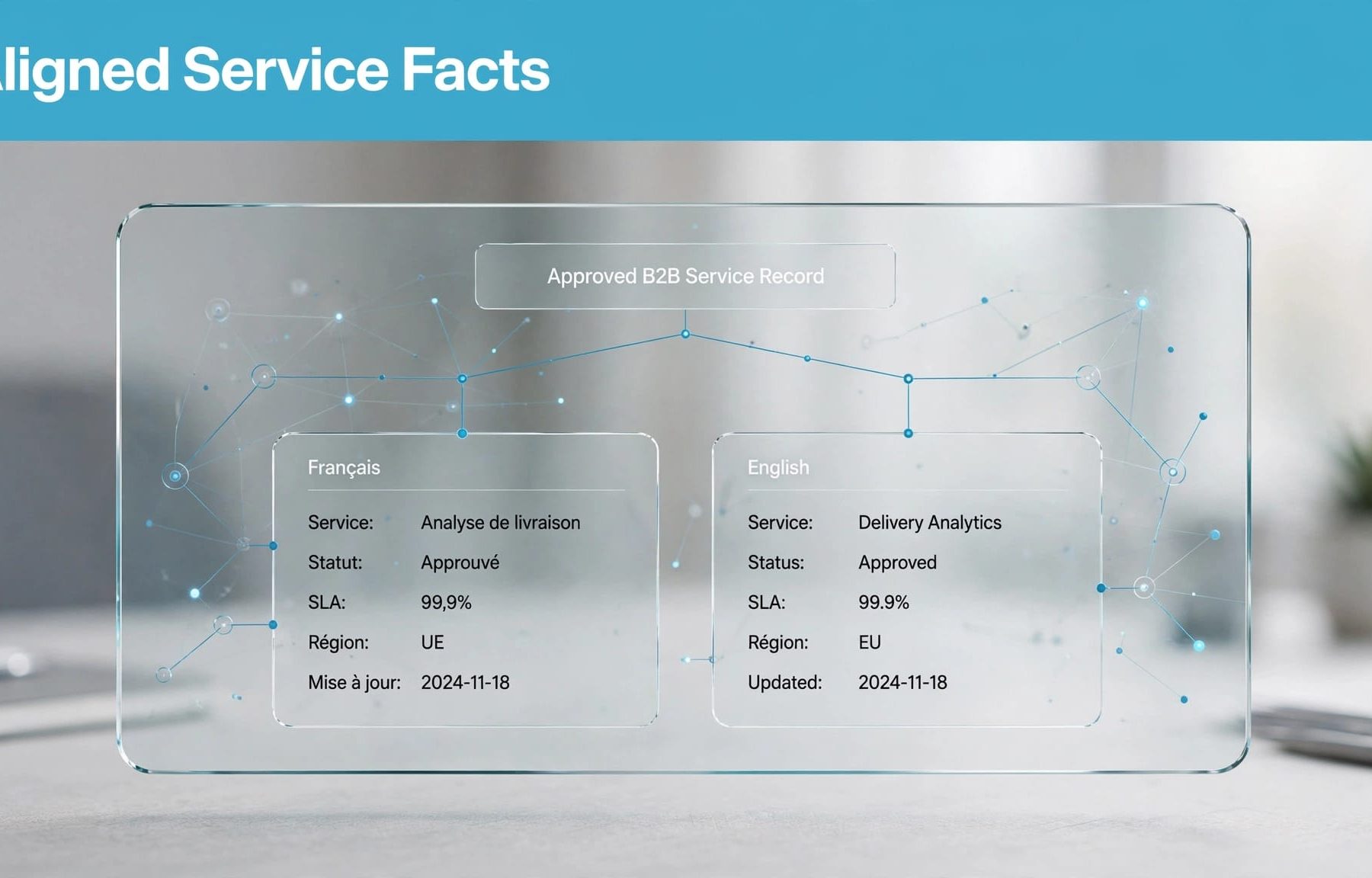
Your French service page shouldn’t promise more than your UK team can deliver. For multilingual AIO, keep one approved record of service facts, preserve its meaning across translations, and review every language version when your offer changes.
If your pricing, delivery scope or support conditions differ between pages, buyers have to work out which version to trust. Start by separating the facts that must stay consistent from the wording that should change for each market.
What multilingual AIO means for service facts
Multilingual AIO applies artificial intelligence optimisation across your language versions. Your aim is to make accurate service information easier for buyers and AI search systems to understand.

Give buyers a consistent description
Your prospects can ask Google AI Overviews, ChatGPT search or Perplexity about supplier suitability before visiting your website. They may encounter information drawn from different pages and sources.
That makes consistency a practical sales issue. If your English page describes implementation support whilst another version implies ongoing managed support, you risk attracting enquiries for work you don’t provide. Your translated pages should describe the same approved offer, with market-specific differences clearly identified.
Keep AI optimisation connected to SEO
Google’s guidance on AI features says supporting pages must be indexed and eligible for a Search snippet. There are no additional technical requirements for AI Overviews or AI Mode, and eligibility doesn’t guarantee selection.
You don’t need a separate set of AI-only service pages. Keep your content preparation for AI search focused on direct answers, accessible information and evidence that supports your claims.
Build one approved record of service facts
Start with the information your sales and delivery teams already approve. Your translation team needs a reliable reference, rather than several competing documents labelled “final”.
Give each service a stable internal identifier. Record its approved facts, supporting evidence, responsible owner and review date. This is an operational record, separate from a page’s canonical URL.
Use the following fields to define what translators can change.
| Service detail | What you should preserve | What you can localise |
|---|---|---|
| Service scope | Deliverables, exclusions and dependencies | Terminology and explanation |
| Availability | Supported markets and delivery restrictions | Local contact instructions |
| Pricing | Charging model, currency and tax treatment | Number formatting |
| Support | Hours, time zone and response commitments | Local time equivalents |
| Credentials | Legal entity, certification scope and validity | Supporting explanation |
| Evidence | Approved results, dates and conditions | Context for local buyers |
The distinction matters because a fluent translation can still alter a commercial commitment. A response target, for example, shouldn’t become a guaranteed resolution time.
Use a B2B SEO content audit to identify pages containing these facts. Include downloadable proposals, brochures and service FAQs, not just your main navigation pages.
Prioritise details that affect buying decisions. A minor wording difference rarely deserves the same attention as an incorrect price or unsupported compliance claim.
Localise wording without changing your offer
You want each page to sound natural in its market. That requires editorial judgement, but it shouldn’t give translators permission to broaden your service.
Protect conditions and qualifications
Keep the conditions attached to every claim. Phrases such as “subject to discovery”, “during UK business hours” and “for supported integrations” affect what buyers can reasonably expect.
For Salesforce integration services, distinguish implementation, migration and ongoing administration if your offer treats them separately. Translating all three as general “support” loses information your buyer needs.
A glossary helps you maintain approved meanings for service names, technical terms and contractual language. Give translators the definition and context, rather than a word-for-word replacement alone.
Document genuine market differences
Consistency doesn’t mean every country receives an identical offer. You may have different support arrangements, contract terms or delivery coverage.
Record those differences as approved market-specific facts. Don’t let them emerge through translation edits that nobody in delivery has reviewed.
Google’s multilingual website guidance recommends separate URLs for different language versions. Use those pages to explain the relevant offer clearly, including any regional restrictions.
Don’t assume the language identifies the market. A French-language buyer may be outside France, so country-specific commitments need an explicit location.
Build a multilingual service-fact workflow
Your source page will change. The practical question is whether you can identify every affected translation before buyers encounter conflicting information.

Trigger reviews when approved facts change
Connect your service records to the pages that use them. When a service owner changes an inclusion, restriction or support commitment, flag the affected language versions for review.
A shared register can work for a smaller website. At greater scale, you can manage these relationships through your CMS or translation management system.
Keep change instructions precise. “Update the support hours and time zone” gives your reviewer a clearer task than “refresh the page”. Review related PDFs and structured data within the same change request.
Review meaning before publication
Use a fluent language reviewer alongside someone who understands the service. One checks whether the wording reads naturally; the other checks whether it describes work you can deliver.
Automated comparison can flag changed numbers, currencies, names and missing qualifiers. Treat those flags as prompts for review, not proof of accuracy.
Apply the same checks to long-form content for AI search, where service claims may sit inside detailed explanations.
Record who approved the change and which source version they checked. That makes later disagreements easier to resolve.
Use hreflang to connect language versions
Your content workflow controls meaning. Your technical setup helps Google identify the relationships between localised pages.
Google documents three equivalent methods for declaring alternate versions: HTML annotations, HTTP headers and an XML sitemap. Choose an approach your team can maintain reliably.
According to Google’s localised-page documentation, each version should reference itself and the other versions in its set. Use fully qualified URLs and reciprocal annotations.
Keep these relationships within your wider international SEO strategy. They should reflect genuine page equivalents, rather than linking every translated page to a general country homepage.
Hreflang doesn’t validate your translation or reconcile conflicting service claims. Google also determines page language algorithmically, rather than using hreflang or the HTML lang attribute for that purpose.
A correct hreflang implementation can connect two pages that still disagree about your service.
Check indexing, canonical signals and language annotations after migrations or template changes. Your technical SEO checks should also confirm that the page remains accessible.
Where you use structured data, keep it aligned with visible service information. Markup containing an older offer creates another discrepancy to maintain; it doesn’t override what buyers can read.
Keep every buyer-facing source aligned
Your translated service pages are only part of the information buyers encounter. Review company profiles, partner listings, brochures and public documentation whenever important service facts change.
Start with your B2B About page. Your legal identity, locations and service descriptions should agree with your service pages and relevant business profiles.
Pay particular attention to older PDFs. A dated brochure may still describe a retired package or support arrangement. Update material you control and make historical documents clearly identifiable.
Your paid campaigns need the same discipline. If PPC messaging advertises a package that has changed, the landing page correction alone won’t resolve the mismatch.
Review translated Google Ads copy against the approved offer. For Facebook Ads, check retargeting messages and linked landing pages too.
These checks also expose gaps in explanation. If prospects repeatedly ask whether onboarding is included, your page probably needs a clearer answer, even when every translation is technically accurate.
For third-party information you can’t edit directly, request a correction and keep a record. You can improve the evidence available without controlling which source an AI system selects.
Test accuracy alongside qualified enquiries
Check multilingual AIO against buyer questions, not just translated keyword lists. Start with questions your sales team already answers about suitability, implementation, restrictions and ongoing support.
Have a fluent reviewer express the same buying intent in each language. A literal translation of the English prompt may miss how buyers ask the question locally.
Use a small, stable prompt set across the platforms your audience uses. Record the date, exact wording, market context, brand mentions, cited sources and factual errors.
Compare each answer with your approved service record. If an answer cites an outdated directory, address that source where possible. If it misreads your page, examine whether the conditions are clear and close to the claim.
Repeat your benchmark monthly, and run targeted checks after material service changes. One answer on one afternoon isn’t a reliable performance trend.
Keep accuracy and commercial performance separate. An accurate citation doesn’t prove that a prospect visited your website, submitted an enquiry or became a customer.
Track identifiable referrals, qualified enquiries and sales outcomes alongside observed visibility. Ask prospects how they found you, whilst recognising that recall won’t capture every touchpoint.
Keep this work inside your SEO programme. Use the findings to improve pages and lead qualification, rather than treating an AI visibility score as the result.
Start with your next service update
Your translations need a shared factual reference, clear ownership and a review process that follows changes across markets. Those controls help you reduce conflicting claims without making every language version sound identical.
Choose one commercially important service and compare its live pages against your approved offer. Resolve discrepancies before extending the process across your website.
If you need support connecting this work with acquisition and qualified leads, speak to Flow20 about your Digital marketing priorities.