

You can automate a large share of PPC work, but you cannot hand over your budget and expect artificial intelligence to understand your commercial priorities. While machine learning can adjust bids faster than any person, it does not know when your sales team is at capacity or when a new offer will negatively impact your margins.
The strongest results come when you treat PPC automation as a decision support system, not a replacement for your own judgement and strategy. Your primary task is to provide the system with clean data, clear goals, and firm boundaries.
Key Takeaways
- AI delivers strong results when it has access to large volumes of reliable conversion data to inform its decision-making.
- Relying on automated bidding, efficient budget pacing and continuous creative testing can save significant time while uncovering hidden performance patterns.
- Inaccurate tracking causes PPC automation tools to optimise for the wrong outcomes, potentially wasting your advertising spend.
- Human judgement remains essential for managing offers, profit margins, brand safety and the conversion rate of your landing pages.
- Running controlled tests is far safer and more effective than switching an entire account to full automation overnight.
Full PPC Automation Is Possible in Theory, Risky in Practice
PPC automation is a concept that is possible in theory, yet risky in practice. Google Ads, Microsoft Advertising, Meta and Amazon all offer tools that promise more efficient campaign management. Google Performance Max, for example, allows you to manage multi-channel campaigns by distributing budget across Search, Shopping, YouTube, Display, Discover, Gmail and Maps. AI Max for Search can widen query matching, create text assets and select a landing page automatically.
These systems use sophisticated machine learning to process signals that would take a person days to review. They can spot patterns in device, time, location, audience behaviour and conversion likelihood within minutes. Meta’s Advantage+ campaigns go further by testing automated audience targeting and creative combinations at scale.
However, full automation means giving the platform freedom to decide where money goes. That freedom has a cost. You may receive fewer details about the precise searches, placements and audience segments behind each result.
A useful PPC overview for business owners can help you separate the basic mechanics of paid advertising from the newer AI features layered on top. Automation changes how campaigns are run, but it does not remove the commercial decisions behind them.
AI can pursue the goal you give it. It cannot decide whether that goal is the right one for your business.
For example, if you optimise solely for form fills, an algorithm may find cheap leads that never answer the phone. If you import qualified lead and sales data from your CRM, it has a far better signal to follow. The quality of your conversion data sets the ceiling for automated performance.
What AI Gets Right in PPC Automation
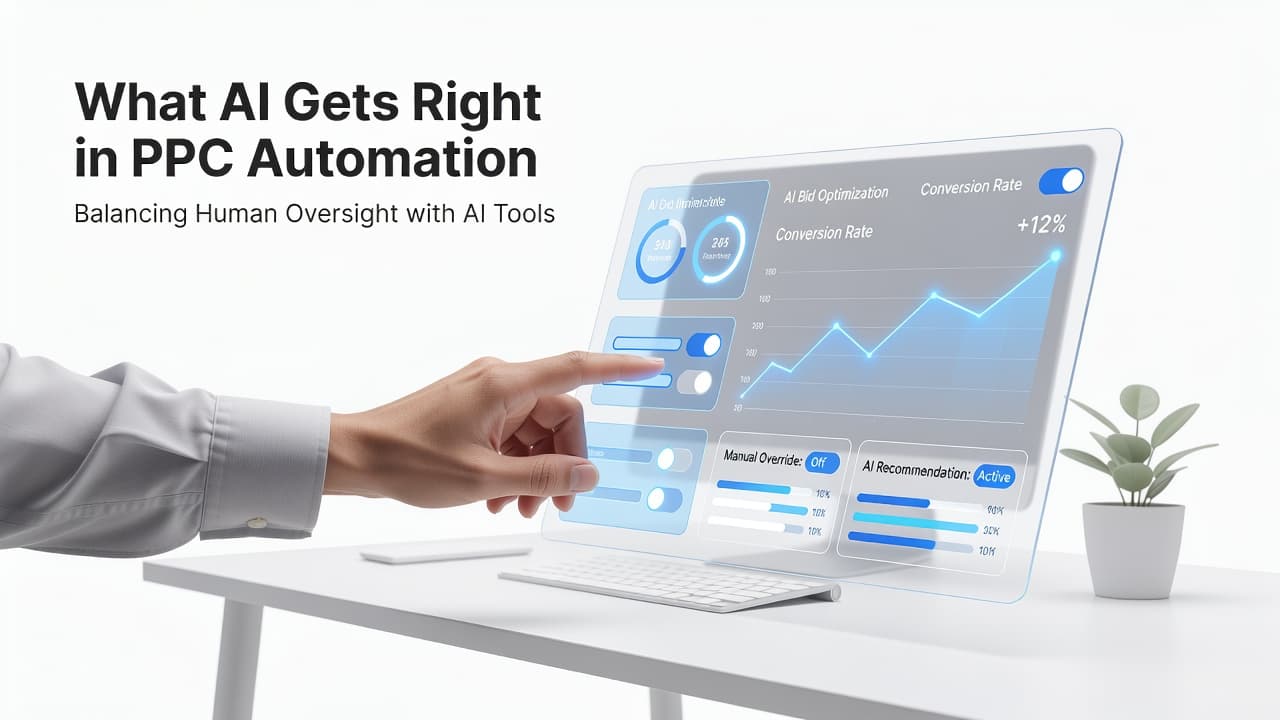
Artificial intelligence is strongest where a clear action follows a measurable signal. When implementing PPC automation, artificial intelligence does not tire, overlook a 2 am spike in spend, or struggle to compare thousands of data combinations.
Faster bidding and budget decisions
Smart Bidding and advanced bid management are core strengths of modern platforms, allowing the system to adjust bids for each auction using predicted conversion value or likelihood. This works effectively when your account records a steady, meaningful volume of accurate conversions. Furthermore, automated budget management reduces the chance that one campaign exhausts its budget too early.
You should still check whether the system is increasing spend because quality improved, or simply because it found more ways to spend. A lower cost per lead or a stable cost per click is not useful if the overall lead quality falls.
Finding patterns across large datasets
Artificial intelligence can identify which search themes, products, locations, and time periods correlate with better outcomes. It can flag unusual drops in conversion rate or sharp rises in cost per acquisition before your next weekly review.
This pattern recognition is especially helpful in accounts with hundreds of products or multiple campaigns. AI approaches to PPC optimisation often focus on this strength, processing signals quickly enough to improve bidding and targeting choices.
Ad copy automation for creative variants
Generating headlines, descriptions, and image variations is now quick. That gives you a broader testing pool, particularly for responsive search ads and paid social campaigns. Meta Advantage+ can test many asset combinations, while Google’s asset tools can adapt messages to likely user intent.
Use ad copy automation as a starting point. Check every claim, price, qualification, and tone of voice before publishing. A polished looking ad can still misrepresent your service or attract people who were never likely to buy.
Routine account maintenance
You can use rule-based automation, PPC scripts, and reporting automation to handle sensible, repeatable tasks, including:
- Bid changes when cost per acquisition moves beyond a set range.
- Performance alerts for when campaigns overspend or underspend.
- Reporting automation that combines ad data with CRM outcomes.
- Suggestions for negative keywords and search term exclusions.
- Pausing ads that link to unavailable products or expired offers.
These jobs make your account easier to manage through various performance alerts and automated workflows. They do not replace regular analysis of why performance changed.
Where AI Makes Expensive Mistakes
Automation works from historic data and platform signals. It cannot see the wider business situation unless you connect that information and act on it yourself.
It follows flawed conversion tracking
If your thank-you page fires twice, an automated bidding strategy can believe performance has doubled. If a phone call counts as a lead without checking its outcome, the platform may chase unqualified callers.
Before you increase automation, audit every aspect of your conversion tracking. Check duplicate events, consent settings, form errors and offline lead imports. Google’s Enhanced Conversions and CRM-based conversion imports can improve the quality of data available to bidding systems, but only when your underlying records are consistent.
This is why a campaign can appear successful in the ad platform while showing a poor cost per acquisition when measured against your actual sales pipeline. Automation reports what it has been told to value, not the health of your bottom line.
It doesn’t understand margins or business constraints
An algorithm may favour a product with strong conversion rates even if its margin is poor. It will not know that stock is low, a supplier has delayed delivery or your team cannot take another 50 enquiries this week.
The same applies to lead generation. A campaign that finds more small one-off jobs may look efficient while taking time away from higher-value contracts. You need to set the value rules, choose which services deserve budget and tell the platform when circumstances change to ensure your cost per acquisition remains profitable.
It can weaken your brand message
Automatically created assets can produce awkward wording, overstate benefits or use phrases your business would never use. This creates extra risk in regulated fields, including legal, financial and healthcare marketing. Furthermore, if the AI generates irrelevant ad copy, it can negatively impact your quality score, leading to higher costs for less effective results.
AI is a pattern matcher. It tends towards familiar language because familiar language is common in its training data. Yet memorable ads often depend on a sharp customer insight, a clear offer and a point of view that competitors have not copied. You must also maintain tight control over your negative keywords to ensure automated campaigns do not align your brand with inappropriate search queries.
The practical limits of AI-driven PPC become clear when context matters more than speed. You need to review tone, claims and intent before automated assets reach prospective customers.
Less visibility makes diagnosis harder
Performance Max and other highly automated formats can make it harder to isolate the cause of a change. A rise in spend could come from a new audience, a placement shift, a creative combination or a change in the platform’s prediction model.
Keep controlled campaigns alongside broader automated ones where possible. Brand search, high-intent exact-match terms and priority services often deserve their own budget and reporting. That gives you a useful benchmark when automated activity changes, helping you monitor whether your quality score or conversion tracking remains consistent across all channels.
Build a Supervised PPC Automation Plan
Start with narrow automation to ensure you are scaling campaigns effectively, and only expand once you can prove that lead quality remains consistent. Taking a gradual approach to PPC automation protects your budget and provides a much clearer view of cause and effect.
First, define one meaningful outcome. For many lead-generation businesses, this is not a click, impression, or form submission. It is a qualified enquiry, booked appointment, sales opportunity, or completed sale.
Next, connect your ad data to your CRM to enable data-driven decisions. Record which leads became qualified, which were rejected, and which turned into revenue. You can then assign different values to specific outcomes instead of treating every contact as equal.
After that, test one automated feature against a controlled alternative. Through rigorous ad testing, you might compare a Target CPA bidding strategy with your existing approach or trial Performance Max for a single product group. Give the test sufficient volume and avoid changing offers, landing pages, and budgets at the same time.
Review results based on more than just platform metrics:
| Measure | What you should check |
|---|---|
| Cost per qualified lead | Whether sales teams accept the leads |
| Conversion rate | Whether landing pages still match the ad promise |
| Cost per acquisition | Whether the final customer cost is profitable |
| Return on investment | Whether the overall spend is generating sustainable profit |
| Lead-to-sale rate | Whether paid leads become real revenue |
| Search-term and placement quality | Whether traffic remains relevant and safe |
Finally, document your guardrails. Set budget caps, exclude unsuitable locations, approve brand language, and maintain a list of terms that should never trigger your ads. Automated systems work better when you define the playing field clearly.
A capable PPC agency should talk about pipeline quality, conversion tracking, and customer acquisition cost, not clicks alone. If your website is weak, automation will simply send more people into the same broken journey. In that case, a joined-up approach with an SEO agency can improve landing-page relevance, content clarity, and organic conversion performance too.
Use Automation Without Giving Up Control
You do not need to choose between manual management and blind trust in AI. The most effective approach is a strategy of measured performance monitoring. By keeping a close eye on your accounts, you can allow algorithms to handle auction-level adjustments using real-time data, while you remain firmly in charge of your core business goals and the overall customer experience.
Effective PPC automation does not mean you stop being involved in the process. While machines excel at repetitive analysis, human expertise is still essential for strategic campaign management, particularly when it comes to nuanced keyword research and creative messaging that speaks directly to your target audience. Balancing these automated tools with your own oversight ensures that your strategy remains aligned with your broader marketing objectives.
If you need support with that balance, explore our expertise as a PPC marketing agency, or reach out to us as a Google Ads agency. We also provide comprehensive SEO services for lead generation, alongside expert LinkedIn advertising for B2B leads and highly targeted Facebook advertising campaigns to help you scale your results.
Frequently Asked Questions
Is it safe to let Google Ads automate my entire account?
It is generally not recommended to switch an entire account to full automation overnight. While AI is highly capable, it lacks an understanding of your business constraints, profit margins, and specific commercial priorities, making a gradual, controlled testing approach far safer.
How does conversion tracking affect PPC automation?
Automated systems rely entirely on the signals you provide to make decisions. If your tracking is inaccurate—such as double-counting leads or failing to filter out unqualified enquiries—the AI will optimise for the wrong outcomes and potentially waste your advertising budget.
Does AI replace the need for a human PPC manager?
No, AI functions best as a decision support system rather than a replacement for human judgement. You are still required to provide the strategic direction, set firm boundaries, oversee brand safety, and interpret whether automated performance aligns with your actual bottom-line profitability.
What are the main risks of automated ad copy?
Automatically generated headlines and descriptions can sometimes sound awkward, misrepresent your services, or use a tone that does not align with your brand. You must always review AI-generated assets to ensure they are accurate and maintain your desired quality standards before they reach potential customers.
Final Thoughts
PPC automation can make your account faster, more responsive, and easier to scale. It works best when it receives accurate conversion data and operates within the guardrails you have established. To further enhance your results, consider integrating third-party tools that provide deeper analysis and more granular reporting than native platform features alone.
Ultimately, your strongest advantage remains human judgement. You understand your customers, margins, sales process, and brand values better than any bidding model ever will. By combining sophisticated automation with your own strategic oversight, you can achieve consistent commercial success in the competitive UK market.