
You build a full-funnel LinkedIn Ads strategy by running three connected stages, awareness, consideration and conversion, each with its own targeting, ad format and success metric, rather than one campaign trying to do everything at once. That single change, splitting cold, warm and sales-ready audiences into separate campaigns, is usually what separates B2B advertisers who treat LinkedIn as a reliable pipeline source from those who treat it as an expensive experiment. This guide walks through how to structure that funnel, which ad formats suit each stage, and how to measure whether the whole system is actually working.
Why most LinkedIn Ads campaigns underperform
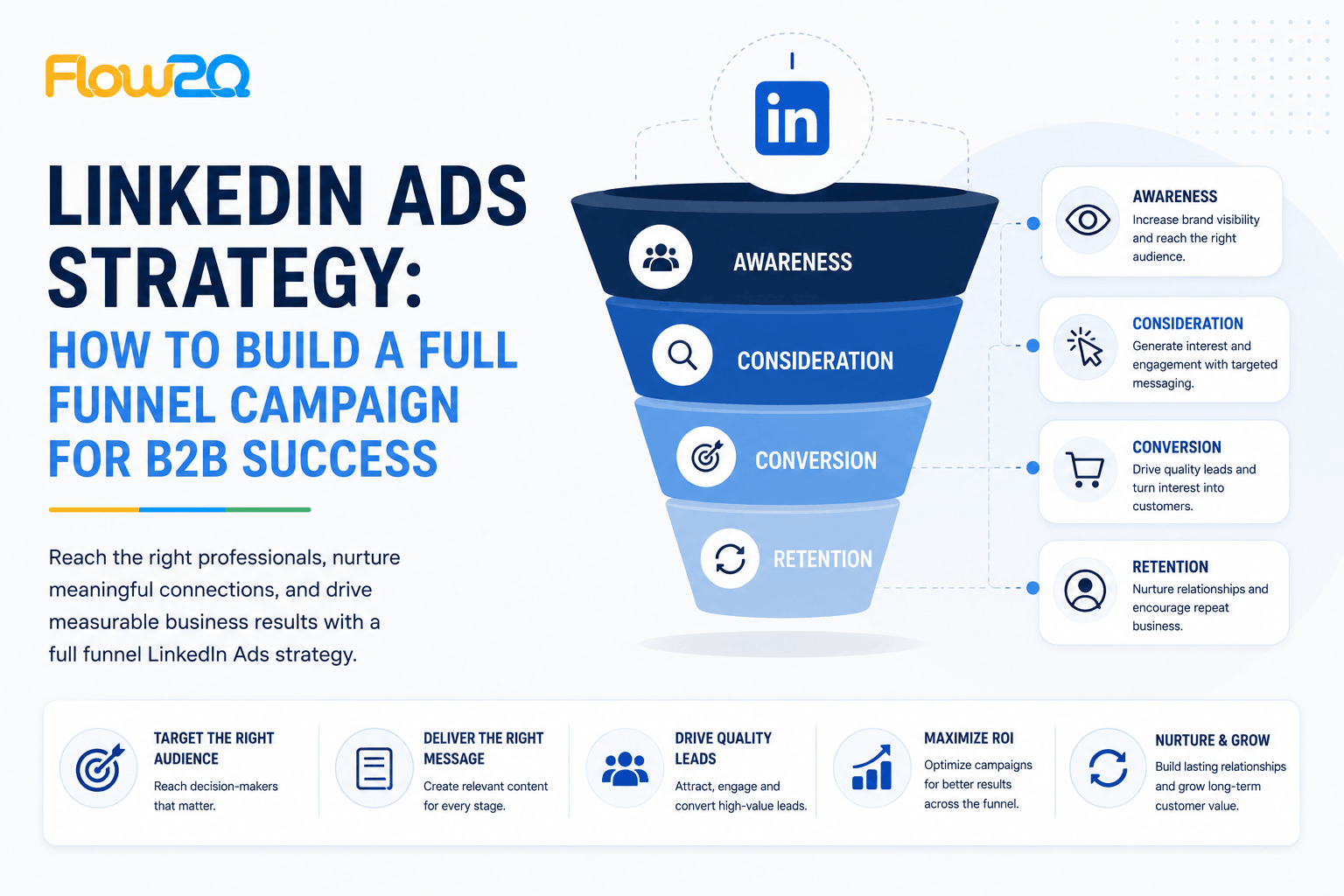
LinkedIn is not a search engine. Nobody opens their feed looking for your product. That means a cold audience served a demo request ad will mostly scroll past it, and the click you do get will cost you more than it should. This is the main reason LinkedIn Ads get a reputation for being expensive. Cost per click on the platform typically runs well above what you would pay on Google or Meta, so every click needs to count.
A full-funnel structure fixes this by matching the offer to the reader’s readiness. Someone seeing your brand for the first time needs a different message to someone who has already downloaded a guide and visited your pricing page twice. If you have read our piece on why use LinkedIn Ads you will know the platform’s real strength is precision targeting by job title, seniority, industry and company size. A full-funnel campaign is simply the disciplined use of that precision at every stage, rather than only at the point of conversion.
I have seen the same pattern across dozens of B2B accounts. A client runs one campaign, sets a lead form as the objective, targets everyone with a relevant job title, and wonders why cost per lead climbs every month. The audience never warms up because there is no earlier stage feeding it. Splitting that single campaign into three connected ones, even with the same total budget, tends to bring cost per qualified lead down within six to eight weeks.
Stage one: build awareness with the right cold audience
At the top of the funnel your job is reach and recognition, not conversion. Prioritise cold audiences defined by job title, seniority, industry and company size, and resist the urge to stack too many filters on top of each other. Narrow targeting shrinks your pool and pushes up your cost per impression without much upside.
Thought leadership content, short native video, and single image ads with a clear problem statement perform well here. The goal is to get your brand recognised before you ask for anything. Our guide to LinkedIn Ads for beginners covers the basic format choices in more depth if you are setting campaigns up from scratch.
Keep the call to action soft. A link to an article or a follow prompt works better here than a demo request. You are planting a flag, not closing a sale.
Stage two: turn attention into leads
Once someone has engaged with your top of funnel content, watched a video past the halfway point, or visited your site, they move into your retargeting pool. This is where LinkedIn Lead Gen Forms earn their keep. Because the form auto-fills using the person’s LinkedIn profile data, completion rates are consistently higher than standard landing pages, particularly on mobile.
That said, forms are not always the right choice. For higher-value or more complex offers, a dedicated landing page can qualify leads better even at a lower conversion rate, because it asks for more information upfront. We break this trade-off down properly in LinkedIn Lead Gen Forms vs landing pages, which is worth reading before you commit a budget split.
Document ads, gated whitepapers, and webinar registrations all suit this stage. Whatever format you choose, connect the form directly to your CRM through HubSpot, Salesforce, or a connector such as Zapier or LeadsBridge. Real-time syncing means sales can follow up while the lead is still warm, and a day’s delay here genuinely costs you conversions.
Stage three: convert warm leads into pipeline
At the bottom of the funnel, narrow your focus to named accounts, decision-makers and buying committees. This is classic account-based marketing territory. Use Conversation Ads, retargeted single image ads with a specific outcome-led message, and Matched Audiences built from your CRM data to reach people who already know who you are.
This stage is also where lead scoring earns its value. Route high-intent leads straight to sales and keep lower-intent ones in a nurture sequence with more educational content. Our post on using LinkedIn Ads to nurture B2B leads into conversions covers how to sequence that content without losing the prospect’s attention.
Funnel stage summary
| Funnel stage | Primary objective | Best-suited formats | Core metric to track |
| Top of funnel (awareness) | Reach and brand recognition among a cold ICP audience | Single image ads, native video, sponsored content | Cost per 1,000 impressions, engagement rate |
| Middle of funnel (consideration) | Capture intent from warm, engaged audiences | Lead Gen Forms, document ads, gated guides, webinars | Cost per lead, form completion rate |
| Bottom of funnel (conversion) | Convert named accounts and sales-ready leads | Conversation ads, retargeted single image ads, ABM | Cost per opportunity, pipeline influenced |
Measuring beyond cost per lead
Cost per lead tells you almost nothing about whether the lead was any good. Track conversion rate from lead to opportunity, pipeline influenced, cost per opportunity and return on ad spend instead. Connecting LinkedIn Campaign Manager data to your CRM is the only reliable way to see this, and it is worth the setup time even if it takes a week or two to get the reporting clean.
According to LinkedIn’s own Marketing Solutions data, roughly four out of five LinkedIn members hold some influence over business purchasing decisions at their organisation. That is a large addressable audience, but it also means broad targeting without funnel discipline wastes spend on people who are technically reachable but nowhere near ready to buy.
If you want a wider view of how ad spend and performance are trending, our post on advanced tips for scaling LinkedIn ad campaigns is a sensible next read once your funnel is running and you are ready to increase budget without losing efficiency.
Where LinkedIn fits alongside your other paid channels
LinkedIn rarely works best in isolation. Most B2B buyers research across several channels before they ever fill in a form, so a full-funnel LinkedIn strategy tends to perform better when it sits inside a broader plan. Many of our clients run LinkedIn for top and middle funnel awareness alongside a Google Ads agency London setup for high-intent search terms, since the two channels catch buyers at different points in their decision process.
Retargeting also stretches further when it is not confined to one platform. A Facebook ads agency London team can pick up warm audiences who are not active on LinkedIn every day, which matters given that only a minority of LinkedIn’s UK user base logs in daily. And because paid and organic reinforce each other, pairing LinkedIn campaigns with solid SEO services means the prospects you have warmed up on LinkedIn find consistent messaging when they search for you directly later on.
If you are weighing LinkedIn against other paid channels for B2B specifically, our comparison in LinkedIn Ads pros and cons sets out where it wins and where it genuinely does not.
Budget and realistic expectations
For a UK B2B business, a workable starting budget for a genuine three-stage funnel usually sits somewhere between two thousand and four thousand pounds a month, though this varies a great deal by industry and audience size. Below that, it is often more sensible to concentrate spend on middle and bottom funnel campaigns targeting warm audiences and skip broad top of funnel reach until budget allows for it.
Give the system time. Retargeting audiences need a minimum pool size before LinkedIn will activate them properly, so your top of funnel campaigns need to run consistently for several weeks before the middle and bottom stages have enough people to work with. Most accounts need eight to twelve weeks before the full funnel is compounding properly, so judge performance over a quarter, not a fortnight.
If your product suits a subscription model, our guide to LinkedIn Ads for SaaS has more specific guidance on budget pacing for that kind of sales cycle. Ecommerce brands testing LinkedIn for the first time may also find our piece on LinkedIn Ads for ecommerce useful, since the funnel logic shifts slightly when the product itself is the offer rather than a demo or consultation.
A quick example
One law firm client came to us running a single always-on lead gen campaign targeting anyone with “partner” or “director” in their title. Cost per lead had crept up for three months straight and sales complained the leads were not qualified. We split the budget into a small awareness layer using thought leadership posts from the firm’s senior partners, a middle stage built around a downloadable regulatory guide, and a bottom stage retargeting only the people who had downloaded it. Within two months, cost per qualified lead had dropped by roughly a third, and sales stopped complaining about lead quality, because by the time someone reached the form, they had already seen the firm’s name twice before.
Common mistakes worth avoiding
Running one campaign objective across an entire cold audience is the most common error, but there are a few others worth naming plainly. Layering too many targeting filters shrinks reach until LinkedIn cannot deliver efficiently. Leaving creative unchanged for months causes frequency to climb and engagement to fall, particularly given how small some B2B audiences are to begin with. And treating cost per lead as the only metric that matters hides the fact that a cheap lead which never converts is not actually cheap at all.
Our post on case studies of successful LinkedIn ad campaigns has a few more real examples if you want to see how other B2B brands have structured their funnels in practice. And if you are exploring how automation and AI tools fit into this, enhancing B2B marketing with AI-driven LinkedIn ads covers predictive scoring and dashboard reporting in more detail.
FAQs
What is a full-funnel LinkedIn Ads strategy?
It is a campaign structure that targets audiences differently depending on where they sit in the buying journey, using awareness content for cold audiences, lead capture formats for warm ones, and account-based tactics for sales-ready prospects.
How much should a UK B2B business budget for LinkedIn Ads?
Most agencies suggest starting somewhere between two thousand and four thousand pounds a month for a proper three-stage funnel, though this depends heavily on your industry, audience size and sales cycle.
Are LinkedIn Lead Gen Forms better than landing pages?
Not always. Forms tend to convert at a higher rate because they remove friction, but landing pages can qualify leads more precisely for complex or high-value offers. The right choice depends on the funnel stage and what you need to learn about the prospect.
How long does it take to see results from a LinkedIn Ads funnel?
Give it a full quarter. Retargeting pools need time to build, and most accounts only start compounding properly after eight to twelve weeks of consistent activity.
Ready to build your funnel
A full-funnel LinkedIn Ads strategy is not a single tactic, it is a system that gets better the longer it runs, provided you keep feeding it and measuring the right things. If you would rather have that system built and managed by people who do this daily, Flow20’s LinkedIn advertising agency London team can structure, launch and optimise the whole funnel for you. We also work across the wider paid mix through our PPC marketing agency services, so get in touch if you want a second opinion on how LinkedIn should fit into your broader B2B marketing plan.