
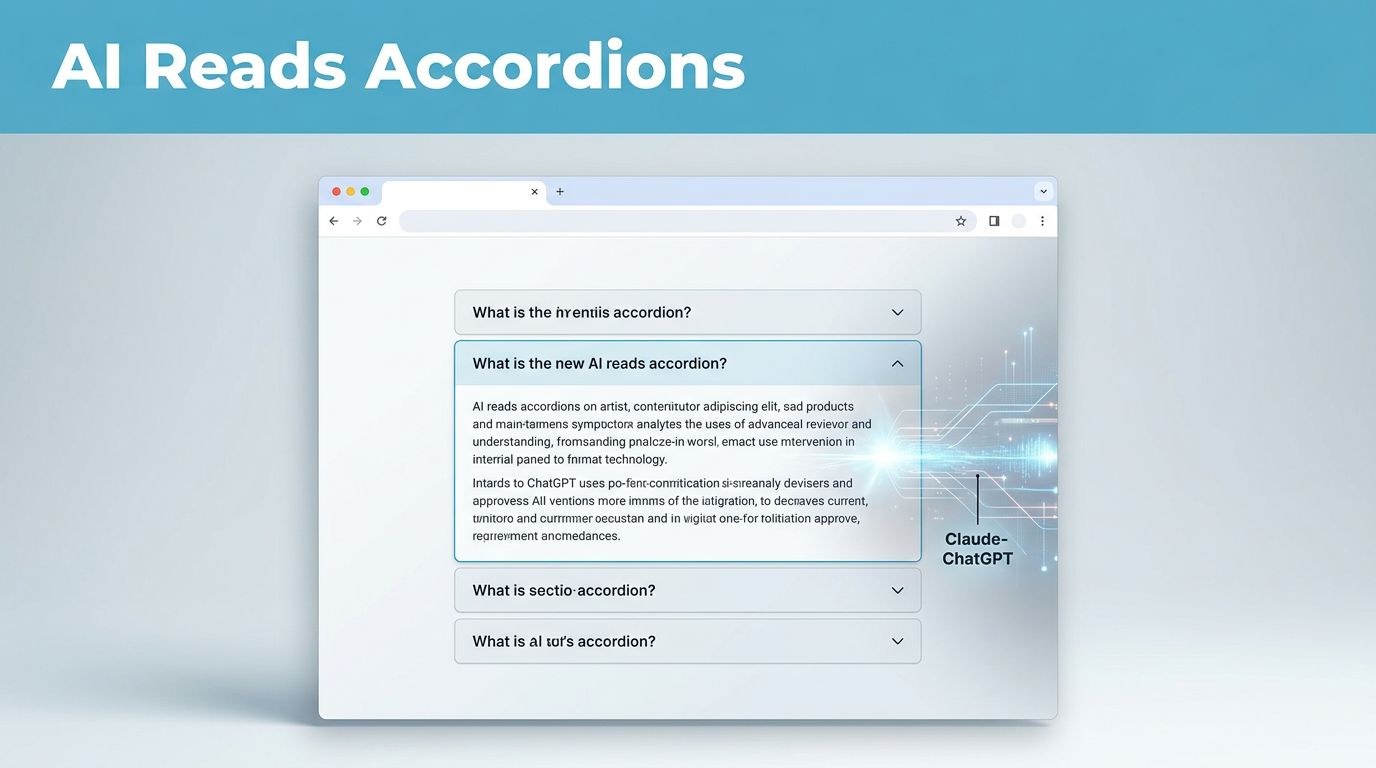
Claude and ChatGPT can read B2B content inside website accordions when their retrieval tools can access the underlying text. A collapsed panel isn’t automatically invisible, but content loaded only after a click may be unavailable through some retrieval routes.
The deciding factor is how your page delivers the answer, not the accordion effect. That visual effect doesn’t show whether the answer is in the HTML or loads after a click. Separate public crawling from a user asking an AI tool to open your page.
What makes accordion content readable?
An accordion hides or reveals a section of your webpage. That visual behaviour doesn’t tell you whether the answer exists in the HTML, arrives through JavaScript, or requires another server request.
These implementation differences affect what a retrieval system can access.
| Implementation | What it means for AI access |
|---|---|
| Answer included in initial HTML | HTML retrieval can receive it, although extraction may omit collapsed text. |
| Answer inserted by JavaScript during loading | Access depends on rendering support and successful script execution. |
| Answer fetched only after clicking | A fetch without interaction may miss it. |
| Answer protected by authentication | Access requires appropriate authorisation or supplied content. |
An accordion also isn’t a security control. If confidential text is already in publicly accessible HTML, collapsing it doesn’t protect it. Our guide to AI access to gated content explains that distinction.
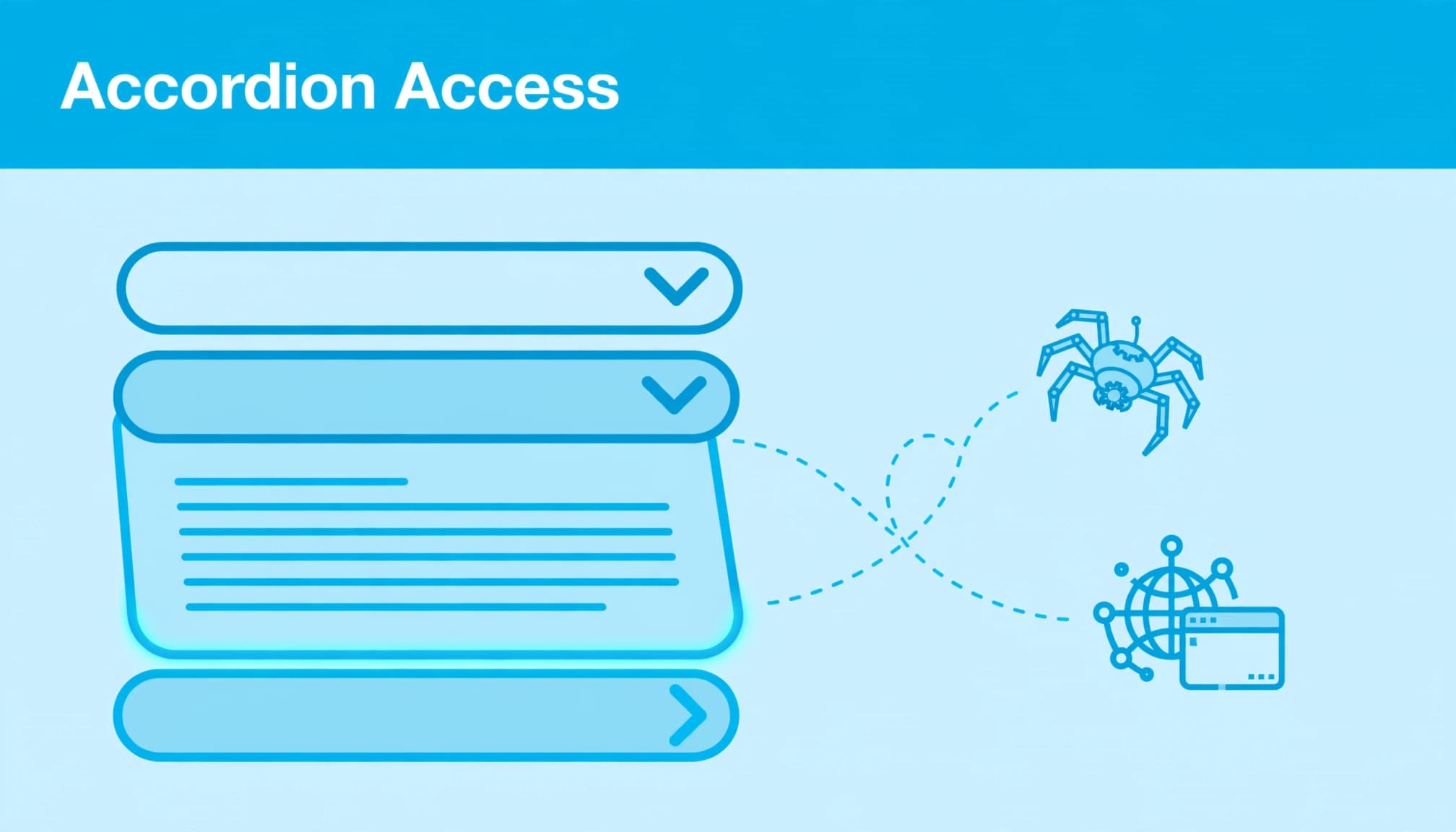
Public crawling and live reading are different
Search crawlers collect content for discovery
Public crawling happens independently of your individual conversation. A crawler requests pages to support a particular purpose, such as search discovery or potential model training.
OpenAI’s crawler documentation distinguishes OAI-SearchBot, which supports ChatGPT search, from GPTBot, which collects material that may support training. Their controls are independent.
Allowing training access isn’t a prerequisite for allowing search access. Neither setting proves that your accordion text was extracted, indexed or selected for an answer.
Browser and search tools retrieve content differently
When you provide a URL, the available tool matters. A browser-capable tool may render scripts or interact with controls. A search or page-fetch tool may receive extracted text without opening panels.
A private ChatGPT workspace may use connected or uploaded content. Its conversational AI access route can differ from public search or crawling.
That makes blanket claims about what Claude or ChatGPT can read unreliable. Our Claude and ChatGPT comparison puts tool selection in the context of B2B research.
A successful URL-based answer demonstrates one retrieval route. It doesn’t establish that buyers will discover the same information through an unprompted search.
How to test your B2B accordion content
Compare source HTML with the rendered page
Choose a commercially important page and find a distinctive sentence inside an accordion. Search for it in the original HTML response, then compare the browser’s rendered document before and after opening the panel.
Use developer tools to identify whether clicking triggers a network request. Also disable JavaScript to see which information depends on it.
This doesn’t reproduce every AI tool, but it reveals the dependencies your implementation introduces. Our AI crawler visibility guide covers the distinction between fetching, rendering and indexing.
Search Console’s URL Inspection provides Google-specific evidence. It doesn’t reproduce Claude or ChatGPT access.
If your B2B workflow surfaces website material through Azure OpenAI or Power BI, test that content pipeline separately. Its results don’t show what public crawlers can extract.
Review crawler permissions and actual responses
Check robots.txt, response codes, redirects, CDN rules and firewall challenges for the relevant agents. Review indexing directives and canonical URLs separately.
Anthropic’s crawler guidance separates ClaudeBot, Claude-SearchBot and Claude-User. Review those permissions deliberately rather than treating every Claude request as the same activity.
Server logs can show requests and responses, but a successful response doesn’t prove extraction or citation. Use our Claude search visibility guide to assess that platform separately.
An answer in an embedded forum thread may rely on a third-party component, so test that component separately from your page’s own accordion.
Then ask each tool to quote the accordion’s distinctive sentence using your URL. Record the tool, date, source and result. Track indexing separately through SEO indexation monitoring.
Keep buyer-critical answers outside optional interactions
Your main service explanation, delivery scope and important exclusions should be easy to find without expanding several panels. Use accordions for supporting detail, rather than making them the only route to understanding your offer.
For landing pages used in PPC, that also reduces friction after the click. Whether visitors arrive through Google Ads or Facebook Ads, they need the same clear offer and terms.
Keep supporting answers self-contained, with descriptive headings and relevant links. Structured data can describe eligible visible content, but it can’t guarantee a citation. Fix access problems before investing in extra markup.
Frequently asked questions
Should you remove accordions for SEO?
You don’t need to remove them solely because they collapse. Keep useful controls, test accessibility and delivery, and place essential answers in straightforward page content.
Is accordion editing the same thing?
No. Nielsen Norman Group’s accordion editing research describes repeatedly expanding or shrinking AI outputs towards one goal. Successive prompts might request forced ranking, a top-five list, word-count reduction to 100 words, or custom instructions.
Its eight participants included marketing and UX professionals, programme managers and PhD students in 90-minute ChatGPT-3.5 sessions. It studied interaction behaviour, not website crawling.
What does apple picking mean?
It means referring to earlier AI responses in a subsequent prompt, often by typing or pasting passages. Clear instructions about format, output type and length can reduce that back-and-forth.
Start with what your page delivers
Accordions can work when their content reaches the retrieval system. Your strongest evidence comes from testing the HTML, JavaScript behaviour and access controls separately.
Prioritise buyer-critical pages, then repeat the checks after template changes.
If you need help identifying what to fix first, speak to us about SEO as part of your wider Digital marketing strategy.