

LLM confidence scores aren’t proof that an answer is factually correct. You can use them to prioritise review, but reliable marketing decisions need source evidence, testing against known answers and clear rules for human approval.
A model can sound certain whilst inventing a product feature or misreading campaign data. The practical question is whether its confidence predicts accuracy on your tasks, rather than whether the percentage looks reassuring.
Start by understanding what the score measures.
What LLM confidence scores actually measure
“Confidence” can describe several different signals. Before using a score, ask your supplier how it’s calculated and what it has been tested against.
Each signal measures something different, and none alone proves factual accuracy.
| Signal | What it measures | Main limitation |
|---|---|---|
| Verbalized confidence | The model’s stated certainty about its answer | The percentage is generated text |
| Token probabilities | Likelihood of particular words given the context | Likely wording can contain false claims |
| Self-consistency sampling | Agreement across repeated answers | Repeated answers can share an error |
| Task-calibrated confidence | Estimated correctness based on labelled examples | Reliability depends on the test data |
The most useful score is one validated against your actual work. A confidence percentage without that context is difficult to interpret.
Verbalized confidence needs validation
Asking “How confident are you?” produces verbalized confidence, not an independent assessment.
That doesn’t make verbalised confidence worthless. Tian et al.’s confidence-elicitation study tested ChatGPT, GPT-4 and Claude on TriviaQA, SciQ and TruthfulQA. Verbalised confidence was often better calibrated than the study’s token-probability estimates.
The finding depends on the models, tasks and prompting method. You can’t assume that the same approach will reliably assess a competitor comparison or campaign recommendation.
Token probabilities describe wording
Token probabilities describe how likely the next piece of text is, given the prompt and preceding text.
A familiar claim can receive high probability because its wording fits the context. That says little about whether today’s product documentation supports it.
For your team, neither token probabilities nor a generated percentage should automatically approve a factual claim. Ask whether the score refers to a token, a complete answer or a separately trained correctness estimate.
Why confident answers can be wrong
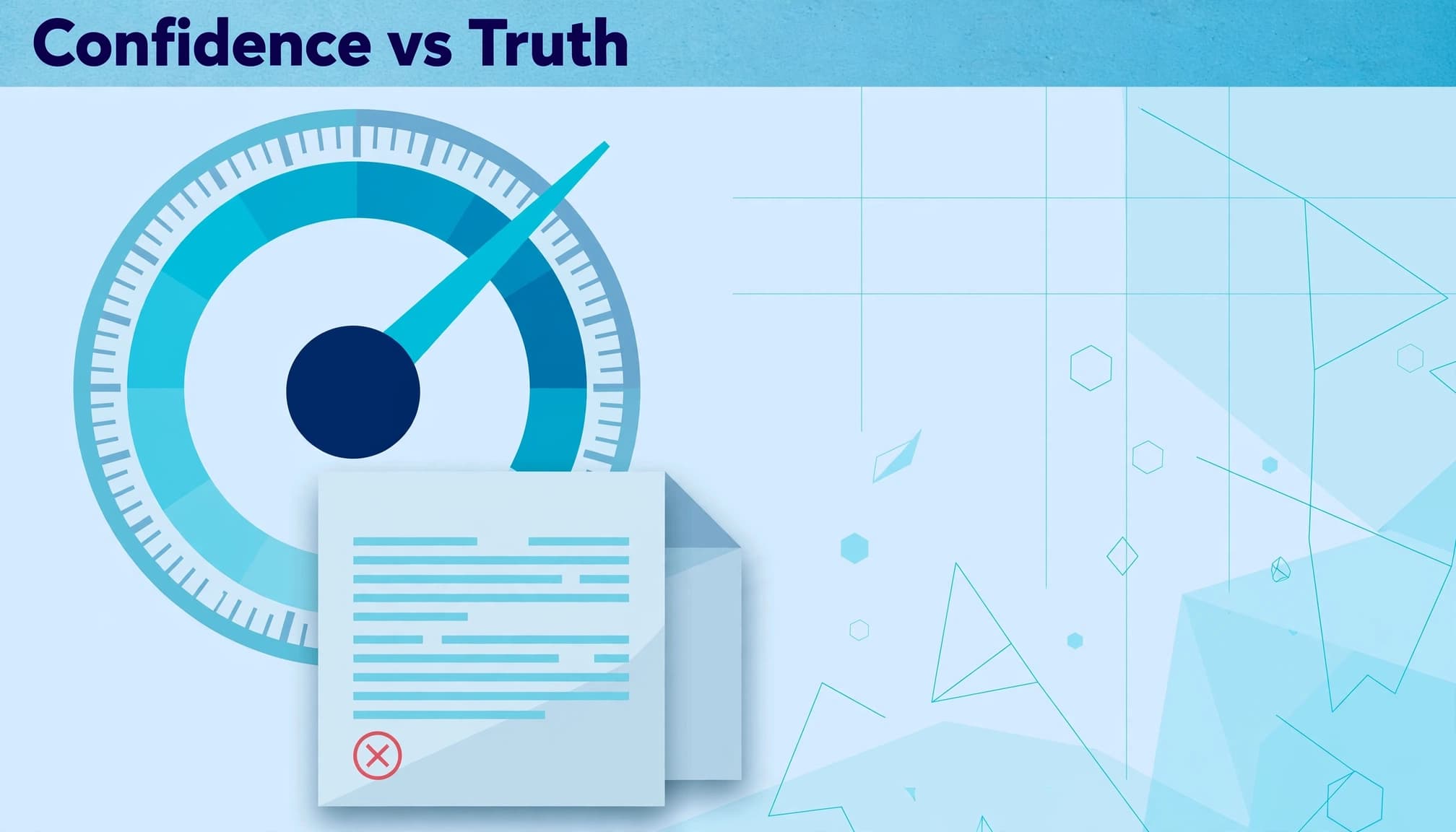
Fluent wording makes errors harder to notice. Verbalized confidence, especially as a percentage, can feel more dependable than a cautious answer, even without supporting evidence.
Instruction tuning and reinforcement learning from human feedback (RLHF) can change model behaviour. They may improve helpfulness without improving every confidence signal’s calibration. Effects vary by model, task and measurement method.
Avoid treating this training as a universal cause of model overconfidence. The more useful test is whether your deployed system identifies its own mistakes, including unsupported claims through hallucination detection.
This matters when you use AI to interpret marketing data. A Google Ads summary might report figures correctly, then attribute a rise in conversions to a campaign change without enough evidence.
Your AI-driven PPC reporting should separate recorded results from explanations that need investigation. Check date ranges, attribution settings and conversion definitions before accepting a recommendation.
The same applies to content research. An AI-generated topic list can sound commercially convincing without showing real demand. Use AI content gap analysis alongside search data and sales questions.
A confident answer also needs the right scope. A correct statement about one product plan may mislead when applied to another. Accuracy includes those conditions, not just whether a sentence sounds broadly plausible.
Measure calibration on your marketing tasks
Confidence calibration asks whether confidence matches observed correctness. Answers assigned 80% confidence should be correct roughly 80% of the time across a relevant sample.
What expected calibration error tells you
Expected calibration error (ECE) groups answers into confidence ranges. It compares average confidence with observed accuracy within each range, then weights those gaps by the number of answers.
A reliability diagram plots average confidence against observed accuracy across the ranges, helping reviewers inspect how closely they match.
Guo et al.’s calibration paper is a useful foundation for understanding this measure and methods such as temperature scaling.
Temperature scaling adjusts prediction probabilities using validation data. It can improve probability calibration, but it doesn’t supply missing knowledge or repair an unsupported claim.
ECE also depends on your binning choices and sample. A reliability diagram can help reveal a calibration failure in a small, commercially important category, such as pricing or compliance claims.
Track accuracy and coverage separately
Build a labelled test set using tasks your team already performs: product summaries, reporting explanations and source-supported comparisons.
Define correctness before testing. For comparisons, record a relevance judgment and decide whether every detail must be correct or each claim is scored independently.
Report factual accuracy, calibration and coverage separately. Coverage is the proportion of requests answered rather than deferred under your abstention thresholds.
Include results by task category and show sample sizes beside percentages. Don’t tune your threshold and evaluate it on the same examples.
For automated SEO reporting, check numerical accuracy separately from the quality of the explanation. Correct arithmetic doesn’t establish why traffic changed.
What newer confidence methods add
Newer approaches use more than an isolated confidence prompt. They can improve decision-making, but each introduces operational requirements.
Experiential confidence estimation learns from previous outcomes
The XConf framework estimates confidence using graded previous tasks. Its experience bank stores outcomes and lessons, then retrieves relevant examples to inform a new assessment.
The authors report favourable benchmark results against ten-sample self-consistency, but these findings don’t guarantee production performance. The XConf implementation provides the accompanying code.
For you, experiential confidence estimation means learning from verified outcomes. Start with reviewed historical examples and use them to seed an experience bank. Keep human approval during the cold start, and ensure records reflect the tasks being assessed.
Hidden states and self-consistency sampling offer different signals
Engineers can train probes on hidden states, the model’s internal activations, to estimate uncertainty or identify likely errors.
These approaches need access to model internals and careful validation. Open-weight models may offer that access, but probes don’t necessarily transfer reliably between model versions.
Self-consistency sampling is easier to try: generate several answers and compare them. However, agreement can reflect a shared misconception.
Extra generations at inference time also add latency and cost. Measure whether they reduce errors enough to justify the expense.
For AI-assisted keyword research, repeated self-consistency sampling on a topic isn’t evidence of search demand. Validate recommendations against customer language and performance data.
Build review into your publishing workflow
A useful system decides when to answer, request evidence or defer. It doesn’t need elaborate architecture to start.
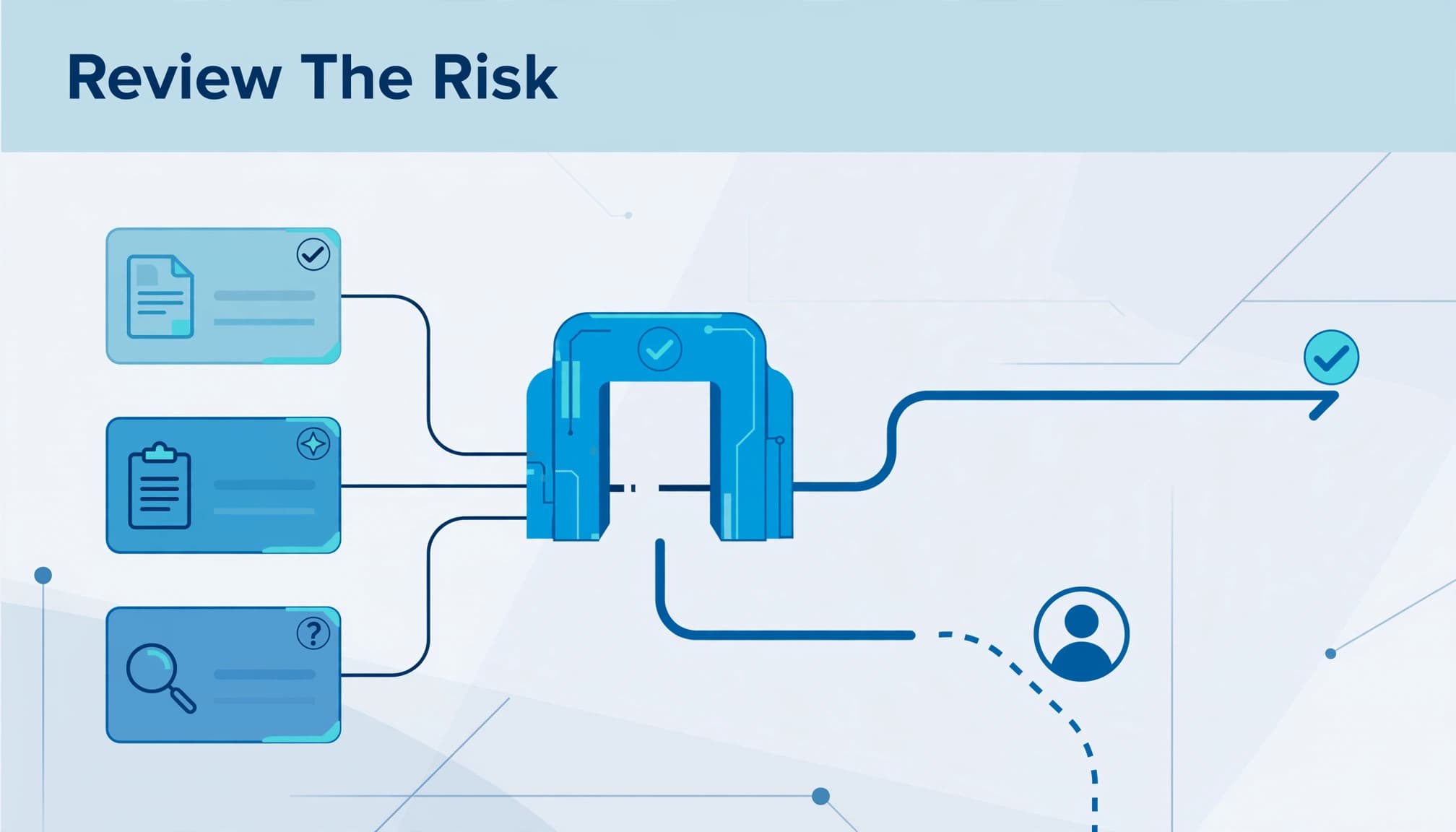
Use this sequence to test the system before production deployment in live content or client recommendations.
- Collect representative tasks with approved answers and supporting sources. Include missing-information cases and previous failures.
- Test confidence signals on held-out examples. Set a confidence threshold against your acceptable error rate and review capacity.
- Route unsupported, uncertain or high-risk claims for human approval using abstention thresholds. Let the system abstain when evidence is insufficient.
- Log prompts, model versions, retrieved passages, scores, verbalized confidence and reviewer decisions. Assess confidence signals against reviewed outcomes and re-test after meaningful changes.
There isn’t a universal abstention threshold that makes publication safe. Raising abstention thresholds generally reduces coverage, so report both the error rate and the amount of work automated.
An LLM-as-a-judge can help prioritise reviews, but inference time adds to operational costs. Ask for a relevance judgment on whether the answer addresses the request. Then ask for a second relevance judgment: does the cited passage support the claim? Compare scores with a manually reviewed sample. Judges can show overrating bias, favouring passages for surface wording and length. Keep the rubric and evaluator version fixed during comparisons.
Your AI SEO quality control should sample apparently successful automated outputs for hallucination detection. Reviewing only flagged answers creates selection bias and leaves confident mistakes unseen.
For an owned assistant using retrieval-augmented generation, inspect retrieval and generation separately, recording which document version supplied the passage. A relevant source can still be misquoted, and a correct document may never have been retrieved.
Keep AI visibility separate from commercial results
Public answer engines need a different measurement approach from your own assistant. These black-box models generally don’t expose their internal confidence signals or retrieval settings to marketers.
Use fixed prompts, consistent settings and repeated runs through LLM search testing. Record changes in answers, but don’t treat stability as evidence of truth.
Keep direct citations, supporting links and plain brand mentions separate. Run-level visibility measures appearances across runs; prompt-level visibility measures which questions produced an appearance. Citation share measures your citations against all observed citation instances.
None of these measures proves that a buyer saw the answer, clicked your page or became a qualified lead.
Connect these observations with landing-page activity, opportunities and pipeline. Your marketing attribution still needs to account for incomplete journeys and delayed sales.
Apply the same evidence standard across channels. In PPC, verify product and offer claims before launch. For Google Ads, check AI recommendations against campaign data before changing budgets.
When using Facebook Ads, don’t let generated copy promise more than the landing page supports. For SEO, publish clear evidence beside important claims.
Bring those checks into one Digital marketing plan. Confidence, visibility and commercial performance answer different questions, so your reporting should preserve those distinctions.
Frequently Asked Questions
Do LLM confidence scores prove an answer is correct?
No. A score is a signal whose value depends on how it was produced and validated against representative examples; check supporting sources before relying on factual claims.
Which confidence score should marketers use?
Use the signal that has been tested against labelled examples from the work you need to assess. Compare calibration, accuracy and coverage rather than choosing a score because it is expressed as a percentage.
How should we set a confidence threshold?
Set it using held-out examples, your acceptable error rate and review capacity. Track how many answers are deferred as well as errors, then reassess after model or workflow changes.
Can repeated agreement between answers be trusted?
Not on its own. Repeated generations can share the same error, so compare answers with trusted evidence and review a sample of apparently successful outputs.
Make confidence useful before you automate
LLM confidence scores become useful when you validate them against representative tasks and attach clear review rules. Verified outcomes should determine how much responsibility you give the system.
Start with one repeatable workflow, such as a monthly report or product-content review. Agree the acceptable error rate, measure what gets deferred and inspect a sample of automated approvals.
If you want to use AI more effectively across your campaigns, ask Flow20 to help define a measurable workflow that protects content quality and supports qualified lead generation.