

TL;DR:
- Shopify is better suited for direct-to-consumer businesses, offering extensive marketing tools and app integrations.
- BigCommerce excels in native B2B functionality, multi-storefront management, and lower costs for large-volume merchant operations.
For UK small and mid-sized businesses, the BigCommerce vs Shopify decision comes down to one question: is your primary model B2B or DTC? Shopify leads on marketing ecosystem depth, conversion tools, and innovation velocity. BigCommerce wins on native B2B functionality, multi-storefront management, and historically lower total cost of ownership for merchants using non-default payment gateways.
Here is the short version:
- Choose Shopify if you sell direct-to-consumer, prioritise marketing automation, or need the broadest app ecosystem for fashion, beauty, or subscription commerce.
- Choose BigCommerce if you run B2B or wholesale operations, manage multiple brand storefronts, or process significant volume through third-party payment gateways.
- Watch the fees closely. Shopify charges a transaction fee on transactions processed outside Shopify Payments. As of June 2026, BigCommerce introduced its own Open Payment Provider Fee on non-embedded gateways, reducing its previous cost advantage.
- Migration is expensive. Switching platforms mid-growth carries real operational risk, so getting this decision right from the start matters.
Table of Contents
- How do BigCommerce and Shopify actually compare?
- How to choose between BigCommerce and Shopify
- How Flow20 helps you get more from your ecommerce platform
- Key takeaways
- FAQ
How do BigCommerce and Shopify actually compare?
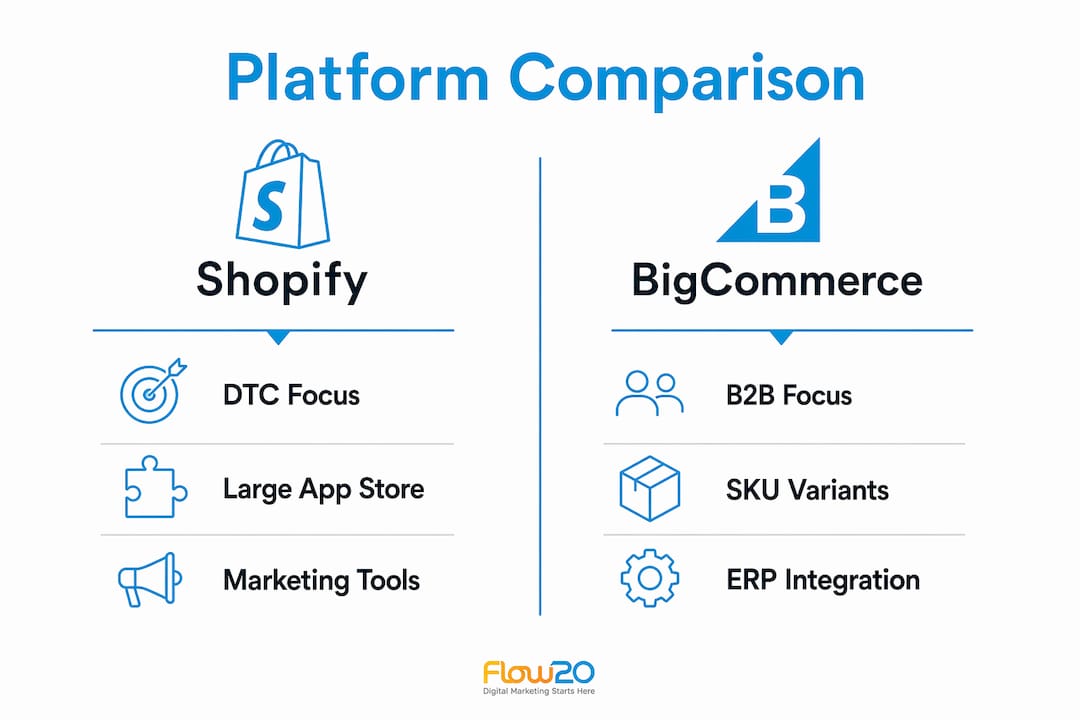
Both platforms start at $39/month and scale to enterprise pricing, but the similarities end there. The table below maps the dimensions that matter most for UK businesses.
| Dimension | Shopify | BigCommerce |
|---|---|---|
| Best for | DTC, fashion, beauty, subscription | B2B, manufacturing, distributors, multi-brand |
| B2B vs DTC suitability | Strong DTC; B2B now on all paid plans | Deeper native B2B out of the box |
| Marketing tools and ecosystem | 13,000+ apps, Shop Pay | ~1,200 apps; stronger native channel integrations |
| ERP and backend connectivity | Third-party middleware (Celigo, Pipe) | Native SAP, NetSuite, Microsoft Dynamics connectors |
| Innovation and platform updates | 18 major updates in 12 months (to June 2026) | Iterative; expanded API rate limits on Enterprise |
| Pricing and scalability | No GMV caps; transaction fees on outside gateways | GMV-based tier upgrades; Open Payment Provider Fee from June 2026 |
App ecosystem and marketing tools
Shopify’s app store depth is a major commercial advantage, offering thousands of integrations. You can layer in Klaviyo for email, Yotpo for reviews, ReCharge for subscriptions, and Loop Returns for post-purchase, all with native support on both platforms. BigCommerce’s app selection is smaller than Shopify’s., but the platform compensates with more built-in functionality: faceted search, customer group pricing, and real-time shipping quotes come standard without additional subscriptions.

Shopify’s Shop Pay network delivers a higher conversion rate for opted-in buyers compared to guest checkouts., a meaningful edge for DTC brands where checkout abandonment directly hits revenue. BigCommerce has no equivalent accelerated checkout network.
B2B functionality
According to IWD Agency experts, platform choice should be driven by business model: BigCommerce for primary B2B operations, Shopify for primary DTC. That guidance holds in 2026, though the gap has narrowed. BigCommerce’s B2B Edition includes quote workflows, purchase order support, net payment terms, unlimited price lists, and sales rep dashboards natively. Shopify opened core B2B features to every paid plan in April 2026, covering company profiles, custom catalogues, and volume discounts, but quote management still requires a third-party app such as Quotify.
Catalogue complexity and variants
BigCommerce supports up to 600 SKUs per product with native options, while Shopify raised its variant limit to 2,048 on Plus (up from 100 on standard tiers). For configurable products with many dimensions, such as industrial parts or bespoke furniture, BigCommerce’s architecture handles complexity more gracefully at lower plan tiers.
ERP and backend integration
BigCommerce’s Enterprise tier offers unlimited API access and native connectors for SAP, NetSuite, and Microsoft Dynamics. Shopify relies on third-party middleware for equivalent ERP connectivity, adding cost and integration overhead. Ecommerce Times analysts note that Shopify’s innovation velocity remains a key advantage for brands prioritising rapid marketing automation and headless commerce experimentation, but for ERP-heavy operations, BigCommerce’s native connectivity reduces technical debt at scale.
Pricing and transaction fees
Both platforms have comparable entry-level and mid-market pricing tiers. The real cost divergence appears at volume. Shopify charges 0.5%–2% on any transaction not processed through Shopify Payments. BigCommerce introduced its Open Payment Provider Fee in June 2026 for non-embedded gateways, with the rate depending on the plan. For a brand processing $5M GMV through outside gateways, BigCommerce Enterprise typically costs $30,000–$80,000 less per year in total cost of ownership than Shopify Plus, but that advantage shrinks if you use an embedded provider on either platform.
BigCommerce also enforces GMV-based tier upgrades: exceed the revenue threshold for your plan and you move up automatically. Shopify has no such mechanic.
SEO, security, and support
BigCommerce offers more granular URL control and built-in 301 redirect management. Shopify enforces URL prefixes such as /products/ and /collections/, which limits structural flexibility. Both platforms are PCI-DSS compliant and provide 24/7 support, though Shopify’s support infrastructure benefits from its significantly larger merchant base.
How to choose between BigCommerce and Shopify
The right platform is the one that matches your revenue architecture today and where you expect to be in three years. Working through these criteria will sharpen the decision.
Identify your primary business model first. If B2B or wholesale is your core operation, BigCommerce’s native depth means fewer apps, lower ongoing costs, and less integration risk. If DTC is primary and B2B is secondary, Shopify Plus B2B for All is now capable enough that rebuilding on BigCommerce is rarely worth it.
Assess catalogue complexity. Merchants with large, configurable catalogues of 10,000+ SKUs benefit from BigCommerce’s variant handling and built-in faceted filtering. For most DTC catalogues under 1,000 SKUs, Shopify’s architecture is more than sufficient.
Model your total payment costs. If you have negotiated preferential rates with Stripe, Braintree, or a regional acquirer, run the numbers on both platforms’ gateway fees before committing. The fee structures changed in 2026 and the old “BigCommerce is always cheaper” assumption no longer holds universally.
Weigh innovation velocity against operational maturity. Shopify shipped 18 major platform updates in the 12 months to June 2026. For brands whose competitive advantage depends on rapid marketing experimentation, that cadence matters. For manufacturers and distributors whose priority is ERP stability and backend reliability, BigCommerce’s more deliberate release cycle is a feature, not a limitation. Practitioners consistently advise prioritising platform maturity and ERP connectivity over initial subscription cost to avoid margin erosion at scale.
Factor in multi-storefront needs. Running two or more independent brand storefronts is available on BigCommerce’s standard plans. On Shopify, it requires Plus at $2,300/month. If you are managing a DTC storefront alongside a wholesale portal before reaching Plus-level revenue, BigCommerce is meaningfully cheaper.
- Consider how your team’s technical capability affects the decision: Shopify’s admin interface is genuinely more accessible for non-developers, with an average time-to-launch of 2–6 weeks versus 6–12 weeks for BigCommerce.
- For headless commerce, Shopify’s Hydrogen framework with bundled Oxygen hosting reduces DevOps overhead. BigCommerce’s Catalyst (Next.js, open-source) offers more hosting flexibility but requires self-managed infrastructure.
- If you sell across Instagram, TikTok, or Meta, Shopify’s native social commerce integrations are stronger.
Pro Tip: Never compare platforms on subscription fee alone. Build a 24-month total cost of ownership model that includes app subscriptions, transaction fees, developer costs, and potential GMV-triggered tier upgrades. For a mid-market UK business processing £2M+ annually, that model often reverses the initial pricing impression. You can find further guidance on ecommerce platform effectiveness and how platform choice affects your marketing returns on the Flow20 blog.
Switching platforms mid-growth carries real risk. Migration involves URL mapping, SEO re-indexing, and data transfer, and a poorly managed move can cause a temporary dip in organic search visibility. If you are already established on one platform and it broadly fits your model, the operational disruption of switching rarely justifies the move unless a fundamental mismatch exists.
How Flow20 helps you get more from your ecommerce platform
Choosing the right platform is only half the equation. The other half is making it perform.
Flow20 is a London-based performance marketing agency working with UK small and mid-sized businesses to generate measurable leads and sales from their ecommerce investment. Whether you are on Shopify or BigCommerce, the platform only creates the opportunity. Paid search, SEO, and paid social are what convert that opportunity into revenue.
Flow20’s services are built around the metrics that matter to your business:
- PPC management and Google Ads campaigns optimised for ecommerce conversion, not just traffic
- SEO services that build sustainable organic visibility alongside your paid activity
- LinkedIn advertising for B2B ecommerce clients targeting procurement and wholesale buyers
- Facebook and Instagram ads for DTC brands running performance-led social campaigns
If you have recently made your platform decision and want to build the marketing layer around it, speak to Flow20 about a performance audit and campaign strategy.
Key takeaways
Shopify suits DTC-led UK businesses prioritising marketing ecosystem depth; BigCommerce suits B2B operators, manufacturers, and multi-storefront merchants who need native functionality without enterprise pricing.
| Point | Details |
|---|---|
| Platform fit by model | Shopify for DTC; BigCommerce for B2B, manufacturing, and multi-brand operations. |
| Fee structures changed in 2026 | BigCommerce introduced an Open Payment Provider Fee; Shopify charges 0.5%–2% on non-Shopify Payments gateways. |
| Catalogue and variant handling | BigCommerce supports 600 variants natively; Shopify raised its limit to 2,048 on Plus. |
| Total cost of ownership | At $5M GMV with outside gateways, BigCommerce Enterprise can cost $30,000–$80,000 less annually than Shopify Plus. |
| Flow20 recommendation | After choosing your platform, partner with Flow20 for PPC, SEO, and paid social to convert platform capability into measurable revenue. |
FAQ
Which platform is better for B2B ecommerce in the UK?
BigCommerce offers deeper native B2B functionality, including quote workflows, purchase order support, and net payment terms, without requiring a third-party app. Shopify opened core B2B features to all paid plans in April 2026, but complex wholesale operations still favour BigCommerce.
Does BigCommerce still have zero transaction fees?
No. As of June 2026, BigCommerce charges an Open Payment Provider Fee on orders processed through non-embedded gateways: 2% on Core and 1% on Growth plans. Shopify charges 0.5%–2% on non-Shopify Payments transactions.
How do Shopify and BigCommerce compare on app ecosystems?
Shopify has over 13,000 apps, giving it a roughly 10x advantage over BigCommerce’s approximately 1,200. BigCommerce compensates with more built-in native features that reduce app dependency for common functions.
Is Shopify easier to use than BigCommerce?
Shopify’s admin interface is widely regarded as more accessible for non-technical teams, with an average time-to-launch of 2–6 weeks. BigCommerce typically requires 6–12 weeks and a higher initial developer investment due to its more complex theme framework.
Can Flow20 help regardless of which platform I choose?
Yes. Flow20 provides performance marketing services including PPC, SEO, Google Ads, and paid social for UK ecommerce businesses on both Shopify and BigCommerce.
Recommended
- Is WordPress Good for Ecommerce Websites? An In-Depth Analysis – Online Marketing Blog | Flow20
- 10 Ways To Optimize Your Facebook Page for Maximum Engagement – Online Marketing Blog | Flow20
- 7 Ways to Get a Better Return from Your Online Store: Proven Strategies for Enhanced Success – Online Marketing Blog | Flow20
- Best Practices for Optimising for Cross-Device Conversions – Online Marketing Blog | Flow20


