
AI search visibility shows how often your business appears in answers, earns brand mentions or gets recommended. This may happen when someone asks ChatGPT, Perplexity or Google AI Overviews about your service. Measure it as share of voice against competitors across a fixed set of buyer questions. Check accuracy and connect patterns to qualified enquiries, rather than treating one dashboard score as revenue. Different AI models can return different answers.
Traditional SEO and search engines still matter. AI search visibility complements organic search, rather than replacing it. When a buyer asks an answer engine to compare agencies, accountants, solicitors or IT providers, its recommendation may shape their shortlist before they visit your website.
What AI search visibility means for your business
AI search visibility is your observed presence in AI-generated answers compared with competitors across an agreed set of prompts. It is not a universal market-share figure. This work is often called generative engine optimization, or answer engine optimization, because it makes useful business information easier for generative systems to retrieve.
AI visibility and search rankings measure different things
Traditional SEO tracks whether your pages rank, gain impressions and attract clicks. AI search visibility tracks what an answer says about you, whether it links to your site, and which competitor sources appear beside you.
A first-page ranking for “London PPC agency” does not guarantee a mention when someone asks, “Which PPC agencies help B2B firms reduce wasted spend?” The answer engine may cite a case study, review site, specialist guide or competitor instead.
That is why traditional SEO remains the base layer. A clear, crawlable site with useful service pages gives search systems something solid to retrieve. Schema markup can clarify what a page means, but it can’t guarantee inclusion. For practical page improvements, use this ChatGPT search optimisation guide as part of your AI search optimization work.
Why absence from an answer can matter
Search isn’t always a click journey now. SparkToro and Datos found that 59.7% of Google searches in the European Union ended without a click in 2024, according to their zero-click search study. That is not a UK-only figure, but it provides useful context for the zero-click rate.
For simple questions, AI Overviews or another AI summary can satisfy the searcher. For higher-value services, it usually starts a research process. A high zero-click rate makes visibility before the click more important, since AI answers can influence consideration before a conventional organic search visit.
Being named and being cited are different signals. Track brand mentions separately from citations, then connect both with enquiries and revenue where possible.
A citation can support consideration without producing a measurable visit, so treat it as a leading indicator, not proof of pipeline.
Measure more than one AI visibility metric
One AI search visibility score looks tidy in a monthly report. It can also hide why performance changed. Keep your measurements separate so your team can see whether the issue is answer presence, citations, accuracy or lead quality.
Track mentions, citations and answer presence
Start with a spreadsheet or an AI visibility tracker such as SE Ranking, Rankscale, SUSO or Frase. The tool matters less than using the same prompts, competitors and scoring rules each month.
| Metric | What it tells you | What it cannot prove |
|---|---|---|
| Answer presence | How often an AI response appears for tracked prompts | That your business was seen |
| Brand mentions | How often your business is named | That your page was used as a source |
| Citation frequency | How often your website is linked or cited | That the user clicked |
| Share of voice | Your observed mentions or citations against competitors | Revenue or market share |
| AI referral sessions | Identifiable visits from AI platforms | All AI-influenced visits |
| Qualified opportunities | Whether leads became useful sales conversations | That AI visibility alone caused them |
Use citation rate to record how often tracked answers cite your business or its pages. Show raw numbers beside percentages. Moving from two mentions to four is a 100% increase, but it is still a small sample.
An AI visibility score should summarise these measures, not replace them. Month-on-month comparisons become more useful after several consistent periods of historical data. Add diagnostic notes, such as whether schema markup may affect how a cited page is interpreted, but don’t treat them as success metrics.
Add context before calling it progress
Record whether the answer recommends you, merely lists you, or gets your offer wrong. A mention that uses an old price, a retired service name or the wrong location is a sales problem, not a win.
Track the prompt type too. “Best payroll provider for a 50-person firm” has a different commercial meaning from “what does payroll outsourcing cost?” Build reporting around AI search reporting for pipeline growth so visibility, referrals, booked calls and CRM outcomes stay connected but distinct.
An AI visibility tracker can’t prove causation or revenue. Your reporting should connect these measures without treating one as proof of the other.
Build a benchmark across the AI platforms buyers use
Testing one prompt on a quiet Tuesday tells you very little about prompt visibility. AI models can vary answers by platform, location, query wording and available sources.
A useful benchmark measures how often and how accurately your business appears across the agreed prompt set. You can also describe this as LLM visibility.
Group prompts by buyer intent
Use 25 to 50 prompts for each priority service, then group them by intent. A London cybersecurity consultancy, for example, might include problem-led, comparison, location and service prompts.
- “How can a UK business prepare for Cyber Essentials certification?”
- “Cyber Essentials consultants in London for a small business”
- “Cyber Essentials consultancy cost for 2026”
- “Best alternatives to handling Cyber Essentials in-house”
Include the phrases prospects use in sales calls, contact forms and Google Search Console. Keep local wording natural, including areas you genuinely serve.
Keep the prompt set stable and review it monthly
Choose AI tools based on buyer behaviour, not novelty. Run the same prompts in Google AI Overviews, ChatGPT Search and Perplexity where they are relevant to your audience.
Answer layouts and cited sources can vary between platforms, including AI Overviews. Record the date, exact wording, brand mentions, cited domains, tone and factual errors.
A monthly benchmark makes movement easier to interpret. You can then add new prompts in a separate test group without losing the original comparison. LLM search testing for B2B is useful if you need a repeatable format that the marketing and sales teams can both follow.
Competitor tracking should be honest. Compare against direct competitors buyers actually shortlist, not national household names you will never meet in a pitch.
Improve the information AI systems can retrieve
AI search visibility depends on information that machines and buyers can retrieve, understand and trust. Good AI search optimization is mostly practical information work and sound technical maintenance, not a guaranteed ranking method.
Put the answer near the top of each key page
Open a service page with a direct answer in roughly 40 to 60 words. Say who the service is for, what it includes, how you measure success and where it may not fit.
Then add detail that a short AI answer cannot replace: process, costs where appropriate, case evidence, customer types, common limitations and decision criteria. Use question-led headings where they reflect genuine buyer concerns, supported by clear content structure.
Google’s guidance on AI features in Search points site owners towards useful content, traditional SEO and sound technical foundations. There is no separate page format that guarantees inclusion in AI Overviews.
Build a clear, consistent business entity
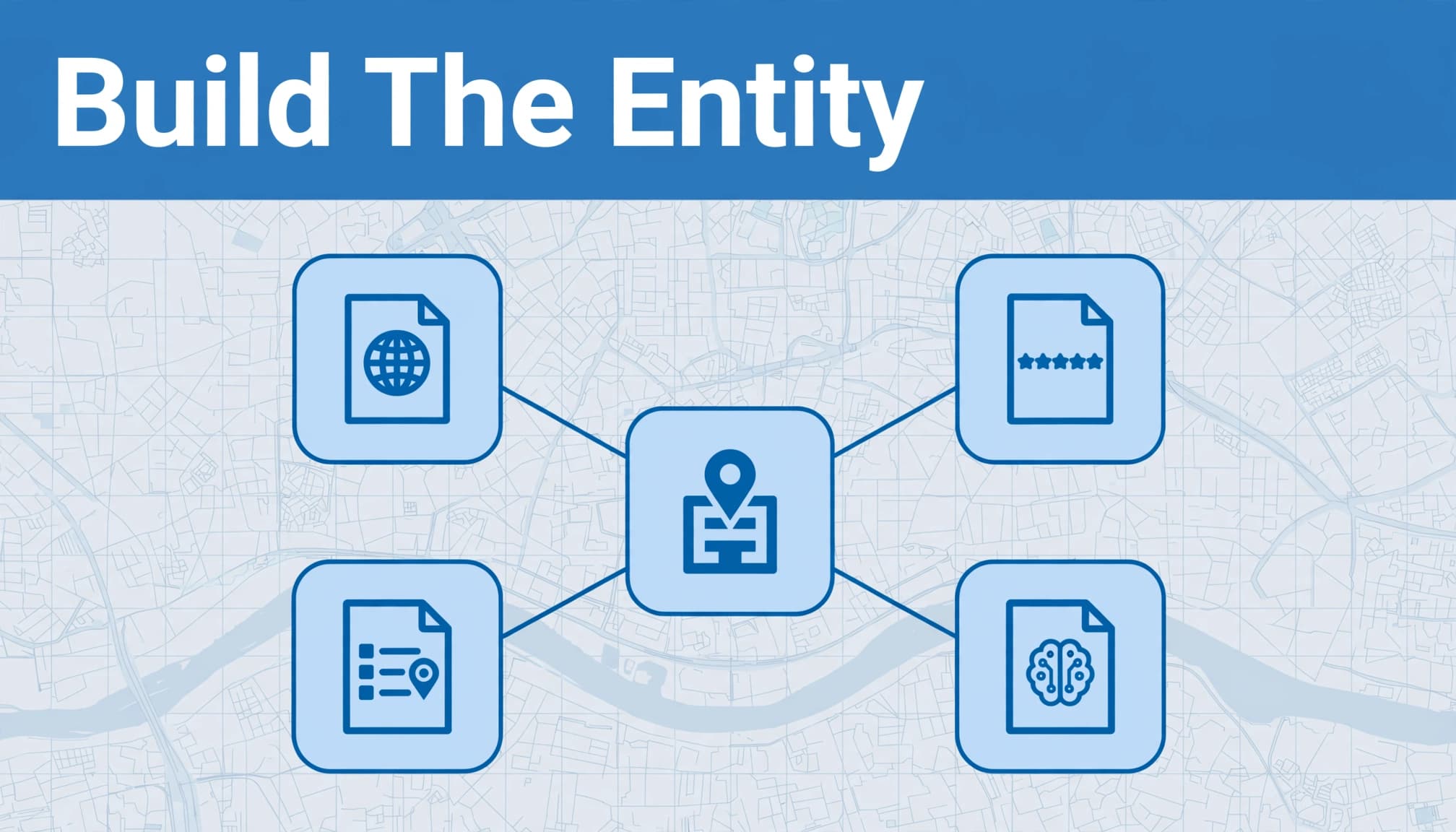
Use one approved business name, website URL, telephone number, service description and service-area wording across your site and legitimate profiles. Keep important brand mentions consistent, including on older location pages and directory listings. Introduce schema markup only when it reflects these details.
Check old location pages, outdated directory listings and former trading names after any business change. Consistent information reduces ambiguity for AI models.
Support service claims with named authors, dates, client evidence and sources for important facts. This helps build brand authority more effectively than vague claims such as “results-driven”. For clear business details, use schema markup for Organisation, LocalBusiness, Service or Article implementations where appropriate.
Validate schema markup against the visible content, then remove anything that no longer matches the page. Schema markup can clarify information, but it can’t guarantee an AI citation.
Check crawl access before chasing new content
A strong service page is wasted if it is blocked, noindexed, buried in a redirect chain or too slow to use on mobile. Review indexability, canonical tags, XML sitemaps, internal links and broken pages every quarter as part of your technical accessibility checks.
For ChatGPT Search, check that public pages you want considered aren’t blocking OAI-SearchBot. AI crawlers may have different purposes, so OpenAI’s crawler documentation explains the distinction between OAI-SearchBot and GPTBot. Allowing one doesn’t mean granting every type of access.
Use visibility findings to improve your wider marketing
The useful question is not “Did our AI search visibility score go up?” It is “What did buyers see, and what should we improve next?”
If competitor tracking shows competitors are cited for pricing guidance, build the missing page. If brand mentions describe your services inaccurately, fix the source pages, business profiles and supporting evidence first. An AI SEO quality control process helps you check accuracy before poor information reaches a prospect.
Paid activity can help you test messaging while organic visibility develops. Use PPC to test high-intent wording, then use the strongest enquiry data to improve service pages that support organic search and paid acquisition. Google Ads can show which offers attract qualified demand, while Facebook Ads may support retargeting for longer buying cycles.
Do not assume an AI citation created a sale because the timing looks neat. Check seasonality, PR activity, price changes, sales capacity and other campaigns before making that call. A proper B2B SEO content audit can expose pages that lack commercial proof or answer the wrong question. Check that schema markup matches visible service details, but don’t treat it as a substitute for evidence.
Key takeaways
- AI share of voice measures observed mentions and citations across fixed buyer prompts, not market share or revenue.
- Keep brand mentions, source citations, AI referrals and qualified opportunities separate, and don’t reduce the reporting framework to one AI visibility score.
- Run the same query set monthly across the AI platforms your buyers use to track prompt visibility consistently.
- Improve direct answers, evidence, page structure and technical access before adding more content for AI Overviews. Use valid schema markup to clarify visible information, not as a shortcut to appearing there.
- Keep traditional SEO and paid media connected, because stronger pages and clearer commercial language can support every channel without guaranteeing AI visibility.
Frequently asked questions
What is the difference between a brand mention and an AI citation?
A brand mention means the answer names your business. An AI citation links to, or attributes a statement to, one of your pages or another identifiable source. A citation is stronger evidence that your content informed the answer, but neither measure proves the searcher clicked or became a lead.
How often should a service business measure AI search visibility?
Monthly is usually enough for a practical benchmark. Include platforms such as ChatGPT in your checks, and measure more often after a major site migration, service-page launch, pricing change or reputation issue. Daily checks create noise unless you manage a large site with high search demand.
Can AI search visibility show return on investment?
Not by itself. Apply the same framework to Google AI Overviews as well as conversational platforms. AI Overviews may influence a buyer before a measurable click, so use Search Console, analytics and CRM data together. Look for identifiable AI referral sessions, engaged visits, qualified enquiries, sales opportunities and pipeline value. Keep attribution cautious.
Make AI search visibility useful
AI search share of voice is worth tracking when it reveals a clear content, technical or commercial issue you can fix. A cited answer is useful, but an accurate message, a relevant landing page and a qualified enquiry matter more.
Build your monthly prompt benchmark, improve the pages buyers need, and connect results to the rest of your Digital marketing activity.