
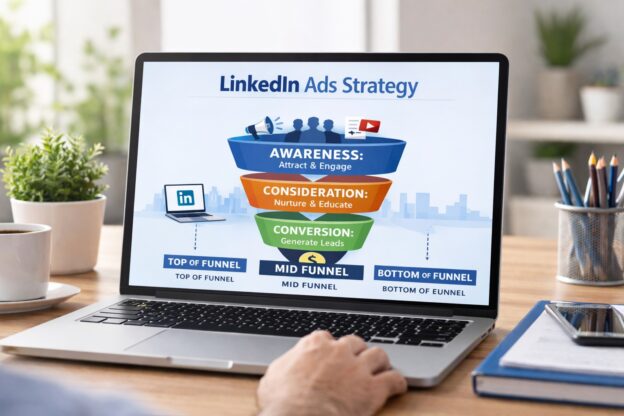
LinkedIn plays a central role in B2B marketing, but results drop when you treat LinkedIn Ads as isolated campaigns. You need a system that guides attention, builds intent, and supports revenue goals. A full-funnel campaign aligns messaging, targeting, and objectives across the entire buying journey.
You build an effective LinkedIn Ads strategy by structuring campaigns around awareness, lead generation, and pipeline impact, with each stage feeding the next through audience segmentation and intent-based objectives. This approach helps you control spend, improve lead quality, and show clear value beyond surface-level metrics.
This article breaks down how to structure a full-funnel campaign and apply the right tactics at each stage. You will see how to move from broad reach to qualified demand while keeping your LinkedIn activity focused on measurable business outcomes.
Core Structure of a Full-Funnel LinkedIn Ads Campaign
A full-funnel strategy on LinkedIn relies on clear funnel stages, correct campaign objectives, and deliberate ad sequencing. You build performance by aligning each LinkedIn campaign to buyer intent and moving prospects through the customer journey with control.
Understanding Funnel Stages on LinkedIn
LinkedIn marketing works best when you treat each funnel stage as a distinct job to be done. You target different audiences, use different formats, and measure different outcomes.
Top-of-funnel (awareness) focuses on reach and brand awareness. You introduce your point of view to cold audiences using video, single-image ads, or thought leadership content.
Middle-of-funnel (consideration) shifts to education and evaluation. You target engaged users with document ads, webinars, and case studies that explain how you solve specific problems.
Bottom-of-funnel (conversion) supports pipeline creation. You focus on warm audiences with lead gen forms, demo offers, and ABM-driven messaging aimed at decision-makers.
Mapping Campaign Objectives to Awareness, Consideration, and Conversion
Campaign objectives determine delivery, optimisation, and reporting. You should align objectives strictly to the funnel stage rather than mixing goals within one campaign.
| Funnel stage | LinkedIn objective | Primary KPI |
|---|---|---|
| Awareness | Brand Awareness, Video Views | Reach, frequency |
| Consideration | Engagement, Website Visits | CTR, time on site |
| Conversion | Lead Generation, Conversions | CPL, SQLs |
Using the wrong objective weakens performance. For example, lead gen objectives at top-of-funnel inflate costs and reduce quality.
You should separate budgets by funnel stage. This structure protects awareness spend while allowing conversion campaigns to scale based on pipeline performance.
Sequencing Ads for Customer Journey Alignment
Sequencing keeps your messaging relevant as buyers move through the funnel stage by stage. You avoid asking for action before you earn attention.
Start by building engagement audiences from video views, ad clicks, and page visits. Then move those users into middle-of-funnel LinkedIn campaigns with deeper content.
For bottom-of-funnel, retarget high-intent users such as document openers or form starters. In ABM campaigns, you layer sequencing with account targeting to influence multiple stakeholders.
This approach creates continuity. Each ad reflects what the buyer already knows, which improves efficiency and pipeline quality.
Tactics for Each Funnel Stage: Awareness to Pipeline Generation
A strong LinkedIn Ads strategy relies on precise audience targeting, disciplined creative choices, and tight integration between lead generation and your sales systems. Each stage of the marketing funnel demands different signals, formats, and success metrics to influence pipeline outcomes.
Audience Targeting and Segmentation Strategies
You build full-funnel performance by separating cold, warm, and high-intent audiences from the start. LinkedIn Campaign Manager supports this through firmographic, demographic, and behavioural segmentation tailored to B2B buyers.
At the awareness stage, prioritise cold audiences using job title, seniority, industry, and company size. Layer in thought leadership posts to drive engagement and low CPC without sales pressure.
For consideration and lead generation, shift to warm audiences. Use website retargeting, video viewers, and content engagers via Matched Audiences. Add lookalike audiences based on high-quality leads or customers to scale efficiently.
At the pipeline stage, focus on account-based marketing. Target named accounts, decision-makers, and buying committees. This segmentation supports higher conversion rates, stronger pipeline influence, and lower cost per opportunity.
Ad Formats and Creative Approaches for Every Stage
Your content strategy should align ad formats with buyer intent and campaign structure. Use sponsored content, single image ads, carousel ads, and video ads to maximise reach and click-through rate at the top of the funnel.
In mid-funnel campaigns, prioritise document ads, webinars, guides, and case studies. These formats support lead generation while building trust through social proof and testimonials. Clear CTA framing improves conversion rate without inflating cost per lead.
For pipeline-focused campaigns, use message ads, conversation ads, dynamic ads, and retargeted single image ads. These formats work well with warm audiences and high-intent signals.
Apply creative rotation and A/B testing to manage fatigue and improve ROAS. Automated creative rotation helps maintain engagement while you monitor CPC, click-through rate, and website conversions.
Lead Generation, CRM Integration, and Nurturing Pipeline
LinkedIn Lead Gen Forms reduce friction and improve lead-to-MQL rate when paired with strong qualification questions. Use different lead gen forms by funnel stage to control volume and quality.
Connect forms directly to your CRM using HubSpot, Salesforce, LeadsBridge, or Zapier. Real-time syncing supports faster sales velocity and accurate pipeline tracking.
Apply marketing automation for lead nurturing, behavioural segmentation, and follow-up. Use lead scoring to route high-intent leads to sales while nurturing lower-intent leads with educational content.
Track performance beyond cost per lead. Measure conversion rates, pipeline influence, cost per opportunity, and return on ad spend. This approach ties LinkedIn Ads directly to revenue outcomes and B2B growth.
Maximise your ROI with targeted Pay Per Click (PPC) campaigns. Let Flow20 drive your digital success. Explore our SEO, Linkedin and Digital marketing services now!
Elevate your law or finance firm with Flow20’s tailored SEO and digital marketing services. Specializing in SEO for law and finance, and PPC for law, we help you dominate your market. Click now to transform your online presence and attract more clients!


